Sometimes all you can say is thank you

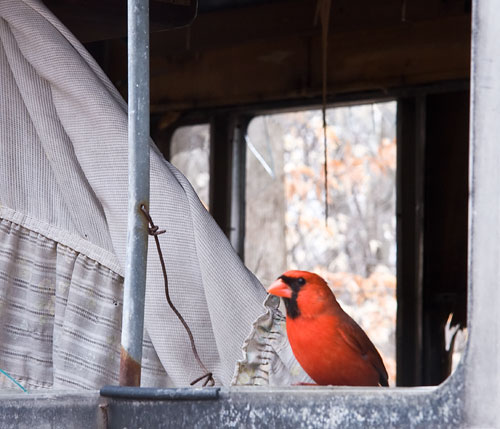
Becky and I went out this morning to the derelict trailer I talked about the other day.  The owner of the trailer was at home.

I think he was as surprised as I was when we saw each other.  He didn’t seem at all happy about it.  I was very grateful.  Not much else to say.

Eye sores and beauty

Instead of going to church yesterday, I went out to shoot.

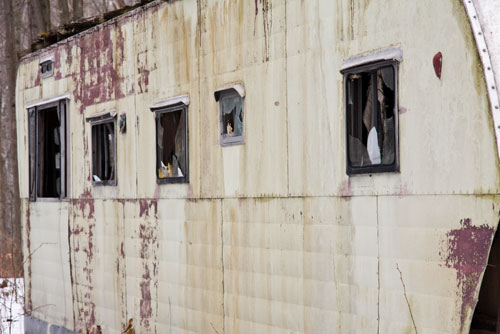
My friend Sally and I went to a nature preserve a few miles north of Bainbridge, IN to photograph this abandoned trailer she had found on an earlier trip.  Sally is the one who came up with the idea of wondering instead of wandering that I talked about in an earlier post.  On this trip she coined another expression that will live; ‘I saw something that didn’t get into the camera’, that undefinable something that is the difference between a great image and one that was just a good idea at the time.

At any rate, we spent a lot of time at this trailer looking inside and out. 

There is no conventional definition of beauty I can think of that would include anything about this trailer.  But then that is the problem with a lot of conventional definitions, they only cover a part of what they are describing.  That’s good, in a way, it helps us recognize the limitations of language and makes room for photography. 

As we were working around and in this trailer I was wondering what its stories are.  Here it is, sitting out in the woods and it has been here for some time.  I think it would miss a lot to ask what the singular story is, there are stories that apply to different parts of its existence.  When it was put where it is now, was it someone’s residence?  A get away place for someone who lived elsewhere?  The story told by the trashing it received in recent years (I hope well after it was abandoned and not before) may just be that someone had a lot of time and anger on their hands.

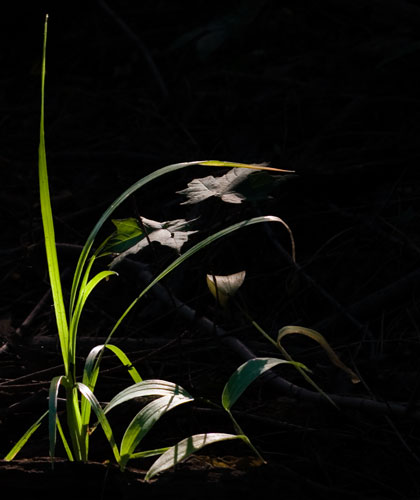
Here is something else that was cast off, although not by people, it is just late in its life cycle.  In its earlier months this weed, if it attracted any attention at all, might have been pulled up.  Would anyone describe it as beautiful?  Probably not but the image is inviting.  There is something about its shape and the oak leaf nestled up to it that instructed me to photograph it.  It will not know death if the seeds in the pods at the end of its stems have anything to say about it.

What is it about dilapidated, unlivable, abandoned buildings (and trailers) that is so attractive?  And why can a photographer go immediately from photographing such a place to photographing something beautiful and not think a thing of it?  Worth thinking about.

Johnny Cash, meet Carl Jung

Every once in awhile two or three things happen close together in time and they work together to set off a train of thought. 

I was reading William Bridges’ ‘Transitions   Making Sense of Life’s Changes’ and ran across a quote from Carl Jung’s ‘Modern Man in Search of a Soul’ where he is talking about a man in the second half of life:

Fully aware as he is of the  social unimportance of his creative activity, he looks upon it as a way of working out his own development.

I’m pretty well into the second half of my life and that struck home;  pursuing creative activities is very important to me and I hadn’t thought of it before as a way of understanding who I am.

The second thing that happened was a repeat of a conversation between Terry Gross, host of ‘Fresh Air’ on NPR and Johnny Cash who was talking about recording songs.  He said

I would  keep trying it and do take after take until it felt comfortable with me and felt that it was coming out of me and my guitar and my voice as one.  That it was right from my soul.

Right from my soul.  Creative activity as a way of working out my own development.

I devote a lot of time to photography and Photoshop and I really don’t feel complete if I’ve been away from it too long.   My wife, who this weekend is off to quilt camp, feels the same way about her quilting.  Are these our mirrors inward?  Perhaps.  I do know that I am coming to see photography as a path in a spiritual life.

Creativity can come in at any stage of the process of making a picture.  Sometimes it is simply seeing something interesting.

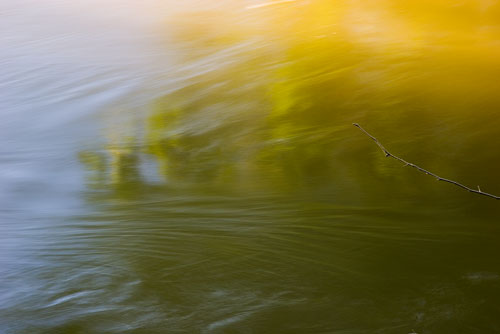
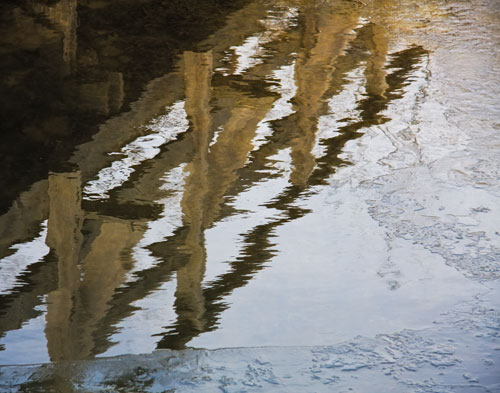
Sometimes it comes about accidentally.  This one benefited from unintentional camera shake.

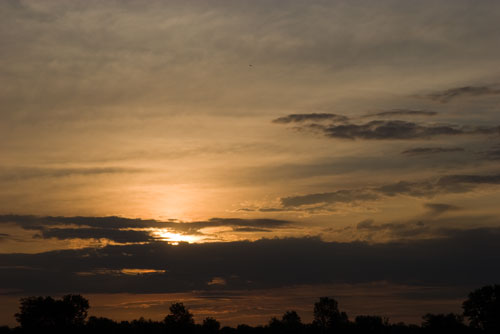
Sometimes it is developed in Photoshop.  As an example, I started with these two images:

and

I had originally intended for them to each stand on their own but that didn’t work out so I combined them and did a little work with Photoshop to produce this:

I have a strong feeling that if creativity, especially in the second half of life, is a way of working out one’s own development, then photography can be the torch that illuminates the way.  At least it does for me.

A trip to Muscatatuck

Saturday I went with friends Becky and Marla to Muscatatuck National Wildlife Refuge, about 65 miles southeast of Indianapolis.  It was warming up but there was still about eight inches of snow on the ground.  If there was one lesson for the day it was to be ready with the camera, starting at the very beginning of the trip.  The first stop was in Indianapolis.  Traffic was blocked because a foot race was in progress and we got to watch the runners and walkers go by.  We were stopped by an apartment building and the reflections in the windows were interesting.  I took several shots (there were lots of participants in the race) and then I saw this shot.  That is a green soda bottle in the tree.  I think it had been a bird feeder at one time.

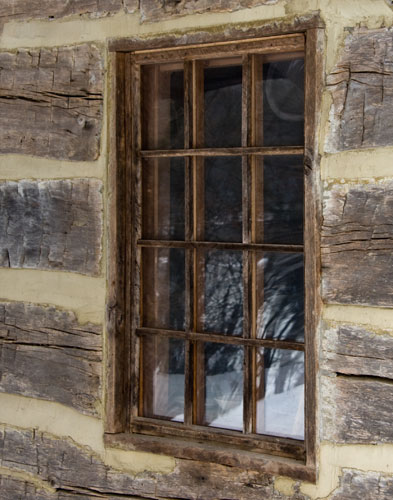
Reflections were not going to be the order of the day but they would pop up again, for example at the Myers’ cabin at Muscatatuck.  It is part of a historical preservation.

We have had a lot of below freezing weather in recent weeks the temperature seldom getting as high as 30 degrees, but it got up into the 40s on Saturday, and snow was melting.
Most of the time I was using my 17 – 85 mm lens but since I had it along, I got out my 120 – 400 mm lens, a pretty hefty telephoto.  We were in the last part of the trip and we drove by a pond where Becky spotted an otter.  We stopped and I got this shot out the window of the car.

I find I do better with the camera when I am open to the moment.  One part of me says to go out there with a plan while another part says to stay loose, stay awake.  I do in fact go out with a plan now.  The plan is to know what the camera settings are (I’ve had several disasters when I thought, for example, the auto focus was on and it wasn’t) and keep the camera handy, ready to shoot.  Then go wondering.

Selective attention

Did you ever take someone’s picture outdoors only to discover later that a telephone pole appears to be growing out of their head?  Did you ever see what the magician actually did when she made a coin disappear from her hand and pulled it out of a bystander’s ear?  Selective attention was operating in both situations, limiting the information you took in. In the one case you were so intent on the subject that you missed the telephone pole.  We’ve all done that.  In the case of the magician, the trick worked because your attention was misdirected.

We know that all of our senses are turned on all of the time which means that from moment to moment a huge amount of information is cascading into our central nervous system.   We can’t deal with all of that and the ability to selectively attend to one part of the information stream to the exclusion of other parts allows us to operate in this world.  We are able to ignore conversations that don’t involve us while we read a book, we can savor good food in a restaurant while a magician is trying to show us a trick.  Selective attention works.

At the same time, the information we bring in is being interpreted against the background of our experience, interests, what we are thinking about at the moment.  It is not surprising then that two photographers working side by side on a field trip can come away with very different sets of images for the day.  Their life experience and interests are different, what they selectively attend to is different, their images are different.

Any photographer will tell stories about how ‘it seemed like a good idea at the time’ to take a picture but later finds out it just didn’t work.  Often, part of the reason for this is that we see things in the image on the computer screen that we didn’t see in the field.   Selective attention in the field was locked on the subject and elements that are later distracting on the screen just weren’t seen.  In some cases the problem can be remedied with work in Photoshop.  I take this to an extreme in my work on flowers.  There, I don’t much care about distracting elements in the background, they are going to be eliminated.   Here is an example.
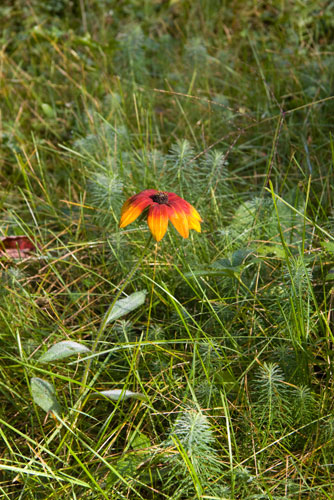
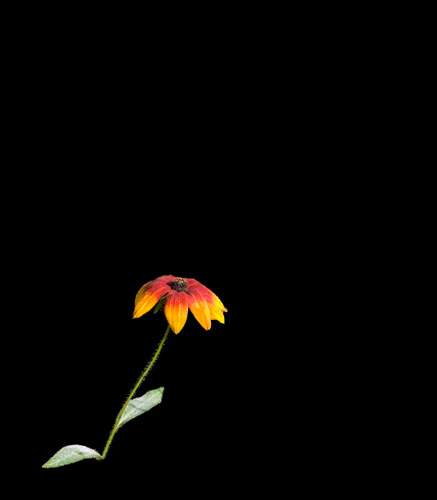
The background is busy and will be distracting in a print.  My answer is to eliminate the background altogether and replace it with solid black or maybe white.  For those of you who use a photo editing program such as Photoshop or Photoshop Elements, I create a mask by tracing around the subject with the polygonal lasso, save it as a selection and then use that selection to deal with the background.  Here is the result for the image above.
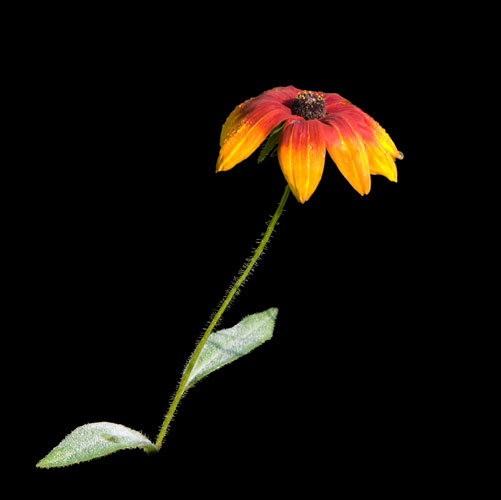
This was my first answer to the problem of directing the viewer’s attention to the subject.  It’s rather difficult for the viewer to miss what the image is about if it has had this treatment.  It certainly isolates the subject and if I use black as the background, it gives the subject extra vividness.  I plan to continue with this method for some images but this is not the only way to direct attention to the subject.

There are several other methods for more subtly directing the viewer’s attention.  Cropping the image, lightening the subject while darkening the background, and increasing the saturation of the subject while reducing the saturation of the background are just a few of the things we can do.

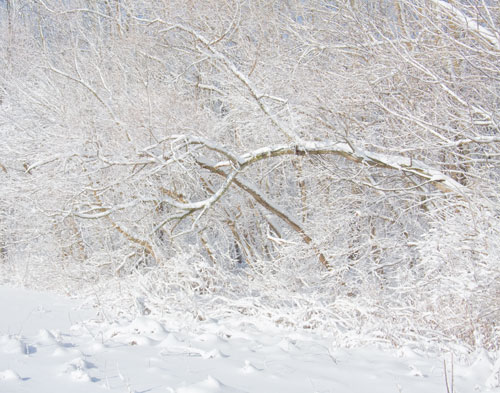
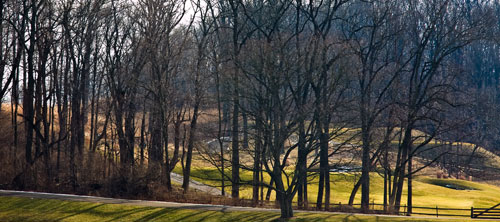
When I saw this scene, I wanted the trees netted with vines and brush to be the subject.
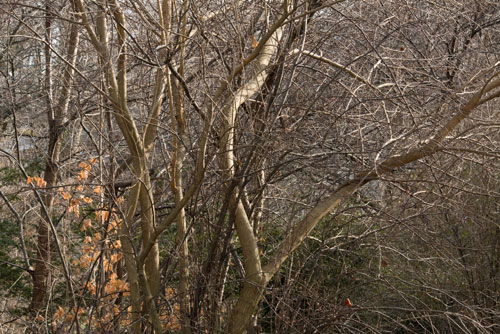
Here is the result to date.  I don’t call it the final result because I’m seldom finished with any given image. 
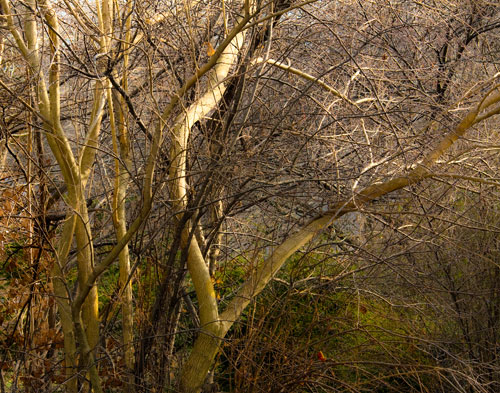
I could give you the laundry list of things I did but the specifics of what I did are less important than the result obtained.  I think it is fairly clear what the subject is in this image.  Leaving the background in means the viewer has to do a little more work to pull out the subject but in doing so, the image can take on a symbolic value in showing that what we are looking for is often at least partially obscured by extraneous elements that pull our attention in a different direction.

Selective attention is a powerful tool.  It helps maintain our sanity – imagine trying to deal with all of the competing stimulation we are subject to, rather than just a small part of it.  To a large extent we can control our own selective attention.  The job of the photographer is to influence that selective process and get the viewer to look at the subject in an image, appreciate it and of course remember the photographer’s name.
Good grief, where have I been?

I’ve been so wrapped up in going out to shoot in this great weather that I haven’t been posting.  I hadn’t realized it had been ten days since my last entry.

For some odd reason I have come to prefer the cold weather.  Part of it has to do with the opportunities for photography and some of it feels a bit like revenge.  I grew up in southwestern Pennsylvania and for many years our driveway was two ruts going up the side of a steep hill.  The driveway was long and we shoveled the snow by hand, not a lot of fun.  Now the driveway in Indianapolis is flat (if rather long) and I clean it in the winter with a good snow blower.  There is great satisfaction seeing the snow in front being thrown off to the side leaving a clear path behind it.

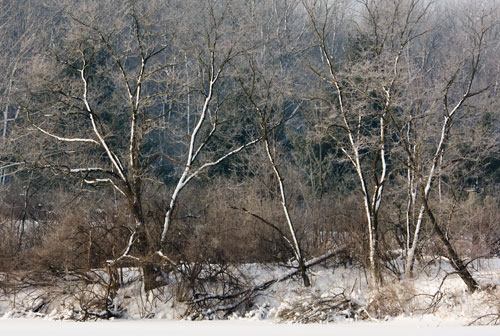
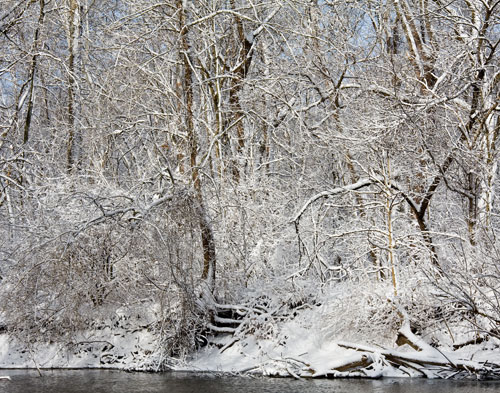
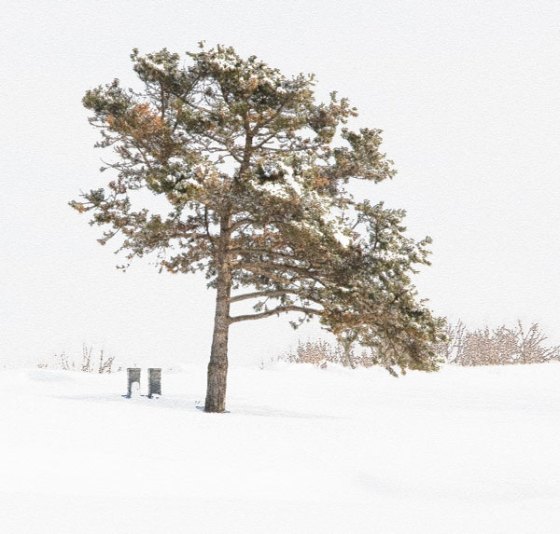
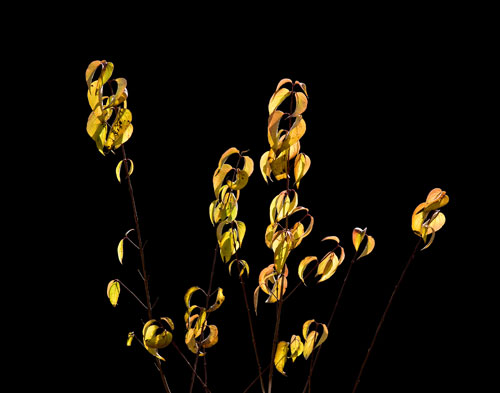
There is a spareness to the winter that I find particularly appealing.  Plants, or their remains, which would have gone unnoticed in the crowd of other plants in the summer, now stand by themselves, stripped of that which we call life but nonetheless still beautiful.

If all we see is the dead and withered stems from last year, we also know that there is a root that is awaiting its opportunity to put forth more bounty.  It won’t be long now.

In the meantime, there is winter and its particular beauty.

Dress warmly and go enjoy it.

The sun came out

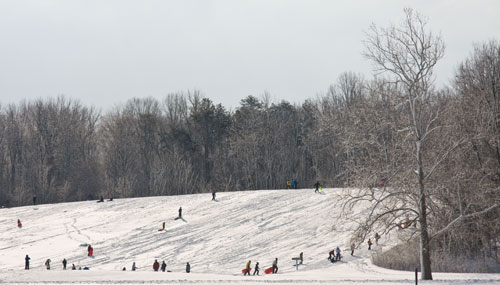
I wasn’t sure we would have much sun today and when the clouds disappeared it was clear that it would be a good day to go make some photographs.  It was ‘gloomy’ yesterday but that was also a good day for making photographs.  Today was also a good day for sledding.

I grinned as I tromped through the snow to get to a favorite place for shooting – the only tracks in this patch of snow beside mine belonged to a dog who had come through earlier.   Or maybe it was a coyote.  No humans though.  With a near virgin snow, and it being very quiet,  it is easy to think that this moment is the beginning of time, and according to one way of looking at it, I suppose it is. 

A friend had a baby boy a few days ago and for that young fellow, all things are indeed  new.   This day is a celebration for him and his family.

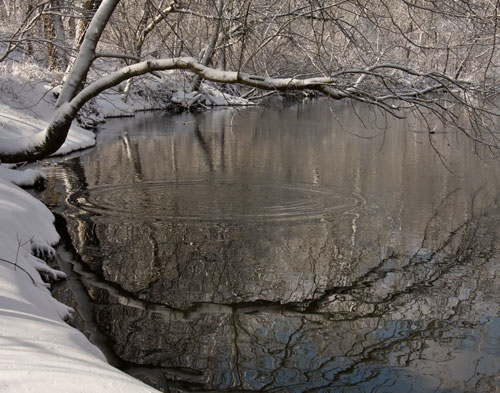
The day will come when he is sliding down that hillside.  Perhaps he will also see what I saw at Fall Creek.

Happy birthday, Roman.

It is never too late to have a happy childhood.  Tom Robbins

4 to 9 inches of snow predicted

It started snowing in the late morning and has continued throughout the day.  I don’t know how much we will get but the snow blower is gassed up and ready to go.  In the meantime I got an email from my friend Becky saying bad weather = good images.  Sometimes I’m glad Becky lives some distance away, otherwise she would be in my driveway blowing the horn.  I don’t know where she went, I did indeed go out but I stuck to our neighborhood. 

I started by removing the screen in my study window and shooting right there.  This worked pretty well but the view was a bit limited.

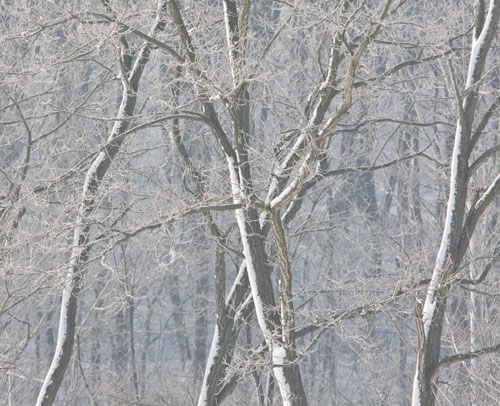
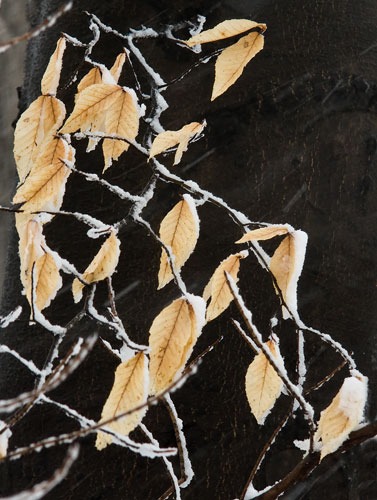
A walk down to the corner brought these leaves against the bark:

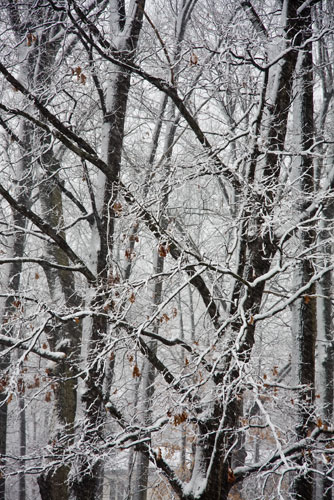
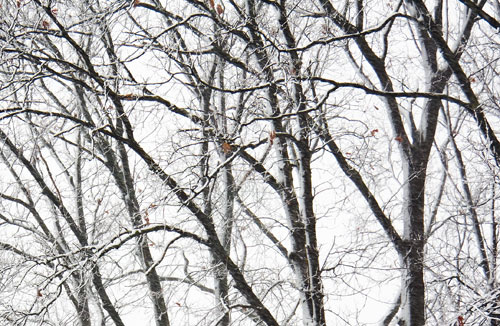
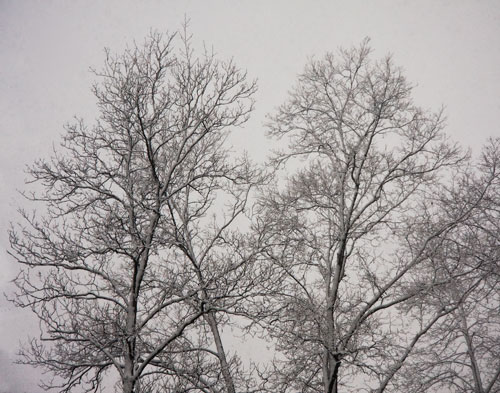
A little further on these trees showed against the sky:

I do like spring , summer and fall but there is something special about winter.

I just checked with Becky and, weather permitting,  we are going out shooting in the morning.

Shooting and sharing

Jane Reichhold is a major American haiku poet.  She has this interesting thought:

‘And the way you know a haiku is lurking about is if you see something and say oh!  I want to show that to somebody!’

Substitute ‘photograph’ for ‘haiku’ and you have the starting point of this post.  You see something interesting and there is a connection demanding to be completed.  It doesn’t matter what it is, it could be a child smiling, a shadow on a wall, the great American landscape scene, you get the idea.  I’m sure you have experienced this too – you see something and if you have your camera you make the photograph.  Because you have to.  If you don’t have your camera with you, it becomes one that got away.  I can vividly remember one from nearly 40 years ago.  I was in a restaurant and a few tables over an older woman was leaning toward the waitress who was leaning toward her to take her order.  There was strong connection for me to that moment.  I didn’t have a camera with me.  And as you can tell, I wanted to share that moment with someone.   That’s a second connection asking to be completed.  We make a picture and we want it to be seen.  We want people to see it and appreciate it.  This is an offering, something to be responded to. 

I have no idea how many pictures there are today on the internet but think about this: in 1853, just 14 years after it was was formally described, there were probably 3,000,000 daguerreotypes in existence.  Not many of us would choose to make a daguerreotype today.  Life with a digital camera is so much simpler and as a result there are orders of magnitude more digital pictures today than there were daguerreotypes back then.  And we want others to see our work so we put them out there to be seen.

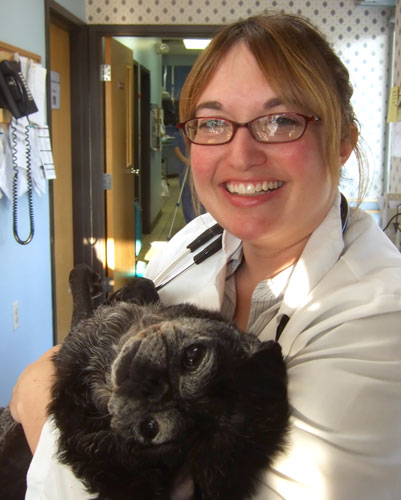
Sharing that image, that moment, with someone can have value beyond any ‘reasonable’ expectation.   Several months ago I had to stop at our veterinarian’s to pick up a prescription for one of our dogs.  It was late Friday afternoon and the vet had a few free moments.  She was playing with a pug who was in for an extended evaluation.  I had my pocket camera with me and got this shot.

I worked on it over the weekend and brought two prints to her the following Monday, one for her and one for the owner.  When I arrived on Monday morning the staff was looking somewhere between professional and somber. A man and woman were in the waiting area, both obviously facing something pretty difficult. The man was biting his lip and the woman was crying nearly hysterically. I dropped off the pictures and left.  I later found out the man and woman were the owners of the pug. The dog was 17 years old and had been at the vet’s  because she was failing. She got worse over the weekend and now it was time to put her down. I’m very thankful I was able to give the prints to people who needed them.

Keep shooting.  Keep sharing.

Light

There are common strands  running through all the religions I can think of.  One is that there is one or more god, whether defined or not.  There is also some variation on the golden rule – do unto others as you would have them do unto you.  Another is the role of light.  In all these religions light is divine, it is sacred, it signals the presence of God.  For example in Hinduism there is Diwali, a festival of light celebrating the triumph of good over evil.  In Islam “God is the Guardian and Protector of those who believe; He brings them forth from darkness into light.” The Holy Quran [2:257] In Psalm 119: 105 the psalmist proclaims “Thy word is a lamp to my feet and a light to my path.”   Christians learn that Jesus is the light of the world.  I’m sure you can think of many other quotes making the same point.  Light is central to religion and spirituality.

And light of course is central to photography.  In an earlier post I outlined my simple spirituality.  One tenet is that God is in all, all is in God.  So what does that say about photography if light is a gift of God? 

I suppose the answer to that question says a lot about one’s personal theology.  For me  it is a gift to be celebrated.  Picking up a camera and going out at any random time will present several of an infinite range of light offerings.  Good photography can be done in all of them. 

My simple spirituality also says that God continues to create and, we, made in God’s image, can also create.  This is an immensely important point.  It is not that our creations rival those of God’s and it is not important that the creations of some of us are ‘better’ than those of others.  The important point is that we have this ability and in my view we are not complete unless we exercise it.

Many years ago, I was subject to periods of depression.  They weren’t periods of deep depression that many have experienced but they were enough to essentially shut me down emotionally for several hours.  That has stopped and I do not think it is coincidental that as I got into digital photography they receded and disappeared.  I know that I have a need to be creative in my own way and photography is the great opportunity. 

Light is a gift of God, a symbol of the presence of God.  That is something to celebrate.  Photography is a wonderful way of celebrating and expressing gratitude, in part because it can be shared with others.  We’ll say more about that in a later post.

And as Jay Maisel says:

If you are out there shooting, things will happen for you. If you’re not out there, you’ll only hear about it.

“God is the Guardian and Protector of those who believe;
He brings them forth from darkness into light.”
The Holy Quran [2:257]“God is the Guardian and Protector of those who believe;
He brings them forth from darkness into light.”
The Holy Quran [2:257]“God is the Guardian and Protector of those who believe;
He brings them forth from darkness into light.”
The Holy Quran [2:257]