Winter sunshine

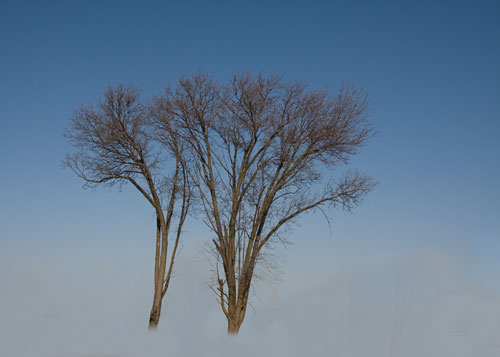
We finally got a few days of sunshine here.  We had had one day after another of clouds and no direct sunshine.  It reminded us of living near Syracuse, NY where a sunny day was call for a discussion with the bank teller.  It was good to get out with a camera in the sunshine.

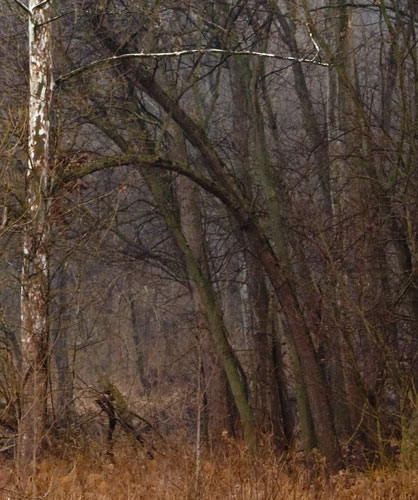
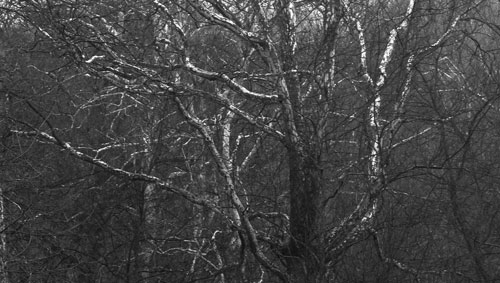
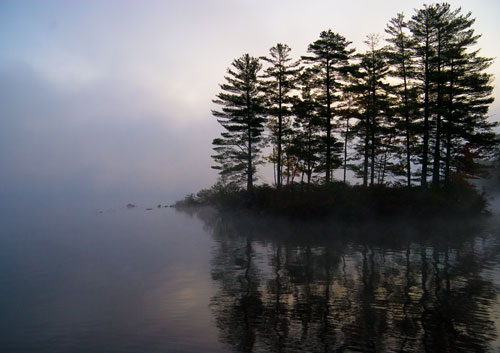
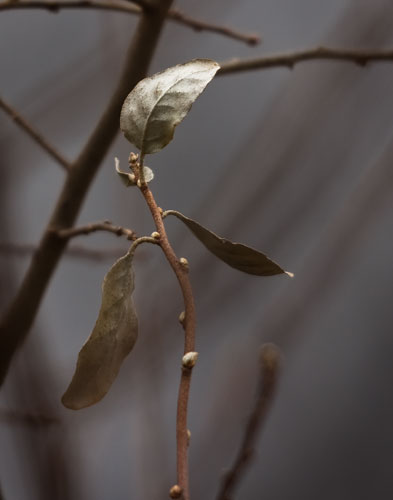
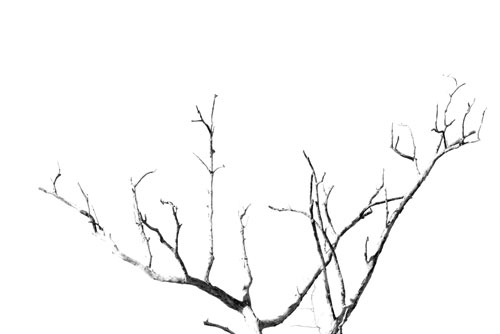
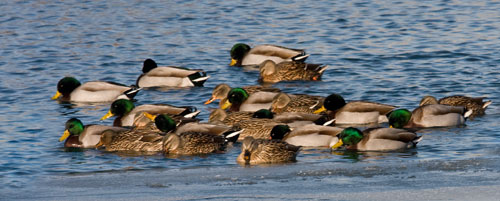
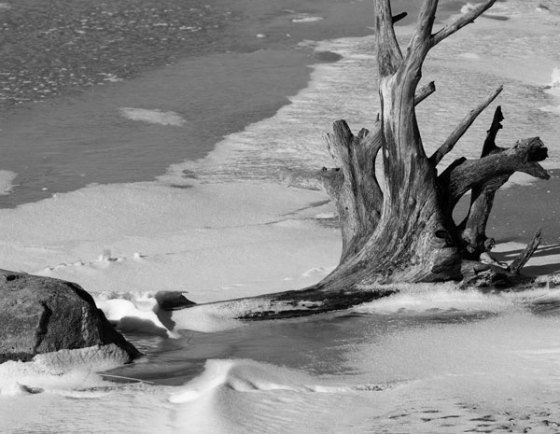
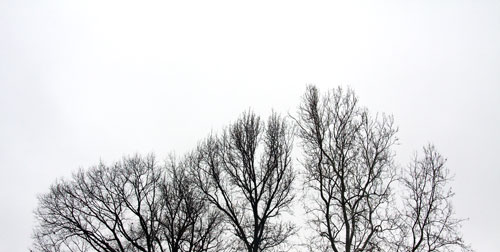
Sunshine this time of year suggests that spring is not far off.  Ice on the pond but light in the trees.  Light and, if we could look closely enough, buds ready to wake up when the day lasts long enough.

Place your hand on one of these trees.  The life is there, the tree has been there for decades and has gone through the same cycle year after year; you can feel the life, even if it is resting.  Sunshine gives rise to these thoughts.

Many of us humans have been through several cycles of the year as well.  We know spring is coming and we know what that brings.

We may long for the warmer weather and it will come.  In the meantime there are some hints out there that it is on its way.

This is the season for snowdrops.  They stand up when it is warm enough and lie down when it is too cold.   And they are a sign that winter is not going to be with us too much longer.  I saw some here the other day and didn’t get out to photograph them.  This shot was taken in January a couple of years ago.

Yes, spring is on the way but there is plenty to appreciate about winter as well. It is a time of bone essentials, a time to reflect on what is, through all the cycles of the year.

Sycamores in the mist

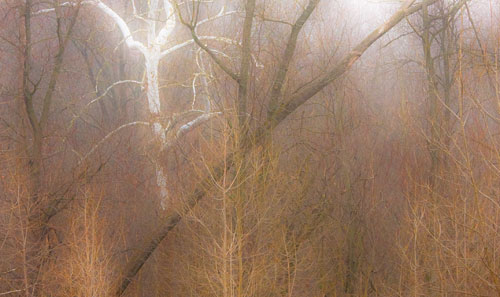
When we lived in Maine we loved the large birch trees with their peeling white bark.  Here in Indiana we don’t have much in the way of birch trees, certainly nothing to rival those in northern New England.  But we do have sycamores.  Their bark peels too and underneath the peeled bark the ‘skin’ of the tree is often white, or near white.  In the summer they are beautiful trees that don’t stand out too much from those around them, but come winter, it’s a different story.

We had some mist yesterday morning and it was too good an opportunity to pass up.  Sycamores in the mist!  In some respects that is about like trying to find our white dogs in a snow storm but not quite.  The sycamores stand out from their neighbors and the mist wasn’t that heavy.  In fact it was rather light but there was enough to make it interesting.

The mist provided a lovely indistinctness to the trees, a softness that seemed to make the trees want to be seen more as contrasting colors than as textures.  I was happy to oblige. 

Some treatment (but not a lot) in Photoshop gave it a story book character.  If you said you saw Hansel and Gretel among the trees I would be ready to look.

I’ve always wanted a painterly effect and this provided it.

And when the mist was lifting, there was more texture evident.

If I’ve learned one thing about photography this year, it is that good shooting is available in just about any weather.  There is always a gift for someone who will just be open to it and  look for it.  I all but bolted out the door to go shooting and my wife smiled and made a comment about the six year old going to the park.  Guilty as charged and proud of it.

Art and spirituality

If you are serious about your photography or any other creative hobby – passionate about it – you are likely treating it as a way of expressing yourself, as an art form. As it turns out, interest in art is often closely related to interest in spirituality as is evident in the work of Robert Wuthnow, a Princeton sociologist.

Wuthnow has done extensive work on spirituality and art. His book “All in Sync.” describes the results of a large study in which he looked at how music and art enrich the spiritual lives of people who are interested in art but are not professional artists. The major conclusion is clear: there is a strong relationship between spirituality and art in the population at large; the more interested one is in art, the more likely one is to take spirituality seriously.

Wuthnow’s principal measure was the individual’s score on the Artistic Interest Scale. Respondents were rated by the interviewer on this scale which had been developed by Wuthnow. The more artistic activities in which the interviewee participated, the higher the score. Playing an instrument, writing poetry, singing etc. were among the activities contributing to the score. Here are some representative results: the higher the score, the more likely it is the individual will

  • Pray
  • Include music or art as part of prayer
  • Seek the guidance of a spiritual director
  • Participate in services to the community such as feeding the homeless, helping those leaving prison make the transition to the larger community, helping children who are behind in school, etc.

These are correlational results and we cannot tell whether an interest in spirituality causes people to be artistic or that an interest in art leads to growth in spirituality or that both are caused by some third factor. For our purposes it is enough to say that interests in art and spirituality are related. If you are passionate about photography or whatever your art may be,  you are likely to be interested in spirituality as well.

So this strong relationship between photography (art) and spirituality we have noticed in us as individuals,  is there for many others as well.  Maybe a blog like this one, which stresses this relationship, was a good idea after all.

<!–[if !mso]> <! st1\:*{behavior:url(#ieooui) } –>

If you are serious about your photography – passionate about it – you are likely treating it as a way of expressing yourself, as an art form. As it turns out, interest in art is often closely related to interest in spirituality as is evident in the work of Robert Wuthnow, a Princeton sociologist.

Wuthnow has done extensive work on spirituality and art. His book “All in Sync.” describes the results of a large study in which he looked at how music and art enrich the spiritual lives of people who are interested in art but are not professional artists. The major conclusion is clear: there is a strong relationship between spirituality and art in the population at large; the more interested one is in art, the more likely one is to take spirituality seriously.

Wuthnow’s principal measure was the individual’s score on the Artistic Interest Scale. Respondents were rated by the interviewer on this scale which had been developed by Wuthnow. The more artistic activities in which the interviewee participated, the higher the score. Playing an instrument, writing poetry, singing etc. were among the activities contributing to the score. Here are some representative results: the higher the score, the more likely it is the individual will

  • Pray
  • Include music or art as part of prayer
  • Seek the guidance of a spiritual director
  • Participate in services to the community such as feeding the homeless, helping those leaving prison make the transition to the larger community, helping children who are behind in school, etc.

These are correlational results and we cannot tell whether an interest in spirituality causes people to be artistic or that an interest in art leads to growth in spirituality or that both are caused by some third factor. For our purposes it is enough to say that interests in art and spirituality are related. If you are passionate about photography you are likely to be interested in spirituality as well.

A dreary day?

The forecast today was for partial sun.  Wherever the sun was, it was somewhere else.  But fog came up about 10:00 and it looked interesting. 

David Ward, an excellent British landscape photographer, identifies three elements of a good image – beauty, simplicity and mystery.  The fog was simplifying the image and adding mystery to it.  A little work in Photoshop helped bring out the feeling of the day which wasn’t quite so evident in the original pixels.

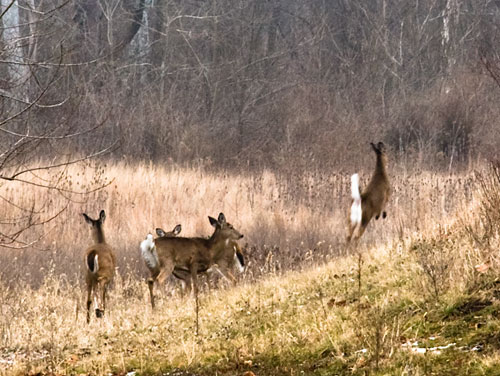
There were surprises, too, both for me and these white tailed deer. 

The fog was the initial attraction but it was lifting and the nearer subjects were were speaking their own quiet messages.

To the eye, a ‘dreary’ day looks so flat but the colors are more saturated and even if the trees do not cast visible shadows, the leaves still reflect more light on one side than on the other.

These were the gifts of the day.  It wasn’t too cold and certainly not too warm and the light was just right.  A good day to be alive.

A simple spirituality: Part 3

In my last post I introduced the basis for my own spirituality as I understand it.  I would like to say this is what that spirituality is, but I’m still discovering new aspects of it.  Here are the basic tenets:

  • God is the original creator and continues to create.
  • Everything is part of God, God is in everything, everything in the Universe is therefore connected.
  • We humans, as part of God, participate in creating.
  • The consequences of our actions are far broader than we can see.

I’ll develop these ideas over future posts and today I will start with the last, concerning consequences of our actions.  It begins with this: we were on our way to Maine for the wedding of the daughter of friends of over 40 years.

These friends were originally from Tennessee but have lived in Maine ever since we have known them.  Tennessee is still in their voices.  We stopped for dinner on the way up and my wife Ellie wanted to get a small gift for Mary Lee.  She saw a t-shirt with the inscription ‘GRITS  Girls Raised In The South’ and bought it.  Mary Lee liked the shirt but with all the activity around the wedding, it was quickly forgotten.

Our friends go back to Tennessee every year and we make it a point to get together for a couple of days.  Some years after the wedding we were together and Mary Lee asked if we had any favorite Southern women writers.  We mentioned Bailey White but didn’t come up with others.  Then Mary Lee said ‘Oh, let me tell you what this is about.’  She had been walking down the street in Brunswick ME wearing the GRITS t-shirt.  A woman came up to her and said that she was raised in the South too.  Well, one thing led to another, and out of this came a kind of support group of several women raised in the South.  They have lunches, a book group, etc.  All of this out of the choice of a simple gift.  Who would have known?

On another occasion, Ellie, our friend Joyce and I were coming back from a trip and stopped in Berea, KY, a community strong in arts and crafts.  We were wandering around a gift shop and since we were the only customers in the store, the clerk wasn’t busy and there was an appealing dog there, I asked the clerk if she minded if I photographed the dog.  She said sure, go ahead.

I offered to send her pictures via email but she said while her husband did email, she didn’t.  The way she said that suggested that she didn’t want to ask her husband to bring the pictures up for her.  I asked if I could send her prints and she gave me her address.  I sent off a couple of 5 X 7s and forgot about it.  Several weeks later I got a thank you note in which she said that she and her husband were now divorced and that Aris, the dog, was one of her few friends.  Who would have known?

A simple spirituality: Part 2

The roots of our spiritual lives run deep.  In my latter years, I find connections among interests and events throughout my life that I was not aware of.  I will talk about my history here in hopes that it will encourage you to do the same.  You may be surprised at what you find.

I was born at the outbreak of World War II, in 1939.  My father went off to the Navy toward the end of the war and my mother, brother and I lived with my father’s parents for awhile.  I was six years old and in the first grade at school.  In those days parents were more trusting and didn’t worry about children being abducted.   I walked to school by myself.

School was about 10 blocks from home and a park, four blocks long, was along the way.  Since the park offered piles of leaves to kick, buckeyes to pick up and shine on the side of my nose, a fountain and a pond with frogs and goldfish as well as a woodland fragrance that had more come hither to it than an expensive perfume, I was detained on my way to school.  Since I went home for lunch and then back to school, well, four trips a day by the park was more temptation than an inquisitive six year old could deal with.  There were conversations at home about being late to school.

There was nothing wrong with school, I just found the park more interesting and for that matter, more nourishing.  I find it interesting that for most kids the park was usually just a place to pass through but for me it was a destination.  I felt more alive there, more in tune with something larger than myself.  To this day if I am sitting in a boring meeting or just need calming down I go back to the park in my head.  It has a connection for me that it took many years to recognize as spiritual.

One of the reasons recognition of the connection as spiritual was delayed is that I grew up in the ‘40s and ‘50s in mainline Protestant churches where the emphasis was on personal salvation and doing good works for other people.  There is a lot of good in that, it isn’t to be slighted, but the implicit assumption at the time was that the Earth, our planet, is here as a stage on which to live our lives as people to be saved.  No particular intrinsic worth of the planet was explicitly recognized: animals are nice but they don’t have souls;  trees need to be harvested for building houses; beautiful property needs to be developed; strip mining isn’t a great idea but it is efficient, etc.  All this proceeded, I think, out of the assumption that we are at most indirectly connected to the rest of Creation.

About 30 years ago my wife, our two children and I were members of a church in New Jersey.  One Sunday a student pastor was preaching and asked the question ‘do you love God?’  The only concept of God I had was as a rather moody authoritarian father figure and it was difficult to think of God in loving terms.  The question resonated with me but didn’t get a good answer.  However, it did stick.

About 15 years ago I read three books that reframed my spiritual journey.  Actually there was more to it than that, I found I could actually have a spiritual journey.  This was exciting.  One of the books had been suggested by the patent attorney at work.  It was ‘The Dream of the Earth’ by Thomas M. Berry. Another was Matthew Fox’s ‘Original Blessing’,  recommended by a wise pastor friend.  I found Sallie McFague’s ‘Models of God’ through a TV interview she did.

It wasn’t so much that the books by Berry and Fox imparted a lot of new information.  What they did more than anything was bring to the surface ideas that I wasn’t aware that I had and give them a coherent framework.  After reading them I had the beginnings of my own cohering view; it wasn’t yet coherent but it was making progress.  Without going into a lot of detail – for all I know these books would be of no interest and something else might be far more appropriate for you – here is the outline of that view which you will see is an expansion of what I said in my last post:

  • God is the original creator and continues to create.
  • Everything is part of God, God is in everything, everything in the Universe is therefore connected.
  • We humans, as part of God, participate in creating.
  • The consequences of our actions are far broader than we can see.

‘Models of God’ was downright exciting in that it offered many ways of thinking about and addressing God.  McFague offered the possibility of thinking of God as Father, Mother, Lover, Friend etc., take your pick of these or something else entirely.  All of these models and more are offered in the Bible.  The power of this approach is suggested in a couple of examples.  Suppose you have had a difficult time with your father.  Would you find it easier to address God as Father or perhaps as Mother?  As another example try the following exercise.  Imagine God as a strict authoritarian and then imagine God as an understanding mother.  Write prayers to each and compare them.  If you are like several people who did that exercise, they will be dramatically different prayers.  How you think of God affects how you address God and perhaps where you see signs of God in the world.

With these books as backdrop, my experience in the park was more understandable; I was going to church.  I’ve been to places of great beauty including Rocky Mountain NP, Great Smoky Mountains NP, Yosemite NP, Glacier NP, Yellowstone NP, Grand Tetons NP, Custer State Park in South Dakota, the Badlands and many others.  They all share the ambience of holiness for me.  Now that I had different ways of thinking about God I could answer the question about whether I love God.  I do indeed.  And beyond that I could begin to understand what those connections that form sometimes in photographic moments are – they are connections back to God and God’s creation.  They are spiritual.

Once I became aware of the possibility of spirituality influencing photography I was very gratified to see how many other photographers had something to say that was in one way or another related to the same point.  I’m sure many of them would not see the relationship between photography and spirituality exactly as I do, but I think you will see some similarities:

Minor White:

When you approach something to photograph it, first be still with yourself until the object of your attention affirms your presence. Then don’t leave until you have captured its essence.

Robert Adams:

‘Why is photography, like the other arts, that kind of intoxication?  And a quieter pleasure too, so that occasionally photographers discover tears in their eyes for the joy of seeing.  I think it is because they have known a miracle.  They‘ve been given what they did not earn, and as is the way with unexpected gifts, the surprise carries an emotional blessing.  When photographers get beyond copying the achievements of others, or just repeating their own accidental first successes, they learn that they do not know where in the world they will find pictures.  Nobody does.  Each photograph that works is a revelation to its supposed creator.  Yes photographers do position themselves to take advantage of good fortune, sensing for instance when to stop the car and walk, but this is only the beginning.  As William Stafford wrote, calculation gets you just so far – ‘Smart is okay, but lucky is better.’  Days of searching can go by without any need to reload film holders, and then abruptly, sometimes back in their own yards, photographers use up every sheet.’  Robert Adams ‘Why people photograph’, Aperture, NY, 1994, pp 15-16.

There is an old Buddhist proverb to the effect ‘When the student is ready, the teacher will appear.’  It took this student (often called a late bloomer) a while to get ready, but the teachers, he finds, are there in abundance – White,  Adams and many others.  They are there for you too.

A simple spirituality: Part 1

With the recent snow fall, I’ve been out shooting every day.  Snow does something special with common, everyday scenes.

If I had been out with one of my photography friends, it may well have happened that I was the only one to see this.  My friend would likely be shooting something else, equally compelling to them.  What is it that causes us to make one photograph and not another?  I’ve been out shooting with several friends and it is a routine topic of conversation – we all shoot in the same area and come back with different sets of images.   John Kennerdell, writing in The Online Photographer said:

‘My experience has been that we don’t choose our best subjects. They come to us, insistent and demanding.’

Your best subjects will be different from my best subjects.  What is insistent and demanding to one of us may not be to the other.  For each of us there is a connection that forms with a subject that we choose or perhaps it chooses us and that connection can be quite insistent.  The connection to the scene above yelled at me when I was taking the dogs for a walk a few minutes earlier and wasn’t going to settle down until I came back and did what I was supposed to do.  This sort of thing is quite common in the arts.  I’ll bet you have experienced something similar to that.

I suppose we could leave it that there is a connection of some kind and not look further into the nature of that connection.  It seems to me though, that there is something deeper going on here, something I would call spiritual and my intention for creating this blog is to explore that spiritual element.  I have found that I am in good company with that interest.  Minor White, for example, says

‘No matter how slow the film, Spirit always stands still long enough for the photographer It has chosen.’

I have been a spiritual seeker for many years.  I started out in a pretty conservative Protestant church and over the years have come to a broader view of spirituality and religion.  I still go to church but the source of my spiritual thinking is as much the world as it is the Bible.  Without getting into too much detail, the following summarizes the important part of my beliefs that relate to photography:

  • God is in everything, everything is in God
  • Everything in the Universe is connected

So what does it mean to go out and make photographs?  For me photographing God’s creation is recording some faint trace of God.  This doesn’t make every trip out with a camera a solemn occasion.  It fact it is usually a freeing and joyous experience, sometimes tinged with a bit of humor.

Meister Eckhart, a German mystic and theologian of the late 13th and early 14th centuries, seems to be speaking directly to me when he says

‘This then, is salvation: to marvel at the beauty of created things and to marvel at the beauty of their Creator’

Pete Myers, a photographer writing on the Luminous Landscape website, seems to be echoing Meister Eckhart when he says

‘When I am out in the field photographing, I enter what for me is a ‘sacred space.’’

It would be unwise to overinterpret what Mr. Myers says.  He may disagree with the thrust of this blog post but he does go on to say that he is there to be open to the moment and be absorbed in the beauty of it.  For me, it is indeed a sacred space.  It is God’s creation and one of our joys in life is to appreciate it.

More on this later.

It was about paying attention

Before getting started on the content of this post, please notice the subscription notice at the top of the right-most column of this blog.  Signing up means that you will be notified by email whenever something new is posted here.  I won’t know who is signed up.

The sermon this morning was about God speaking to Moses from the burning bush.  It was about paying attention.  As I was listening, I was wondering what God had done before that to get Moses’ attention.  Had there been earlier cues, escalating in insistence, before the burning bush was noticed?  We’ll never know.

As I was listening, I was also thinking about how important to photography attention is.  Varying attention is probably what contributes most to the difference between a good day’s shooting and one that’s not so good.

I’ve been out a couple of times since the first of the year and neither time resulted in images that are going to make it to the top of my list.  I’m not complaining, just noticing that some days are better than others. 

One part of me says now is the time to bear down and try harder while another part says to relax and exercise ‘soft focus’ – stay alert and see what is there, what presents itself.  

Perhaps that is the best way to see the burning bush.

New Year’s Eve Day

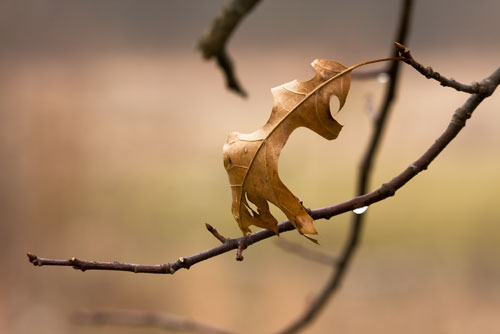
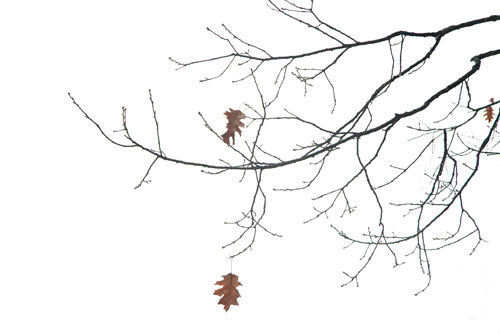
Last day of the year.  My photography buddy Becky and I went to the grounds of the Indianapolis Museum of Art to see what was up for shooting.  We stopped next to the tree with these leaves because they looked interesting.

There are lots of interesting areas at the IMA and I don’t know that this one is intrinsically any more interesting than any other except that these leaves caught my attention.  Neither one of us anticipated that we would spend all of our shooting time this morning within a 30 yard radius of this tree.

I liked these tree tops.

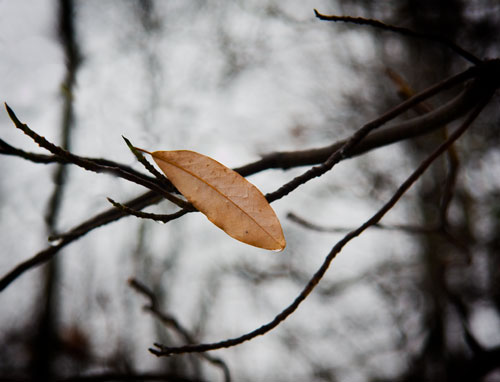
And this leaf.

The day was quite overcast but I have found that a gray sky can be a plus.  I shot these oak leaves and branches and then forced the gray sky to white in  Photoshop.  It produces a somewhat painterly effect.  I removed some of the branches; it seemed to want to be a simpler image.  I may remove more before I’m through.

By many criteria – it was muddy, cold and damp – it was not very pleasant but it was well worth it to cap off the year with a shooting day like this one.

A snowy day

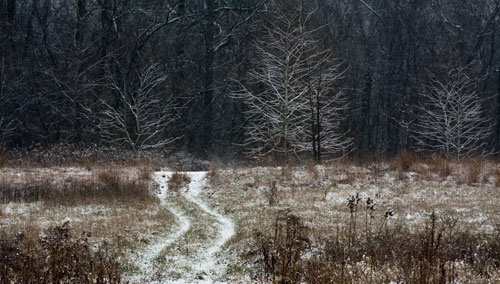
My friend Becky and I went to Fort Harrison State Park on Saturday to shoot in the snow. 

It was in the low 30’s and it came down as snow rather than rain.

We wandered (and wondered) around the park getting the usual winter shots and looking for something out of the ordinary.  We could hear guns in the distance; it wasn’t target practice and guessed it must be hunters.  They were pretty far away and we could ignore them. 

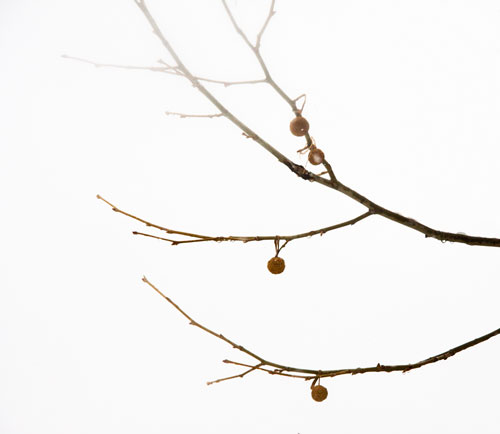
The sky behind the branches in this image was gray, but pushing it to white in Photoshop gave the image a painterly quality I have always liked.  I would like to make a card of it and say something profound on it but nothing like that occurs to me so I’ll leave it as an image.

As we wander about, I recommend shots to Becky and she recommends some to me.  Here is one she suggested.

She gets good ideas.

After about an hour and a half I was soaked and ready to go home.  Becky said she would stay and poke around the park some more.  She called me later to say that she found out what the gunfire had been about.  A re-enactment of a World War II American/German battle was just ending and Becky was right there.  She got some pretty unusual shots for a snowy day at a state park.

I’ll dress more warmly next time and hang out longer for the better shots.