I have/had trouble praying

From the time I was small, I’ve had a problem with prayer.  As long as I stick to standard prayers – the Lord’s Prayer and some other memorized prayers- I am alright but as soon as I go off into prayers for specific people or situations I get stuck and my mind wanders.  But that isn’t quite true, my mind also wanders during the Lord’s Prayer, any prayer or any time for that matter.rock_5343_2s
I got into a conversation about this with three of my friends, all of them solid church goers and dedicated contributors to the community.  All four of us admitted to problems with prayer.  All of us are men and one of us is a minister.   Now that I think about it we never did pursue that problem very far, perhaps none of us knew quite what to do.

Some weeks later and in a different context the minister friend recommended Barbara Brown Taylor’s ‘An Altar in the World:  A Geography of Faith.’  Ms. Taylor had been an Episcopal priest for several years before going into writing and teaching full time.  She had been named by Baylor University as one of the 12 most effective preachers in the English speaking world.  I had been prepared to take her seriously anyway but that pushed her book to the top of my reading list.  The deeper I got into the book the more interesting it got.  And then there was this:

‘I would rather show someone my checkbook stubs than talk about my prayer life.  I would rather confess that I am a rotten godmother, that I struggle with my weight, that I fear I am overly fond of Bombay Sapphire gin martinis than confess I am a prayer-weakling.  To say I love God but I do not pray much is like saying I love life but I do not breathe much.’  (p 176)

Now she really had my attention.  And to cap it off a few pages later she took her cue from Brother David Steindl-Rast, author of ‘Gratefulness, The Heart Of Prayer’, in suggesting that

‘Prayer…is waking up to the presence of God no matter where I am or what I am doing.’  (p 178)

Alright!  Prayer isn’t just a recitation of fixed passages or verbal requests for God’s attention.  I knew that all along but for a truly outstanding minister to admit she has trouble praying, as I suspect many of us do, was quite a revelation.  But she went further than our little group of four men had gone by pointing out that just being aware of the presence of God no matter what we are doing is a form of prayer.  And_there_was_light_7289_7289_2

If we are wiping a child’s nose, running a backhoe, mowing the lawn, watching a ball game, helping out in a soup kitchen, playing with the dog, any of these activities – and are aware of the presence of God, we are praying.  I think that would include the activity of photography.
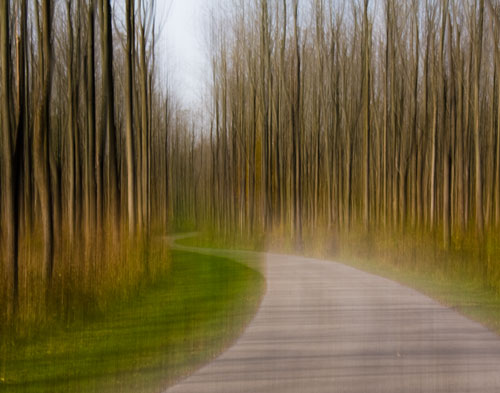
Meanwhile, back at the walnut plantation

I wrote a couple of days ago about a walk through the walnut plantation at the Fort Harrison State Park and how I ended up shooting little things instead of big things such as walnut trees.  I have a bias toward little things but in my defense there is a lot of distracting underbrush around the walnut trees, as beautiful as they themselves are.

I went back today and much as I would like to say that I was determined to shoot big things and big things only, I just went to shoot.  It occurred to me to try a technique I learned reading William Neill’s ‘Impressions of Light’ which is available as an ebook at his website.  I regularly go back to this book for inspiration.walnut_plantation_7192

The technique is simple.  Slow the shutter speed and move the camera while the shutter is open.  I had done this before with images of water (I’ll cover that in a later post).  I put a four stop neutral density filter and a polarizer on the lens and shot at f/11 and  ISO 100.  This slowed the shutter down to 1/13th to 1/6th of a second for various exposures.walnut_plantation_7140

The camera was on the tripod and I simply moved it up and down more or less vertically to emphasize the trunks of the trees.  The brush is still present but instead of being distracting, it now it adds a bit of color.walnut_plantation_7207

Camera motion can be an artistic tool.  I can’t say that I know how an image is going to turn out as I am setting up the shot; I can’t previsualize with any accuracy what it is going to look like.  The ‘take’ rate, the percentage of images that turn out well, is small but I do like what the technique can do.  And the bonus is that parts of the image that are potential distractions, such as underbrush, can, with some luck, turn into desirable features of the image.

In looking at these images, I get the sense that we are seeing something about the scene that we wouldn’t see any other way.  Somehow, to use Wordsworth’s phrase, we are seeing into the life of things.  We are seeing something for which there is no immediate verbal label, something that for a short while at least, we can treat as new.  That is something we expect of art and something we hope for as spiritual seekers.

Shooting with an agenda?

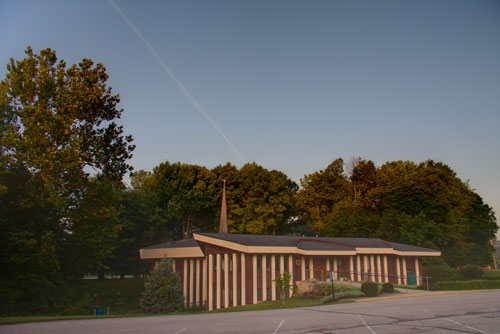
Our little congregation was putting together a cookbook and they needed a picture of the church for it.  Since the  book was going to press on Wednesday, I went up early on Monday hoping to get a nice picture of the sunbathed  front of the church.  Good idea.  The sky was clear and promising.  I set up and got shot after shot over a period of several minutes but  it became clear that the right image was not going to be there.  And the patched parking lot in front wasn’t helping either.  Nothing much of interest as far as the light was concerned and the shot was poorly positioned and composed.

Not very interesting view of Church of the Saviour

Not very interesting view of Church of the Saviour

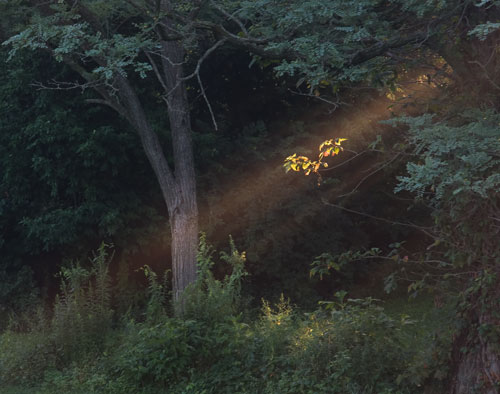
I’m a fan of Dewitt Jones and one of his dicta at this point would have been “turn around Barry, turn around”!  So I did and that’s when I saw this.

God beam

God beam

The church is situated on eight acres of ground and I’m sure I’ve looked back in this area before but there was never anything of interest or, better, anything interesting I was prepared to see.  It would have been difficult to pass up this shot in any case but there was another reason it was important to me.  In a few weeks I would be preaching while our minister was on vacation and I planned a sermon built around the idea of spirit and seeing.  I was looking for shots that I could use.

Religious language is very symbolic since it deals with the transcendent and unimaginable.  It is interesting to a photographer to see how often light is part of the description of the transcendent – ‘Light of the world’, ‘your word is a lamp unto my feet’, etc.  I had thought early on that a picture of a God beam would be a nice addition to the sermon.  And there it was.

We humans always have an agenda.  My ‘front of the head’ agenda that morning had been to get a good shot of the church.  One item in my ‘back of the head’ agenda, that vast pool of hopes, interests, and yearnings we all carry around, was to get a shot of a God beam.  I’m not going to argue that God gave me a present with that shot, the real gifts to me in the present context are the continued existence of Barry Lively and a growing appreciation of what there is to see.

Christians often quote Matthew 3:2 – ‘Repent for the kingdom of God is near.’  For some that can take on an ominous tone;  it is time to straighten out our lives for the end is coming.  A Bible scholar I know said that a better translation than ‘repent’ would have been ‘turn around.’ ‘Turn around for the kingdom of God is near.’  Indeed it was.  And is.

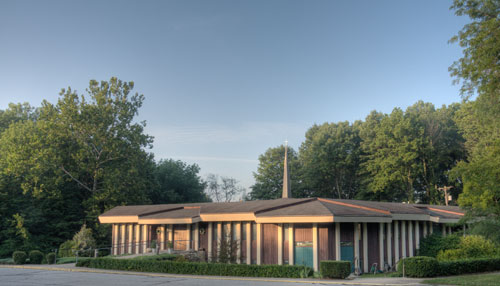
After working the God beam shot I still had to get a picture of the church.  I moved up the parking lot about 200 feet and shot from the other direction.  It was a better composition but the light was still not what I would want so I used a technique called high dynamic range (HDR) where I did the same shot (on a tripod) three times, overexposing, underexposing and exposing as suggested by the auto exposure feature of the camera.  The shots were combined in software to produce this image.

A better picture of Church of the Saviour

A better picture of Church of the Saviour

The light is still not great but the glow that came from the HDR treatment was nice.  And as it turned out the publisher changed the image from color to black and white.  If I had known that was what they wanted, I might have settled for one of the first shots I took at the original position and converted it to black and white myself.  I’m glad I didn’t know that.  Otherwise there would have been no God beam picture and I might have settled for a poorly composed picture of the church.  If ignorance isn’t really bliss, at least sometimes it is blissful.

Why Spirit and Seeing?

The name of this blog is ‘Spirit and Seeing.’  Why isn’t it called ‘Spirit and Photography?’  That’s what it’s really about isn’t it?  The surface reason for not calling it ‘Spirit and Photography’ is that name seemed too long  for people to type in; it’s just a bit more cumbersome than I would like the title to be.  The deeper reason is that, for me at least, seeing is at least 75% of what goes into successful photography.  A good camera is nice, a good lens is always welcome, technique – at least as far as operating the camera is concerned – is also good.  But the selection of what appears in the viewfinder and the way it is composed there is even more important.

Spring impression

Spring impression

A modern digital camera – I’m using a Canon 40D – automates a lot of what used to trip me up.  Autofocus is a boon, image stabilization is great and automatic metering is good too.  Having a histogram adds a critical dimension to image making.  All of that taken care of automatically to one extent or another means that the bulk of the job shifts even more over to image selection and composition, or seeing.

As complex as it is, the English language often compresses multiple meanings into a single word.  Take for example the word ‘seeing.’  If I’m absent-mindedly walking along and managing to avoid running into trees, dogs, people and parked motorcycles, am I ‘seeing’ in the same sense as when I’m composing a picture that people will find interesting?  The answer, obviously, is no.

One of the benefits of a strong interest in photography is that it helps us see more of the world.  Not more square inches of the world, but more per square inch.  When we first start out with a camera and have gotten to the point that we don’t have to think too much about the camera settings, it often happens that we see more and more interesting things when we have the camera in our hands than when we don’t.  With more practice, that difference decreases and we see more ‘photographically’ even when we don’t have a camera with us.

I take our two dogs for a walk around the block every morning at around 5:45.  We’ve been doing this for years.  It is usually dark and there isn’t much that changes from one day to the next but thinking photographically helps me see things I hadn’t noticed before.  The photo below was taken one winter morning.  I had been by that tree hundreds of times but perhaps because of the frost on the ground and who knows what else, it was different.  When we got back home I picked up the camera and tripod and went back to see if it was what I thought it was.

Do you really want to know what is behind that tree?

Do you really want to know what is behind that tree?

The light being obscured behind the tree makes a huge difference.  Moving a few inches to the left or right turns the image into nothing very interesting.  I’ve looked at this tree many times since and the shot just isn’t there for me now.  Maybe when there is frost on the ground, then again, maybe never again.

So yes, this blog is about photography but then photography is largely about seeing.  I’m happy with the title ‘Spirit and Seeing.’

The real voyage of discovery consists of not in seeking new landscapes but in having new eyes.
Marcel Proust

A definition of spirituality

In the last post I asked the question whether my experience of photographing two Canada geese coming together on a spring morning could be described as ‘spiritual.’  People use the term spiritual in many different ways so before going much further it would be useful to have a working definition of the term.

Canada geese at dawn

Canada geese at dawn

What the word “spiritual” means for you is unlikely to be exactly the same as what it means for me for a very good reason – we are different people.  Start with this definition of spiritual identity:

‘the pattern of beliefs, attitudes and feelings about the Sacred and the world – a pattern that defines who you are at the profoundest level.’ (From Skylight Paths, Who Is My God?: An Innovative Guide to Finding Your Spiritual Identity, Skylight Paths Publishing; March 2004, p5)

Beliefs, attitudes, feelings about the Sacred – a defining pattern.

This definition looks very much like the definition the American Psychological Association gives for personality:

‘the unique psychological qualities of an individual that influence a variety of characteristic behavior patterns (both overt and covert) across different situations and over time.” (From http://www.psychologymatters.org/glossary.html#p)

The APA definition explicitly ties personality to behavior, the definition of spiritual identity implies behavior.

Some could go on for years making finer and finer distinctions between these two definitions but at a practical level they strongly overlap. Work the term “Sacred” into the APA definition and the definitions are indistinguishable in a practical sense. Our spiritual identity and personality, to the extent they are even different from one another, are entwined and an attempt to pull them apart would do damage to both. Our personalities are all different, our spiritual identities are also different. An attempt to offer a more precise definition for spirituality that works for everyone is not a fruitful exercise because the form spirituality takes depends so heavily on the individual.

Our definition describes spiritual identity.  I am going to treat spirituality as the way that identity manifests itself.  Here is where things get a bit complicated because spirituality is just one of the factors contributing to the choice of what we photograph and how we photograph it.  A shooting agenda (I’ve got to get a picture of sunlight dappling the leaves in fall color), responding to the influence of other photographers  (I’d like to do one like Freeman Patterson does it), other things being on our mind (my 401K is going down the tubes) and other factors contribute as well.  We will have more to say about this in future posts.

This is all wonderful stuff but what does it mean for us as photographers?

Here are some implications:

  • If you and I go out to shoot within the same two acre plot, we will come back with different images.  We are different people, we see the world a bit differently and our photographs are different.
  • Whatever we do, whether it is eating breakfast or looking for that next great photographic inspiration, will involve our spiritual identity to one extent or another.  After all, it is part of who we are.
  • We often aren’t even aware of the spiritual component in our everyday lives, let alone in our photography.  It may be crowded out by agendas and other competing factors or we might not even be aware of a genuine spiritual impulse.  By tying spiritual identity to the Sacred and not God, the door is open for people who aren’t religious or perhaps don’t believe there is a god to be included in this discussion.  Just about everyone holds something sacred and that may be the touchstone for those peoples’ spiritual life.  In a later post we will talk about ‘The Little Book of Atheist Spirituality’ by Andre Comte-Sponville.  Comte-Sponville provides a fresh understanding about how atheism, for some people at least, can be compatible with a spiritual life.

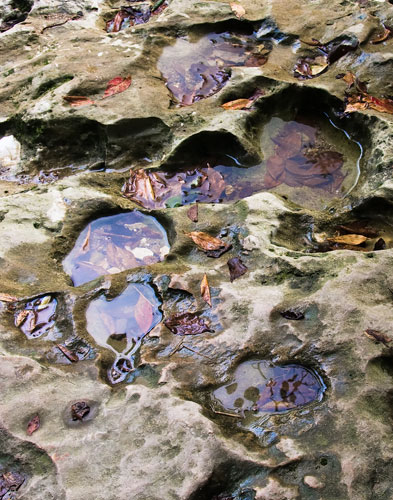
    Reflection, Fall Creek Gorge, Indiana

    Reflection, Fall Creek Gorge, Indiana

I don’t know that many will agree with my definitions of spiritual identity and spirituality, I offer them here as a place to begin and as a reference point for what, at least, I believe.

Photography and something more

I was in position. The digital camera lens and sensor were both clean and the battery was fresh. The camera was on the tripod, ISO was set at 100 and the camera was ready to take up to five pictures per second just by holding down the button. The camera was focused on the male Canada goose in the foreground.

waiting_7730

The technical side of the job was done and it was time to just be in the present and enjoy what the day had to offer. There was a delicate scent of spring, the sound of birds calling and the promise of warmer weather in the softness of the breeze.

I had my hopes. We had seen a female goose come join the male the day before. Maybe she would be back. It was time to wait. If I didn’t know what would happen, it was at least a great day to be outside and see what was going on.

We were staying at Natural Bridge State Resort Park in Kentucky and in the mornings we would go over to Mill Creek Lake. It was late April and the trees were budding. The first few mornings were fine but not particularly noteworthy as far as photography was concerned.

_MG_7397-2

This morning was misty and the sky above was clear. The possibilities were improving.

impression_7503

The male goose called and around the bend came the female who surprised us by settling on the water about 40 feet away rather than coming directly to him. Off he went to join her.

_MG_7742

All I had to do was push the button and watch. I got in 14 shots between the time she arrived and they were together. That coming together of two instinct-driven gorgeous birds will be with me for a long time. This was far better than anything I had hoped for!

There was a real rush in this moment. The lake with golden mist was an outdoor cathedral and the geese were participants in a ritual that goes back to the beginning of life as we think of it. I had prepared as well as I knew how so I could just be there and not worry about what the camera would do. I would have been grateful to just be present to see this. To get the pictures as well was a blessing, ‘a good measure, pressed down, shaken together, running over (Luke 6:38).’ The moment was touched with something beyond the ordinary.  Would it be correct to describe it as spiritual?

The central theme of this blog is that spirituality and photography mutually nourish one another.  Spirituality can enhance the experience of photography and photography can strengthen spirituality.  The result, for me, is a greater awareness of beauty and mystery in the world, a greater appreciation of God and God’s creation, a greater sense of connection to it all.

We’ll talk a lot more about this over time and I hope that as a result you may find posts and articles of interest to you.  I won’t say I have answers to the important questions;  I’m a seeker and at best I am simply  more aware of the journey and the joy of being on it than I have been in the past.  Join me!