Did you ever take someone’s picture outdoors only to discover later that a telephone pole appears to be growing out of their head? Did you ever see what the magician actually did when she made a coin disappear from her hand and pulled it out of a bystander’s ear? Selective attention was operating in both situations, limiting the information you took in. In the one case you were so intent on the subject that you missed the telephone pole. We’ve all done that. In the case of the magician, the trick worked because your attention was misdirected.
We know that all of our senses are turned on all of the time which means that from moment to moment a huge amount of information is cascading into our central nervous system. We can’t deal with all of that and the ability to selectively attend to one part of the information stream to the exclusion of other parts allows us to operate in this world. We are able to ignore conversations that don’t involve us while we read a book, we can savor good food in a restaurant while a magician is trying to show us a trick. Selective attention works.
At the same time, the information we bring in is being interpreted against the background of our experience, interests, what we are thinking about at the moment. It is not surprising then that two photographers working side by side on a field trip can come away with very different sets of images for the day. Their life experience and interests are different, what they selectively attend to is different, their images are different.
Any photographer will tell stories about how ‘it seemed like a good idea at the time’ to take a picture but later finds out it just didn’t work. Often, part of the reason for this is that we see things in the image on the computer screen that we didn’t see in the field. Selective attention in the field was locked on the subject and elements that are later distracting on the screen just weren’t seen. In some cases the problem can be remedied with work in Photoshop. I take this to an extreme in my work on flowers. There, I don’t much care about distracting elements in the background, they are going to be eliminated. Here is an example.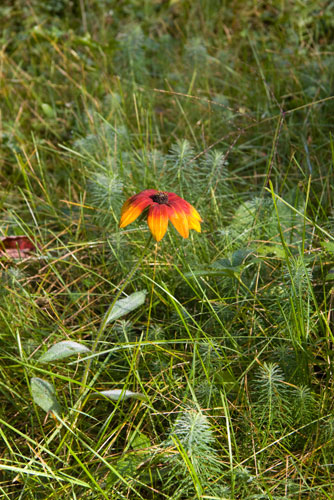
The background is busy and will be distracting in a print. My answer is to eliminate the background altogether and replace it with solid black or maybe white. For those of you who use a photo editing program such as Photoshop or Photoshop Elements, I create a mask by tracing around the subject with the polygonal lasso, save it as a selection and then use that selection to deal with the background. Here is the result for the image above.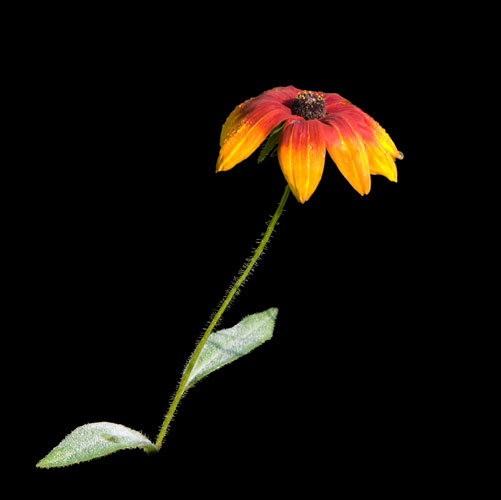
This was my first answer to the problem of directing the viewer’s attention to the subject. It’s rather difficult for the viewer to miss what the image is about if it has had this treatment. It certainly isolates the subject and if I use black as the background, it gives the subject extra vividness. I plan to continue with this method for some images but this is not the only way to direct attention to the subject.
There are several other methods for more subtly directing the viewer’s attention. Cropping the image, lightening the subject while darkening the background, and increasing the saturation of the subject while reducing the saturation of the background are just a few of the things we can do.
When I saw this scene, I wanted the trees netted with vines and brush to be the subject.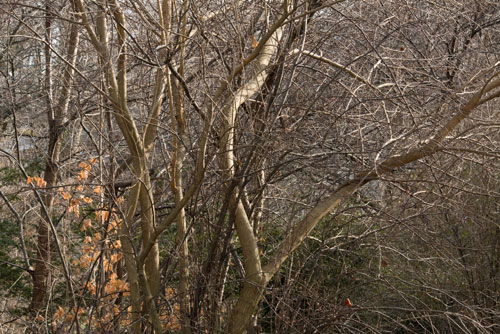
Here is the result to date. I don’t call it the final result because I’m seldom finished with any given image. 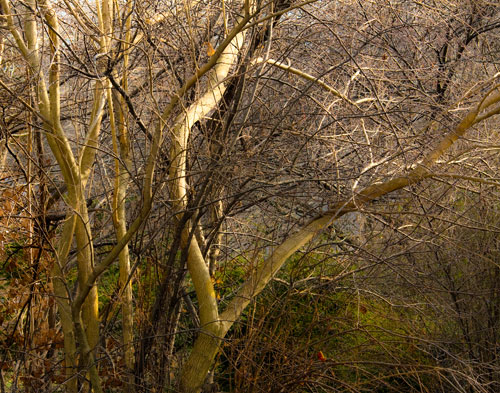
I could give you the laundry list of things I did but the specifics of what I did are less important than the result obtained. I think it is fairly clear what the subject is in this image. Leaving the background in means the viewer has to do a little more work to pull out the subject but in doing so, the image can take on a symbolic value in showing that what we are looking for is often at least partially obscured by extraneous elements that pull our attention in a different direction.
Selective attention is a powerful tool. It helps maintain our sanity – imagine trying to deal with all of the competing stimulation we are subject to, rather than just a small part of it. To a large extent we can control our own selective attention. The job of the photographer is to influence that selective process and get the viewer to look at the subject in an image, appreciate it and of course remember the photographer’s name.
 Spirit and Seeing