Object lesson

I went over to Fort Harrison State Park this morning, more to see what was going on than to do any serious shooting.  The light on the hillside across Delaware Lake was inviting so I set up to shoot in that direction.
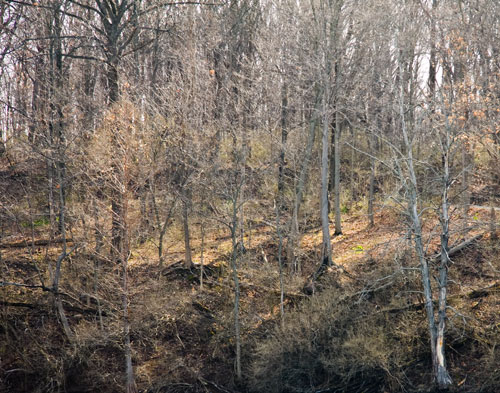
I was so wrapped up in composing and shooting that I wasn’t paying much attention to the camera settings.  Where I usually shoot at f/11 in a focusing mode that allows the camera to pick where it will focus (normally the closest object), here it was at f/5.6 and focusing was set to a point off to the right, roughly where the dead tree is at the right of the image.  The focusing point was left over from a shoot a few days ago.  None of this mattered much for this particular shot.  The distance was such that I had enough depth of field and even if the camera had been free to pick where to focus, it would likely have focused where it did anyway.  On top of that, I intentionally overexposed the scene by two stops because normal exposure produced a rather dark image.  Correct exposure and where the camera would focus quickly became very important.

A blue heron flew across the lake to give me the opportunity for a great shot.  It was coming in from the left and cut right across my field of view about 20 feet away.  But the camera was focused off to the right (not very evident in this shot, but it was).  And the shot was two stops overexposed. 

I looked at the camera settings after the shot.  That’s when I saw how the focusing was set.  As you can see in the image, Photoshop did a good job recovering from overexposure but if the image is out of focus to begin with, it stays out of focus.  I try to remember to put the camera back to my favored settings when I shut it down, but sometimes I forget.  Oh well.

The rest of the morning produced some OK shots.  Here is one.

And here is a black and white shot.  It worked much better this way than in color.

My camera is put away for the present and I have checked it twice to make sure the right settings are in place.  They are.

Just a good day to shoot

Some days are a gift.  It was nicely cloudy this morning when I had the dogs at the bark park.  In between throwing tennis balls for Prince and Tuck I was able to get in a few shots.BP_7436

The clouds largely disappeared and later in the morning I was on the Fall Creek Trail at Fort Harrison State Park.  It’s hard to beat an autumn day, a good day for smelling the leaves and kicking through them.  Inside every six year old boy there is a six year old boy.  Inside every 70 year old man, there is a six year old boy. We were having a warm spell and a lot of people were enjoying it.

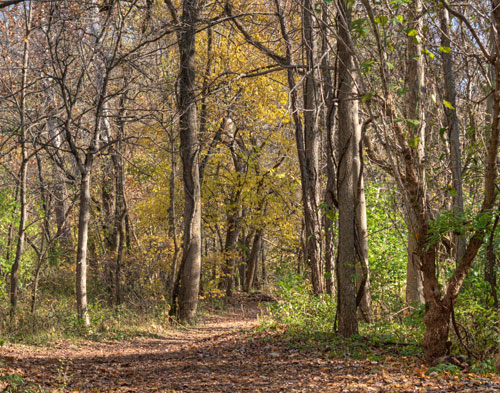
It being toward the middle of the day, lighting was more harsh than it was in the morning but shooting high dynamic range eased that.  The camera was on the tripod and shots were bracketed plus and minus two stops.  I later combined the resulting three images in Photomatix Pro and was quite pleased with the result.  There are times when I want some of what has come to be called the ‘HDR effect’, an effect that can push colors to the cartoonish side while the range of illumination is taken from, say, 13 stops down to eight or nine stops.  That cartoonish effect can be effective in some situations but not here.  All I wanted to do was compress the range of captured light into the range that can be displayed and keep the colors pretty much as they were.   Here is the result:Fall_Creek_7523_4_5Enhancer

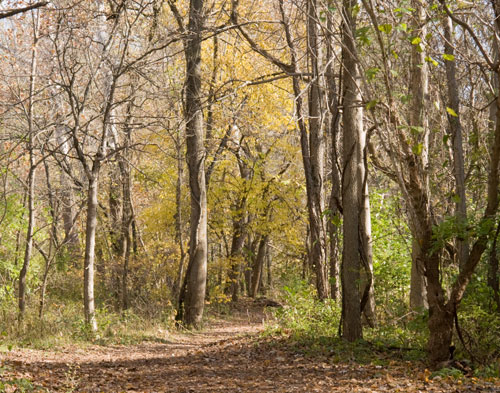
One effect of compressing a wide dynamic range into a narrower dynamic range is that tonal transitions become more smooth and gradual.  Compare the above with this image, the one the camera recommended and was included as part of the HDR work:

Fall_Creek_7523

This is very nice too but the brightness on the right side of the tree to the right of the path suggests why it isn’t a good idea to shoot at this time of day if it can be avoided.  All in all, a good result with new technology and better yet, a good day to be outside.

Meanwhile, back at the walnut plantation

I wrote a couple of days ago about a walk through the walnut plantation at the Fort Harrison State Park and how I ended up shooting little things instead of big things such as walnut trees.  I have a bias toward little things but in my defense there is a lot of distracting underbrush around the walnut trees, as beautiful as they themselves are.

I went back today and much as I would like to say that I was determined to shoot big things and big things only, I just went to shoot.  It occurred to me to try a technique I learned reading William Neill’s ‘Impressions of Light’ which is available as an ebook at his website.  I regularly go back to this book for inspiration.walnut_plantation_7192

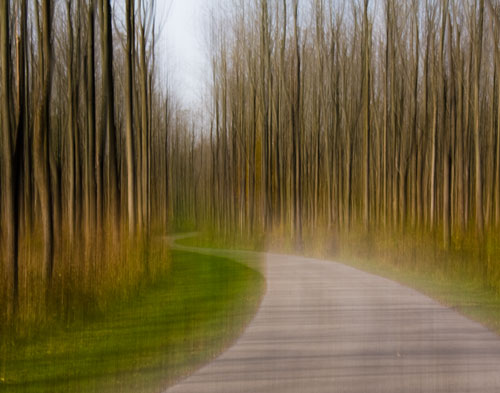
The technique is simple.  Slow the shutter speed and move the camera while the shutter is open.  I had done this before with images of water (I’ll cover that in a later post).  I put a four stop neutral density filter and a polarizer on the lens and shot at f/11 and  ISO 100.  This slowed the shutter down to 1/13th to 1/6th of a second for various exposures.walnut_plantation_7140

The camera was on the tripod and I simply moved it up and down more or less vertically to emphasize the trunks of the trees.  The brush is still present but instead of being distracting, it now it adds a bit of color.walnut_plantation_7207

Camera motion can be an artistic tool.  I can’t say that I know how an image is going to turn out as I am setting up the shot; I can’t previsualize with any accuracy what it is going to look like.  The ‘take’ rate, the percentage of images that turn out well, is small but I do like what the technique can do.  And the bonus is that parts of the image that are potential distractions, such as underbrush, can, with some luck, turn into desirable features of the image.

In looking at these images, I get the sense that we are seeing something about the scene that we wouldn’t see any other way.  Somehow, to use Wordsworth’s phrase, we are seeing into the life of things.  We are seeing something for which there is no immediate verbal label, something that for a short while at least, we can treat as new.  That is something we expect of art and something we hope for as spiritual seekers.