Just a good day to shoot

Some days are a gift.  It was nicely cloudy this morning when I had the dogs at the bark park.  In between throwing tennis balls for Prince and Tuck I was able to get in a few shots.BP_7436

The clouds largely disappeared and later in the morning I was on the Fall Creek Trail at Fort Harrison State Park.  It’s hard to beat an autumn day, a good day for smelling the leaves and kicking through them.  Inside every six year old boy there is a six year old boy.  Inside every 70 year old man, there is a six year old boy. We were having a warm spell and a lot of people were enjoying it.

It being toward the middle of the day, lighting was more harsh than it was in the morning but shooting high dynamic range eased that.  The camera was on the tripod and shots were bracketed plus and minus two stops.  I later combined the resulting three images in Photomatix Pro and was quite pleased with the result.  There are times when I want some of what has come to be called the ‘HDR effect’, an effect that can push colors to the cartoonish side while the range of illumination is taken from, say, 13 stops down to eight or nine stops.  That cartoonish effect can be effective in some situations but not here.  All I wanted to do was compress the range of captured light into the range that can be displayed and keep the colors pretty much as they were.   Here is the result:Fall_Creek_7523_4_5Enhancer
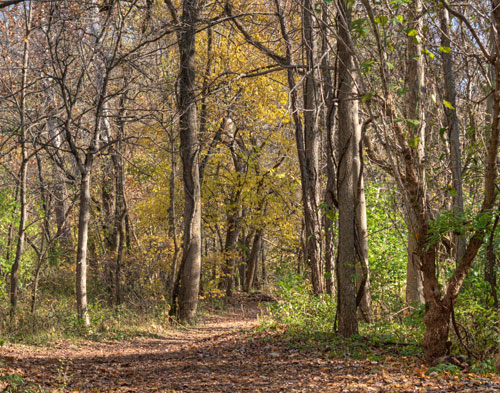
One effect of compressing a wide dynamic range into a narrower dynamic range is that tonal transitions become more smooth and gradual.  Compare the above with this image, the one the camera recommended and was included as part of the HDR work:
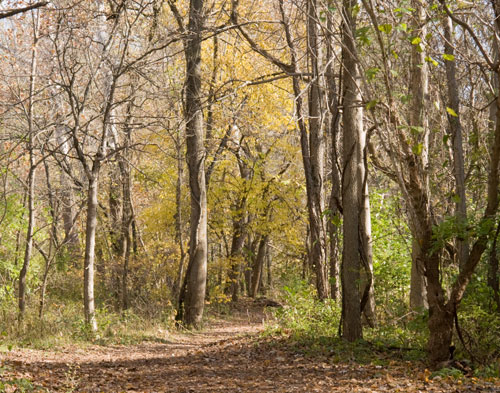
Fall_Creek_7523

This is very nice too but the brightness on the right side of the tree to the right of the path suggests why it isn’t a good idea to shoot at this time of day if it can be avoided.  All in all, a good result with new technology and better yet, a good day to be outside.
Sticking with it

One more time into the walnut plantation.

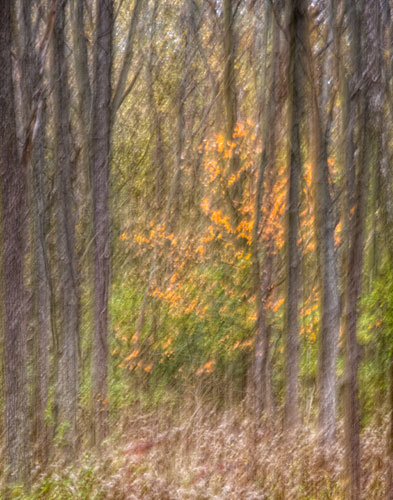
Gold among the walnuts

Gold among the walnuts

It was wet and a little drizzly yesterday morning when I went out to shoot.  I was there because Alain Briot’s column on landscape blurs reminded me that that was a good time to get saturated colors.  As indeed it was.

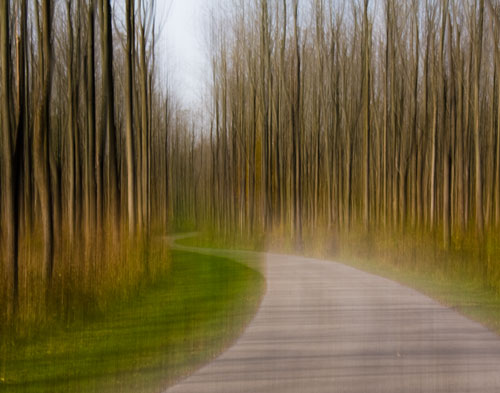
It was windy and dark which spells disaster for some kinds of photography but for landscape blurring – which consists of moving the camera while the shutter is open – it is very promising.  As usual the number of images retained after the shoot was much smaller than the number taken, a great argument for digital cameras.  I got the shot above early on.  (For those interested in such things, most of the effect in the image above was created in the camera.  Adobe Camera Raw added some contrast and a little vividness while Photoshop permitted selective darkening and bringing up the orange a little bit in the leaves.)

The story continues.  There was a red poison ivy vine decorating a tree trunk several yards into the brush and without thinking I just went in to get a shot of it, looking for poison ivy along the way but forgetting about the burrs that are so common this season.  I was immediately attacked by a lurking burr factory.  I was born in 1939 so I grew up watching horror movies where some otherwise more or less mildly obnoxious pest was irradiated in an accident and grew to gigantic size and set out to take over the world.  I don’t remember any giant burr movies but it would have been a good subject.

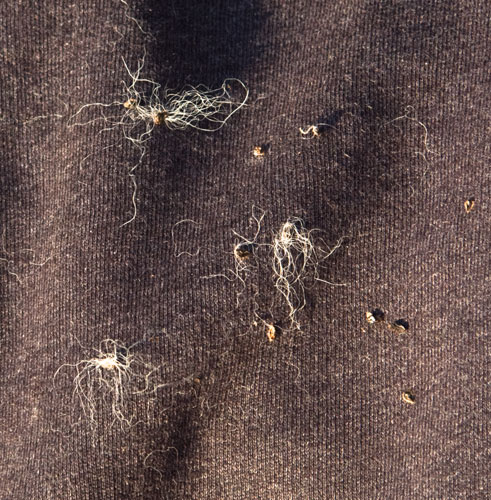
You have probably encountered burrs.  Once they are stuck to your pants, they are as tenacious as a politician working to stay in office.  I was wearing sweats so conditions were ideal for them.  I tried brushing them off and that didn’t work very well so I put an old towel on the driver’s seat and sat on that on the way home where surely there would be a good solution.  I tried lots of things and they all failed.  I’ll talk about just one of the methods.  We have a brush which we use to brush our two White German Shepherds.   Note that the brush was full of white dog hair, something I noticed but didn’t think about.  The brush didn’t work as intended.  In fact it achieved the opposite result, which was that the burrs did not come off but the dog hair left the brush to join the burrs.  Now many of them have little white beards.

Burrs with dog hair

Burrs and dog hair among the threads

Michael Pollan, in his ‘The Botany of Desire’, says with tongue in cheek that members of the vegetable kingdom rule the world and use us to carry their seeds from one place to another.  I’m coming to believe that.  Maybe those old horror movies were speaking the truth.  Burrs just didn’t need to be irradiated and they don’t need to be big to take over the world.  That’s my story and I’m sticking with it.

Meanwhile, back at the walnut plantation

I wrote a couple of days ago about a walk through the walnut plantation at the Fort Harrison State Park and how I ended up shooting little things instead of big things such as walnut trees.  I have a bias toward little things but in my defense there is a lot of distracting underbrush around the walnut trees, as beautiful as they themselves are.

I went back today and much as I would like to say that I was determined to shoot big things and big things only, I just went to shoot.  It occurred to me to try a technique I learned reading William Neill’s ‘Impressions of Light’ which is available as an ebook at his website.  I regularly go back to this book for inspiration.walnut_plantation_7192

The technique is simple.  Slow the shutter speed and move the camera while the shutter is open.  I had done this before with images of water (I’ll cover that in a later post).  I put a four stop neutral density filter and a polarizer on the lens and shot at f/11 and  ISO 100.  This slowed the shutter down to 1/13th to 1/6th of a second for various exposures.walnut_plantation_7140

The camera was on the tripod and I simply moved it up and down more or less vertically to emphasize the trunks of the trees.  The brush is still present but instead of being distracting, it now it adds a bit of color.walnut_plantation_7207

Camera motion can be an artistic tool.  I can’t say that I know how an image is going to turn out as I am setting up the shot; I can’t previsualize with any accuracy what it is going to look like.  The ‘take’ rate, the percentage of images that turn out well, is small but I do like what the technique can do.  And the bonus is that parts of the image that are potential distractions, such as underbrush, can, with some luck, turn into desirable features of the image.

In looking at these images, I get the sense that we are seeing something about the scene that we wouldn’t see any other way.  Somehow, to use Wordsworth’s phrase, we are seeing into the life of things.  We are seeing something for which there is no immediate verbal label, something that for a short while at least, we can treat as new.  That is something we expect of art and something we hope for as spiritual seekers.

Shooting little things

Fort Harrison State Park is nearby on the northeast side of Indianapolis and I stop by once in awhile to do some shooting.  A couple of friends had been there recently and got some magnificent shots in a stand of walnut trees, a stand large enough to be called a plantation.  I went over this morning to see if I could do as well.

All I found was row after row of trees with a lot of brush growing in between.   I got a few uninspired shots and then started looking at other possibilities.  I’ve noticed that, given a choice, I shoot small things rather than large ones.  My defense is that there are a lot more small things than there are large things and if you are in the woods the range of lighting on small things is a lot broader than it is for large things such as trees.  That’s my argument and I’m sticking with it.

There were back-lit possibilities all over the place.  Here is one:WP_6969

That, by the way, is the bark of a walnut tree.  Two walnut trees in fact.

A problem with shooting small things, and large things for that matter, is the background.  It can be pretty difficult to get the ‘right’ angle for the subject while avoiding a distracting background.   The image above is OK in that regard – the background doesn’t overwhelm the subject.

But here is the problem in spades. Autumn_leaves_7081_pre

There are three leaves that attracted my attention but they are lost against the background.  This has happened so often that some time ago I took up removing the background altogether for some subjects.  Autumn_leaves_7081

Exactly the same image as above but without the background.  Georgia O’Keefe made the comment

Nobody sees a flower – really – it is so small it takes time – we haven’t time – and to see takes time, like to have a friend takes time.  I decided that if I could paint that flower in a huge scale, you could not ignore its beauty.

I don’t do large images, I just remove the distracting part and leave the image relatively small.  Removing the background certainly calls attention to the subject.  Works for me.  Some day I really will make images of large subjects.  Just not today.