Wondering in winter

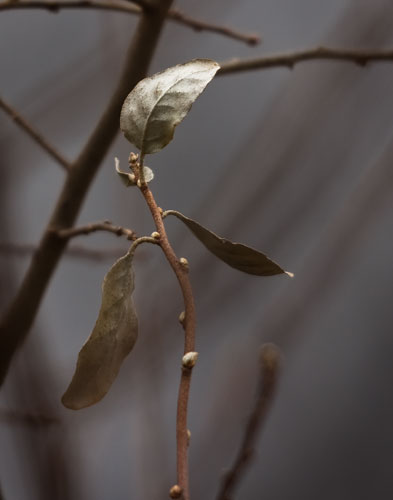
I had just one shot in mind as I set out yesterday, this one:
I had seen this on another trip but had the wrong lens for it at the time.

I had stopped at a local orchard to pick up some apples on my way to shoot so I had the camera with me. 

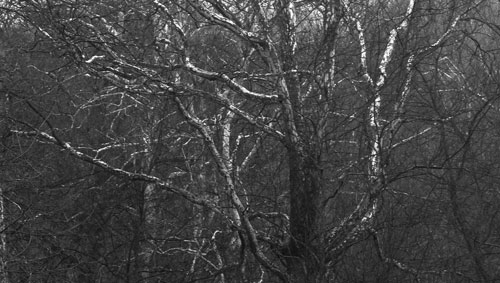
Finding this shot put me in ‘wonder’ mode for the morning.  Who knows what else there would be?  That shot is in color by the way, it was just a gray day, and yes, that was a very green door.  The other three shots are in black and white.

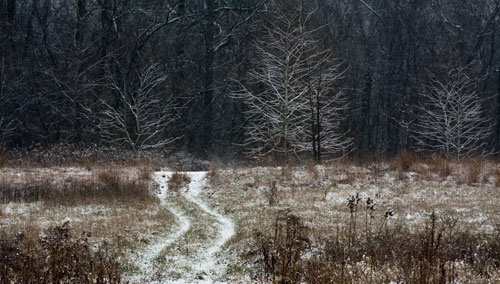
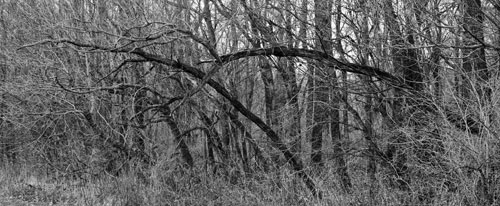
Wondering around in the woods at Fort Harrison State Park initially yielded little of interest.  But that was because I was looking at eye level.  Down on the ground things were much more interesting.
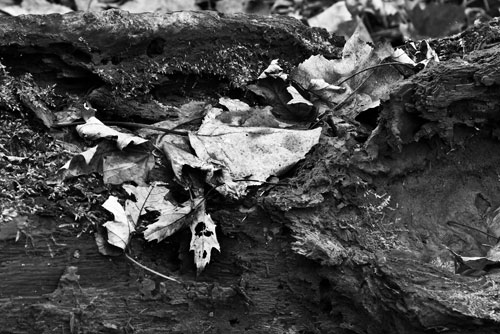
Being in ‘wonder’ mode means being open to what’s there, open to discovery.  I have to say that this is not easy to do for very long, it is similar to turning up one’s hearing and becoming aware of all those clamorous voices.  After awhile, it’s as the expression says – too much information – and that can be tiring.

Underlying all that visual clamor I listen for the still small voice.  It’s there but it picks its own way of expressing itself and it won’t be forced.  I hope that the images I find in my wondering about reflect that voice in some sense and in some sense I feel that I am getting closer to it.  I don’t even know what that means but it seems like a brush with the ineffable. 

“Heaven gives it glimpses only to those
Not in position to look too close.”
Robert Frost, “A Passing Glimpse”

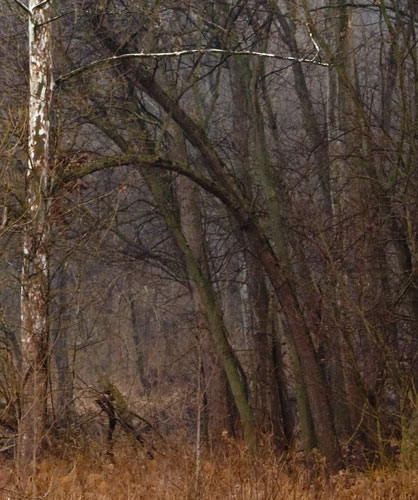
Sycamores in the mist

When we lived in Maine we loved the large birch trees with their peeling white bark.  Here in Indiana we don’t have much in the way of birch trees, certainly nothing to rival those in northern New England.  But we do have sycamores.  Their bark peels too and underneath the peeled bark the ‘skin’ of the tree is often white, or near white.  In the summer they are beautiful trees that don’t stand out too much from those around them, but come winter, it’s a different story.

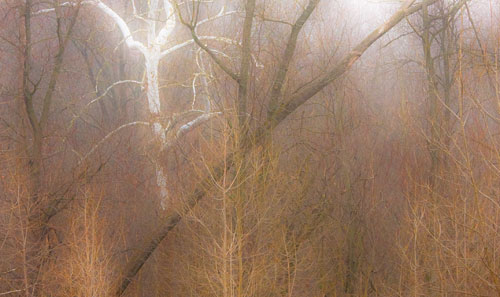
We had some mist yesterday morning and it was too good an opportunity to pass up.  Sycamores in the mist!  In some respects that is about like trying to find our white dogs in a snow storm but not quite.  The sycamores stand out from their neighbors and the mist wasn’t that heavy.  In fact it was rather light but there was enough to make it interesting.

The mist provided a lovely indistinctness to the trees, a softness that seemed to make the trees want to be seen more as contrasting colors than as textures.  I was happy to oblige. 

Some treatment (but not a lot) in Photoshop gave it a story book character.  If you said you saw Hansel and Gretel among the trees I would be ready to look.

I’ve always wanted a painterly effect and this provided it.

And when the mist was lifting, there was more texture evident.

If I’ve learned one thing about photography this year, it is that good shooting is available in just about any weather.  There is always a gift for someone who will just be open to it and  look for it.  I all but bolted out the door to go shooting and my wife smiled and made a comment about the six year old going to the park.  Guilty as charged and proud of it.

A dreary day?

The forecast today was for partial sun.  Wherever the sun was, it was somewhere else.  But fog came up about 10:00 and it looked interesting. 

David Ward, an excellent British landscape photographer, identifies three elements of a good image – beauty, simplicity and mystery.  The fog was simplifying the image and adding mystery to it.  A little work in Photoshop helped bring out the feeling of the day which wasn’t quite so evident in the original pixels.

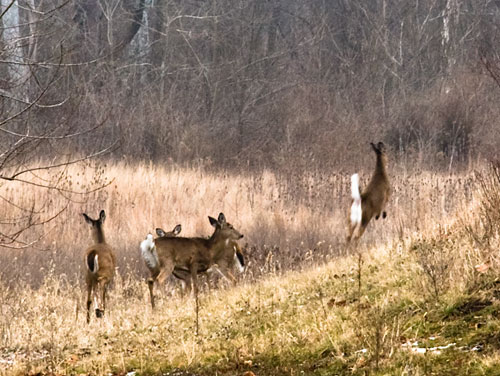
There were surprises, too, both for me and these white tailed deer. 

The fog was the initial attraction but it was lifting and the nearer subjects were were speaking their own quiet messages.

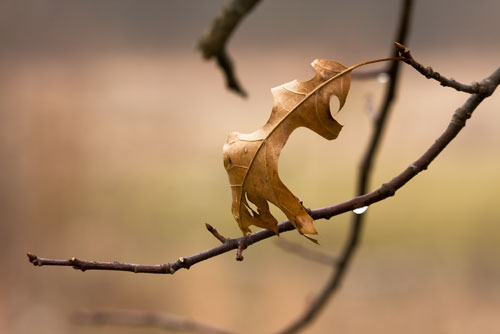
To the eye, a ‘dreary’ day looks so flat but the colors are more saturated and even if the trees do not cast visible shadows, the leaves still reflect more light on one side than on the other.

These were the gifts of the day.  It wasn’t too cold and certainly not too warm and the light was just right.  A good day to be alive.

A snowy day

My friend Becky and I went to Fort Harrison State Park on Saturday to shoot in the snow. 

It was in the low 30’s and it came down as snow rather than rain.

We wandered (and wondered) around the park getting the usual winter shots and looking for something out of the ordinary.  We could hear guns in the distance; it wasn’t target practice and guessed it must be hunters.  They were pretty far away and we could ignore them. 

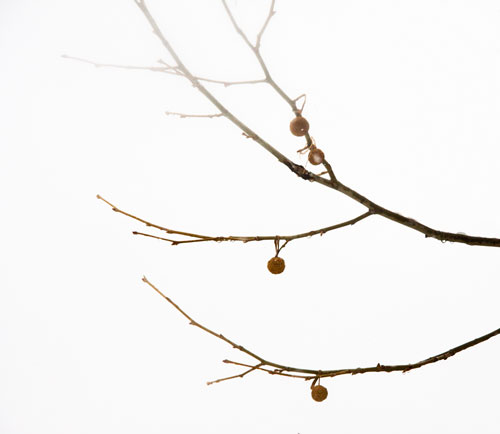
The sky behind the branches in this image was gray, but pushing it to white in Photoshop gave the image a painterly quality I have always liked.  I would like to make a card of it and say something profound on it but nothing like that occurs to me so I’ll leave it as an image.

As we wander about, I recommend shots to Becky and she recommends some to me.  Here is one she suggested.

She gets good ideas.

After about an hour and a half I was soaked and ready to go home.  Becky said she would stay and poke around the park some more.  She called me later to say that she found out what the gunfire had been about.  A re-enactment of a World War II American/German battle was just ending and Becky was right there.  She got some pretty unusual shots for a snowy day at a state park.

I’ll dress more warmly next time and hang out longer for the better shots.

Don’t drive, photograph

‘Hazardous road conditions…., pileups at ……, ambulance called to the scene…, slippery side streets…’   We had an inch of snow in Indianapolis yesterday.  Don’t get me wrong, this kind of havoc is not particular to this part of the country.  Several years ago we lived near Syracuse, NY and before that we lived in Maine.  Same behavior all over in the first snow of the season.  So I drove carefully on my way to photograph how the snow had changed the scene.

There was just enough snow to make it interesting.  The snowfall yesterday accounted for all the snow so far this month and it is always a surprise to see what it adds for the photographer.

The snow tends to simplify the scene as it offers contrast.  Given that it is fleeting, it’s a good idea to get out there not long after it falls.  I suppose I could say we need to strike while the iron is hot, but that idiom is probably not the best choice for talking about ephemeral snow. 

It is beautiful, isn’t it?  I suppose it is all just physics that causes the individual flakes to accumulate the way they do but that doesn’t account for the experience of seeing it, especially the first snow of the season.  It is fresh, it signals a change in season, it decorates and it vanishes.

I’ve photographed this scene several times in the summer and fall but nothing I have done previously compares with the opportunity I had here.  The snow set it off in just the right way and the water was calm enough for the reflection to work.

Irenaeus, a Christian bishop in about the year 200 CE said ‘the glory of God is the human being, fully alive.’  Getting the opportunity to photograph this snow and especially the trees reflected in Fall Creek brought me to, what for me, was an uncommon level of aliveness, which, like the snow, was ephemeral.

It is raining as I write this.  The snow is gone.  But looking at the weather forecast, we may get some more snow in the next few days.  Some more snow would be nice; a lot more is maybe not so good.  Moderation in all things.

I need a new lens

Golf was one of my dad’s favorite occupations for a good bit of his life.  He and my mother had a house that backed onto a golf course and Pop spent a lot of time out there.  Every once in a while, accompanied I’m going to guess, by a slump in performance, he would say he needed new clubs.  Just to see what he would say, we would ask why he needed new ones, since he had a perfectly good set of clubs already.  He always had an answer to that, and what it lacked in logic,  it more than made up for in conviction.  He got new clubs and he was happy.

I’ve gone for several years with a 17 – 85 mm zoom as the main lens for my Canon digital cameras, first a 20D and now a 40D.  This has worked just fine, even in situations where others might have wanted a longer telephoto lens.  The reason it worked, is that it produced a result that I liked, a rather painterly effect rather than a tack sharp image. 

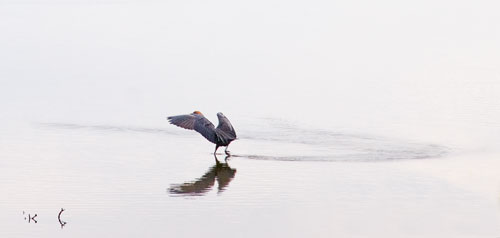
The image of this reddish egret, shot on Sanibel Island in Florida, accounted for about 10% of the raw image file in size.  Blown up to 15 inches or so, I find it appealing but definitely not sharp.

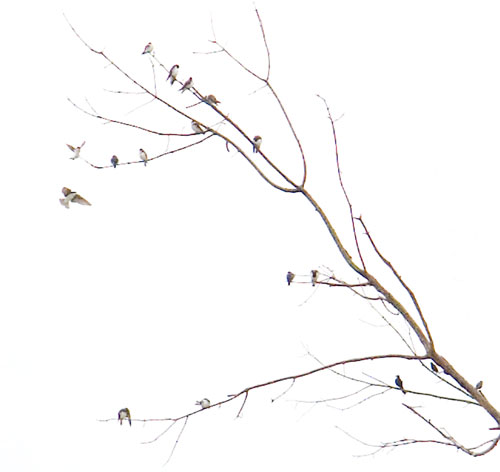
The same is true for these birds photographed at Muscatatuck National Wildlife Refuge in Indiana.  Seen printed on matte paper, it is hard to tell if they were painted or photographed.

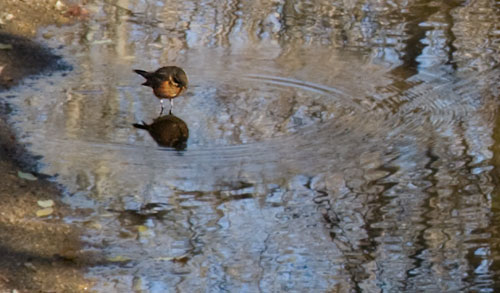
I was out yesterday and saw some robins about 40 feet away (I’m guessing here) bathing in a stream.  I wanted to get them creating circles of ripples as they cleaned themselves and I wanted it sharp.  Naturally they left as I was setting up the camera and tripod.  I was patient though, and they came back. 

I got in a few shots before they left altogether.  Yes, I did get pretty much what I wanted although it would have been better to get the reflection of the head inside the inner ring.  The image is fairly sharp but the problem is it is small.  Cropped out of an image 3888 by 2592 pixels, this image was 619 by 362 pixels, or a little over 2% of the total area of the original.   In other words, pretty small.  This lens is not doing the job.  I need a larger one.

Pop, if you can hear me wherever you are, would you give me a few pointers on making the case for this new lens?

An appreciation of milkweed

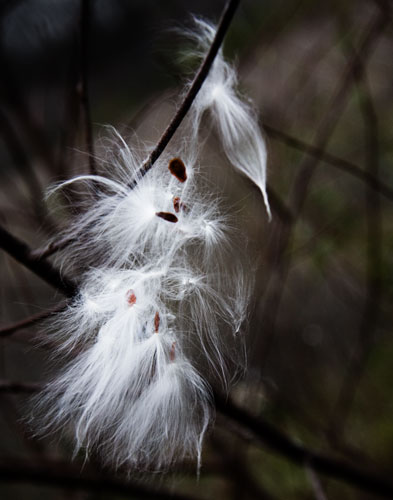
Yesterday I talked about the utility of milkweed – habitat for monarch butterflies, substitute for kapok in World War II – and said I would go back today to gather seeds for our butterfly garden.  I did that.  It was breezy and since I had my camera with me I planted it in front of a nice strand of milkweed floss and took a lot of shots as it danced in the breeze.milkweed_8662

It is easy to walk by milkweed and to notice the floss and seeds in only the most pedestrian way.  Unless we are looking, truly looking, they won’t occupy more than a moment of thought; visually, just a glimpse.

These little creations are striking when you take the time to look at them.  I could go on and on about this but I think the best tribute to them is just to show a few shots.  Words just can’t capture their subtlety and beauty.  (In each case I have darkened the background somewhat to help them stand out.)
milkweed_8637_2

milkweed_8634_2

milkweed_8620_2

They speak for themselves.

Milkweed then and now

Nice overcast sky today and the breeze wasn’t particularly strong so I went out to shoot milkweed.  Milkweed is a favorite subject this time of year, it stands still and the variations in form, texture and luminosity go on and on.Milkweed_8539

Milkweed is valuable today as habitat for monarch butterflies.  My wife reminded me of that and I expect I’ll be going back tomorrow to collect some seeds for our butterfly garden.

In 1944, in World War II, milkweed took on another kind of importance.  The Japanese controlled what today is called Indonesia and that meant they had control of the kapok crop.  Like milkweed, kapok produces a floss that was the main component in making flotation devices such as life jackets and life preservers.  With a lot of the war fought on and over the seas, kapok, and its loss to the Allies, was very important.

Milkweed produces its own floss and it works about as well as kapok.  Unfortunately milkweed was not a commercial crop and so people had to go out into the countryside to gather the seed pods before they burst open in the fall.  With adults off to war or working in the factories, it was up to school children to gather this crop valuable to the war effort.  I remember going out with my aunts and uncles (in junior high and high school) to gather them.  I was five years old at the time.  We knew it was important and a lot of work went into it.  I have no idea how much we gathered.  I do remember the large onion sacks bulging with milkweed pods.  We were doing our part and I got a chance to do something important with the big kids.Milkweed_8526

It will likely rain tomorrow but I will probably go collect milkweed seeds anyway.

Creative typo

My brother and I spent part of  yesterday at Fort Harrison State Park.  A couple who were out for a walk stopped and asked what I was photographing.  I replied ‘Anything that will stand still long enough’ which is true enough that it didn’t seem to require any further explanation.   _MG_8452

What I was really doing would have required a bit more conversation but would probably have been worth the time to say it.  I was out wondering.  Not wandering, but wondering.

About a year ago I was emailing back and forth with a friend.  I was intrigued by a photograph she had done and asked how she got it.  She was busy doing other things and wasn’t paying attention to what she was typing and she wrote that she was ‘wondering’ around and saw the image.  That word ‘wondering’ captures it for me.  It was a typo but when I pointed it out to her and how great a choice of words it was, she agreed and now she goes wondering too.  Or maybe we’ve been wondering all along and didn’t know it.

Wondering.  Sometimes that leads to seeing something we might not have noticed before and sometimes it means asking ‘I wonder what will happen if I move the camera during the exposure?’ or try some other creative technique.  That is what I was doing yesterday beside Fall Creek.  Most of the images weren’t very interesting but some were, at least to me._MG_8455

It’s time to go out again.  I wonder what I’ll see?

This is turning into a favorite place

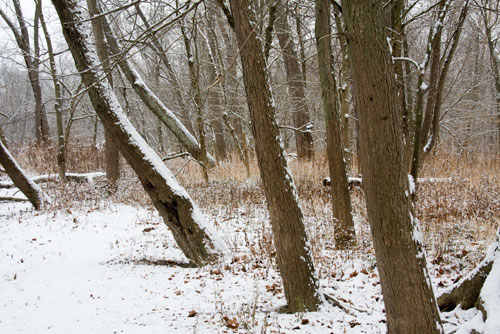
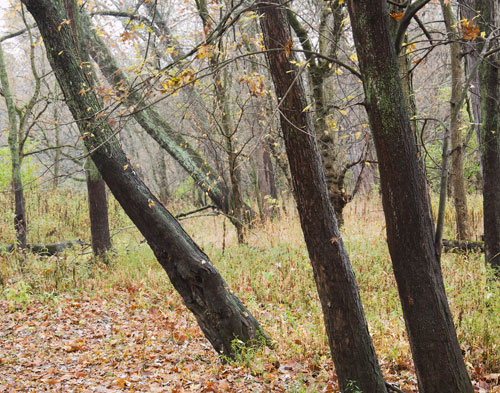
My friend Becky and I went to Fort Harrison State Park the other day to see what there was to see and photograph.trees_7880_2

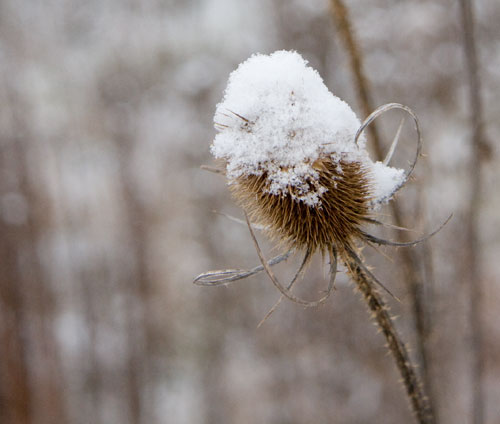
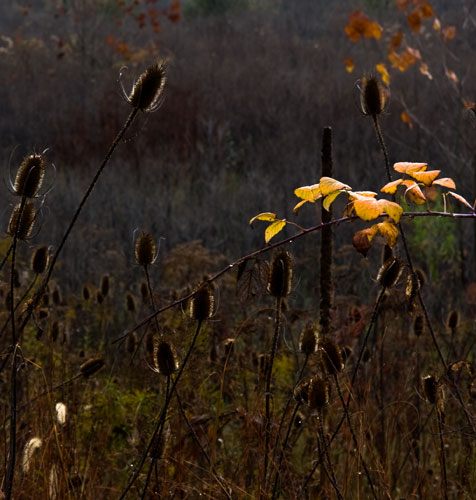
I find that sometimes it’s good to go out with someone else; each of us sees things the other doesn’t.  This doesn’t mean, though, that we end up shooting the same scenes.  Sure, there are some shots that are very similar to one another but the majority aren’t.  We could be standing side by side and the shots would still be very different.teasel_7765

The conversation was good and the shooting opportunities were plentiful.  It is always a source of wonder to me that what I bring back from one of these jaunts is nothing like what I would have anticipated getting.  So I usually just don’t try to anticipate.  Great encouragement for living in the moment.trees_7635_3

It is in those moments in the present that the connection is felt.  After a while the dialog with Becky drops off to brief exchanges as we walk from one place to another and the dialog with the scene picks up.  I have no idea what the content of that dialog is, it obviously isn’t words.  But it is there and it is in the connection.  I’m coming to think that these felt connections are traces and hints of our spiritual identity making contact with the world.  It is something to celebrate.backlight_7800_2