Smorgasbord day

Today I went out without any specific focus, in fact I was trying to avoid any preconceived notions of what I would shoot.


It’s a day in autumn so color would be part of it.

Not a day to be hung up on any particular theme except autumn.


That’s enough of the puns, visual and otherwise.


I wondered around a patch of milkweed;  they are coming along.


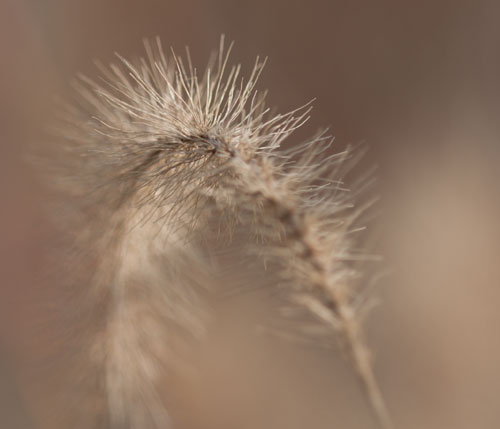
I used to be in R&D at AT&T and then at Lucent Technologies.  In other words, the telephone business.  When I first saw these teasels with the spider web connecting them, it seemed to represent a communications network.  I guess that isn’t a pun but a metaphor.


Teasels are easier to work with than some people.  Not as communicative though.

An appreciation of milkweed

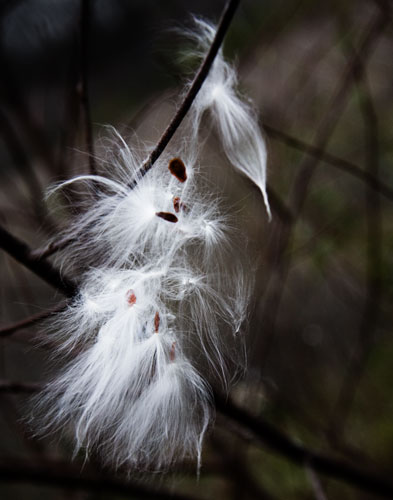
Yesterday I talked about the utility of milkweed – habitat for monarch butterflies, substitute for kapok in World War II – and said I would go back today to gather seeds for our butterfly garden.  I did that.  It was breezy and since I had my camera with me I planted it in front of a nice strand of milkweed floss and took a lot of shots as it danced in the breeze.milkweed_8662

It is easy to walk by milkweed and to notice the floss and seeds in only the most pedestrian way.  Unless we are looking, truly looking, they won’t occupy more than a moment of thought; visually, just a glimpse.

These little creations are striking when you take the time to look at them.  I could go on and on about this but I think the best tribute to them is just to show a few shots.  Words just can’t capture their subtlety and beauty.  (In each case I have darkened the background somewhat to help them stand out.)
milkweed_8637_2

milkweed_8634_2

milkweed_8620_2

They speak for themselves.

Milkweed then and now

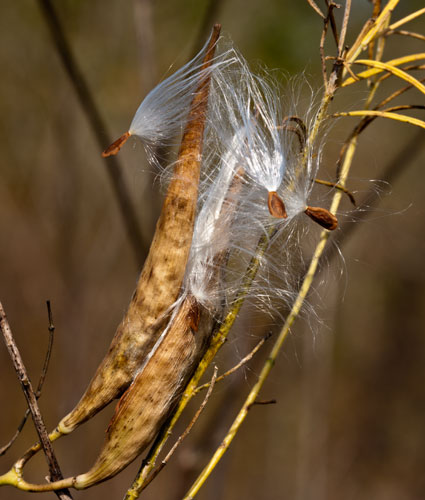
Nice overcast sky today and the breeze wasn’t particularly strong so I went out to shoot milkweed.  Milkweed is a favorite subject this time of year, it stands still and the variations in form, texture and luminosity go on and on.Milkweed_8539

Milkweed is valuable today as habitat for monarch butterflies.  My wife reminded me of that and I expect I’ll be going back tomorrow to collect some seeds for our butterfly garden.

In 1944, in World War II, milkweed took on another kind of importance.  The Japanese controlled what today is called Indonesia and that meant they had control of the kapok crop.  Like milkweed, kapok produces a floss that was the main component in making flotation devices such as life jackets and life preservers.  With a lot of the war fought on and over the seas, kapok, and its loss to the Allies, was very important.

Milkweed produces its own floss and it works about as well as kapok.  Unfortunately milkweed was not a commercial crop and so people had to go out into the countryside to gather the seed pods before they burst open in the fall.  With adults off to war or working in the factories, it was up to school children to gather this crop valuable to the war effort.  I remember going out with my aunts and uncles (in junior high and high school) to gather them.  I was five years old at the time.  We knew it was important and a lot of work went into it.  I have no idea how much we gathered.  I do remember the large onion sacks bulging with milkweed pods.  We were doing our part and I got a chance to do something important with the big kids.Milkweed_8526

It will likely rain tomorrow but I will probably go collect milkweed seeds anyway.