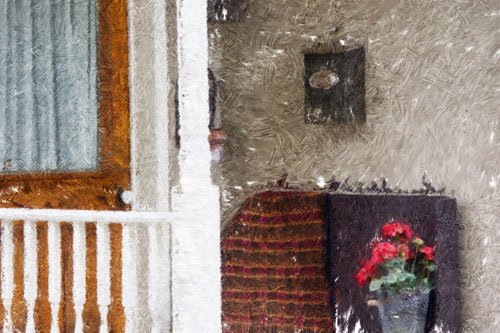
Learning more about painting photographs

I’ve found that learning often progresses by spurts followed by a leveling off and then, if I keep at, another spurt and more leveling off.  The longer I’m at it, the more time elapses before the next spurt.  Right now I’m early in the process of learning to use Corel Painter Essentials 4, a paint program that, with a lot of choices on the user’s part, can turn a photograph into what looks like a painting.


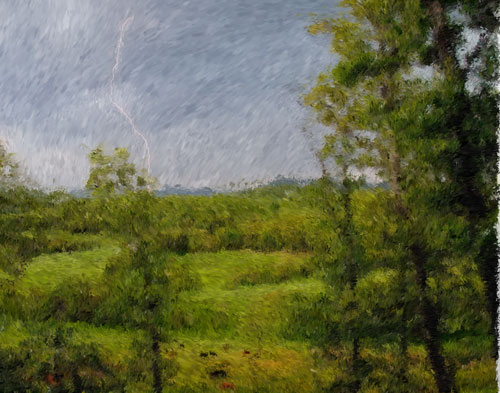
This image (above) started out as a photograph of a tree in a rock wall along the Buffalo National River in Arkansas.  Below is a spring storm on that same trip.

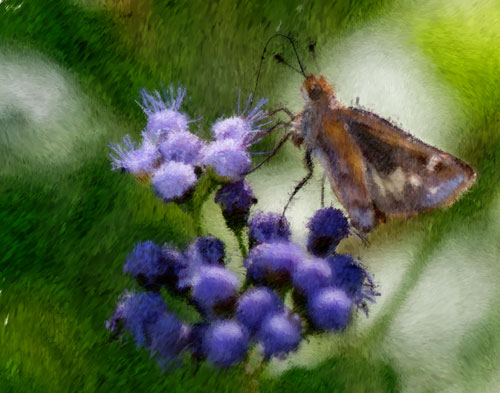
Here’s a hummingbird coming in to feed.


I do like this program.  And for all my complaining it isn’t hard, it just takes getting used to.

There are programs (apps) for the iPhone that do amazing things with photographs taken with the iPhone.  All the work is done in the phone and it is surprisingly good.  To see some good examples, click on the link to see Rad Drew’s work.  Be sure to look at the whole album.  For my part, I’m not tempted (yet) to get an iPhone.  I am happy to play with Photoshop and Painter Essentials.


Can’t go anywhere with my wife without seeing quilts of some kind:

I am still working on this one.


Actually I’m still working on all of them.
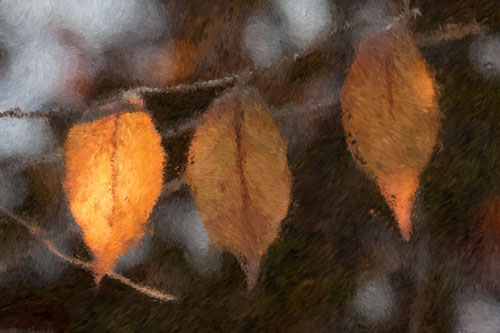

And I’m starting to see image possibilities with a view toward doing these ‘paintings’. More about that later.

Practice painting

Since I downloaded Corel Painter Essentials 4 I’ve been practicing with it, working at getting a feel for it.


When I’m working with Photoshop I have a pretty good idea what the effect of a particular manipulation will be.  I plan it, do it, and most of the time, there it is.  The situation with this paint program is quite different.


I don’t have a feel for this program yet.  I can’t predict what will happen when I push the button and when I can, it is often an effect I don’t want, but I have to try it to be sure. This is nothing to complain about, it is part of the process and I have to keep at it.


The rewards are there often enough to justify the effort.  Back when I taught psychology, we would talk about a random reinforcement schedule.  The rat presses the bar repeatedly but food is delivered after a random number of bar presses.  The rat works hard under this condition.  So do I.


It’s been 35 years or so since I taught regularly and I haven’t been keeping up with the literature and I wonder if the rats work better while listening to Stan Kenton.  I do.


By no means do I want this to sound as if it is drudgery.  It is not.  I’m enjoying myself but I do look forward to being able to predict the effect of a combination of painting type (oil, modern, impressionist, etc.) with brush type (smeary round, captured bristle, broad water, gritty charcoal, etc.) and color rendition (chalk, high contrast, intense, watercolor, etc.).  How do we get to Carnegie Hall?  Practice, practice, practice.