New Year’s Eve Day

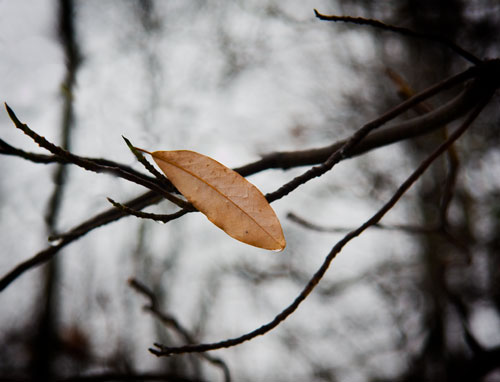
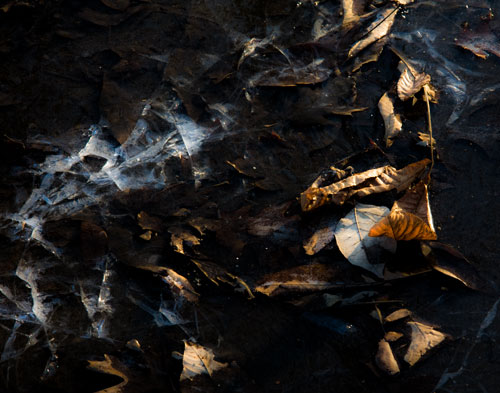
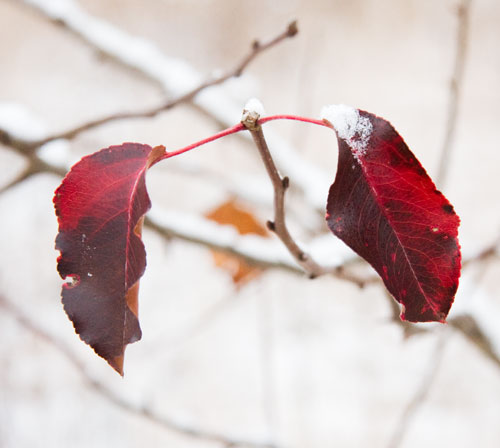
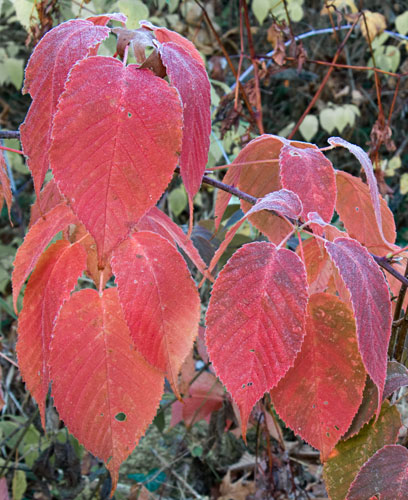
Last day of the year.  My photography buddy Becky and I went to the grounds of the Indianapolis Museum of Art to see what was up for shooting.  We stopped next to the tree with these leaves because they looked interesting.

There are lots of interesting areas at the IMA and I don’t know that this one is intrinsically any more interesting than any other except that these leaves caught my attention.  Neither one of us anticipated that we would spend all of our shooting time this morning within a 30 yard radius of this tree.

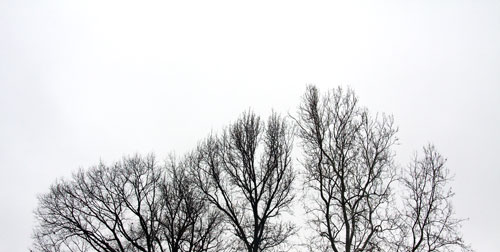
I liked these tree tops.

And this leaf.

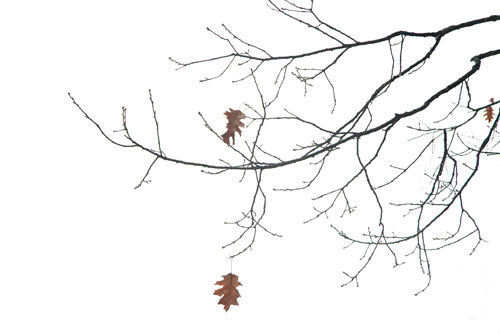
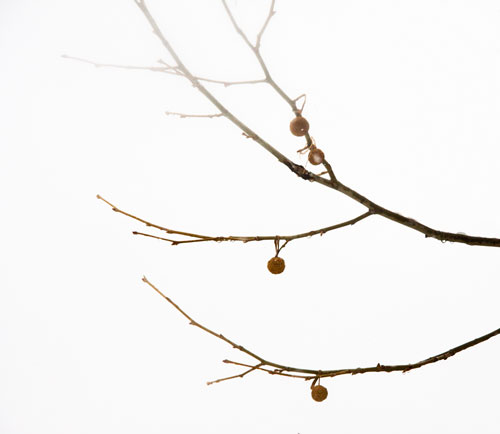
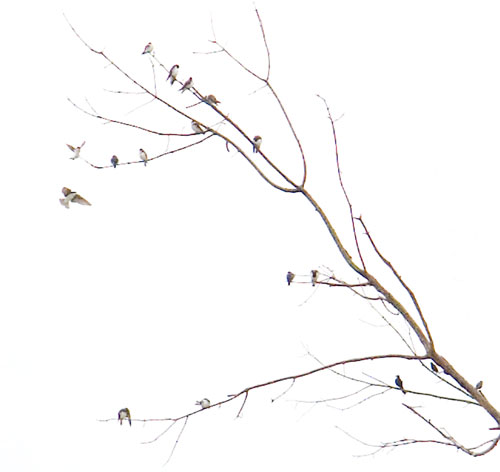
The day was quite overcast but I have found that a gray sky can be a plus.  I shot these oak leaves and branches and then forced the gray sky to white in  Photoshop.  It produces a somewhat painterly effect.  I removed some of the branches; it seemed to want to be a simpler image.  I may remove more before I’m through.

By many criteria – it was muddy, cold and damp – it was not very pleasant but it was well worth it to cap off the year with a shooting day like this one.

A snowy day

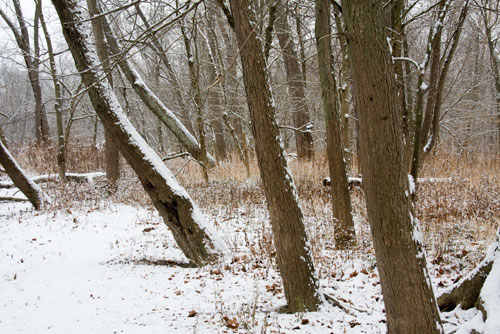
My friend Becky and I went to Fort Harrison State Park on Saturday to shoot in the snow. 

It was in the low 30’s and it came down as snow rather than rain.

We wandered (and wondered) around the park getting the usual winter shots and looking for something out of the ordinary.  We could hear guns in the distance; it wasn’t target practice and guessed it must be hunters.  They were pretty far away and we could ignore them. 

The sky behind the branches in this image was gray, but pushing it to white in Photoshop gave the image a painterly quality I have always liked.  I would like to make a card of it and say something profound on it but nothing like that occurs to me so I’ll leave it as an image.

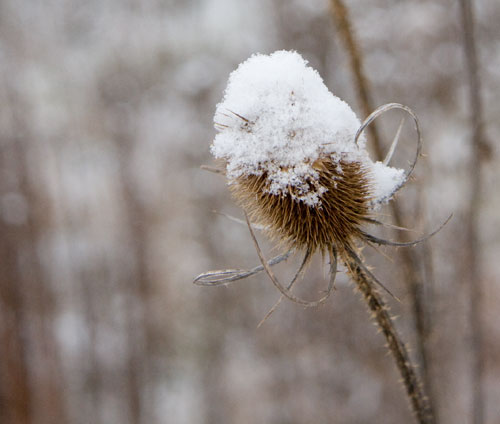
As we wander about, I recommend shots to Becky and she recommends some to me.  Here is one she suggested.

She gets good ideas.

After about an hour and a half I was soaked and ready to go home.  Becky said she would stay and poke around the park some more.  She called me later to say that she found out what the gunfire had been about.  A re-enactment of a World War II American/German battle was just ending and Becky was right there.  She got some pretty unusual shots for a snowy day at a state park.

I’ll dress more warmly next time and hang out longer for the better shots.

Winter

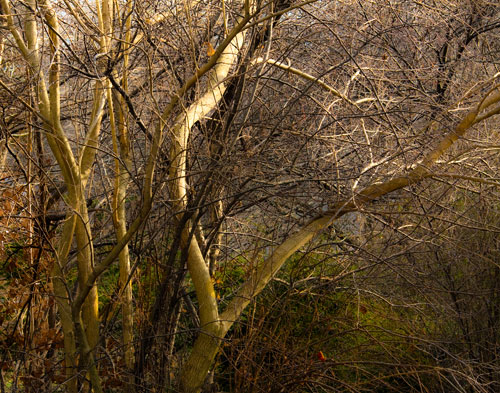
Alright, it isn’t technically winter, being the 18th, but we are close enough.  I don’t think the plant life knows the difference, being asleep and all.  Leaves are down about as much as they are going to be although there are some that will hang on through the winter.  Here, for example, is Japanese honeysuckle, which is an invasive species that we need to keep under control.  But on a day like this, with its leaves just so, it can be beautiful.

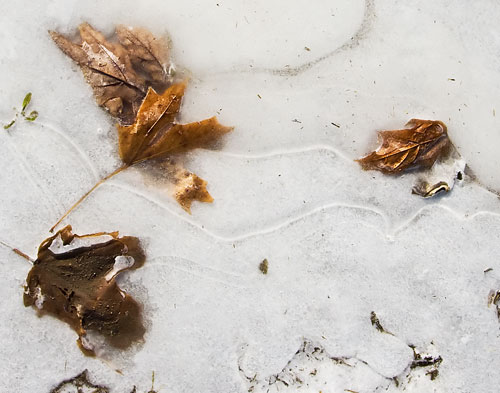
Ice with leaves can be beautiful too.  I’m coming to like this season.

The forecast for tomorrow is snow in the morning.  The plan for tomorrow is to go shoot in the morning.

Being right here in the present

I read an article in the online edition of the Washington Post this morning making the point that a lot of people are being seduced by technology and are spending more time than ever texting, Twittering, talking on a cell phone, or just sitting in front of a computer (which is what I am doing now).  If they are out and about doing all this stuff, that means they are not as available to what is going on around them as they would be if they were not engaged with all of that technology.

Lots of folks believe they can successfully ‘multitask’ and they do generally avoid major problems but I can personally attest that multitasking reduces the margin for safety.  I made this observation as the car next to me was pushed into my car broadside by someone who ran a red light because he was on a cell phone.  No one was injured.  The data show that multitasking is not a good idea.

Multitasking is a vote against being here (right here in this physical place) in the present.  A vote in the sense that we make choices and the choice of the multitasker is to not be entirely here.  A college professor friend of mine says that he walks around the room as he is teaching a class because if he stays at the front of the room, the people at the back will be texting.  He would rather they didn’t.

I don’t want this post to be a rant.  The point I am building toward is that photography, for me, demands that I be fully present to get the most out of it.  And that isn’t just being present with a camera in hand but as much of the rest of the time as possible because the eye is constantly looking for image potential.  Some of my most memorable images were ones I didn’t take (the ones that got away?)

The image below, one I got yesterday, wouldn’t have been made if I had been on the phone as I was looking around.  It was fleeting and in its context, more subtle than it appears.  It’s funny that with all its busyness, it is a kind of symbol for multitasking. 

I know I wouldn’t have seen these leaves in the ice if I had been on the phone.

It’s been warm the last few days and it is getting cold tonight so there will be more leaves to photograph tomorrow.  If you call me, leave a message;  I won’t be near a phone.

Don’t drive, photograph

‘Hazardous road conditions…., pileups at ……, ambulance called to the scene…, slippery side streets…’   We had an inch of snow in Indianapolis yesterday.  Don’t get me wrong, this kind of havoc is not particular to this part of the country.  Several years ago we lived near Syracuse, NY and before that we lived in Maine.  Same behavior all over in the first snow of the season.  So I drove carefully on my way to photograph how the snow had changed the scene.

There was just enough snow to make it interesting.  The snowfall yesterday accounted for all the snow so far this month and it is always a surprise to see what it adds for the photographer.

The snow tends to simplify the scene as it offers contrast.  Given that it is fleeting, it’s a good idea to get out there not long after it falls.  I suppose I could say we need to strike while the iron is hot, but that idiom is probably not the best choice for talking about ephemeral snow. 

It is beautiful, isn’t it?  I suppose it is all just physics that causes the individual flakes to accumulate the way they do but that doesn’t account for the experience of seeing it, especially the first snow of the season.  It is fresh, it signals a change in season, it decorates and it vanishes.

I’ve photographed this scene several times in the summer and fall but nothing I have done previously compares with the opportunity I had here.  The snow set it off in just the right way and the water was calm enough for the reflection to work.

Irenaeus, a Christian bishop in about the year 200 CE said ‘the glory of God is the human being, fully alive.’  Getting the opportunity to photograph this snow and especially the trees reflected in Fall Creek brought me to, what for me, was an uncommon level of aliveness, which, like the snow, was ephemeral.

It is raining as I write this.  The snow is gone.  But looking at the weather forecast, we may get some more snow in the next few days.  Some more snow would be nice; a lot more is maybe not so good.  Moderation in all things.

New lens

The new lens showed up Thursday and I had it out Friday, first at the bark park where I take the dogs to play and then at a park in Carmel, a little north of Indianapolis.  This is a Sigma 120 – 400 mm f/4.5-5.6 lens with optical stabilization, which means the lens can compensate to an extent for shaky hands.
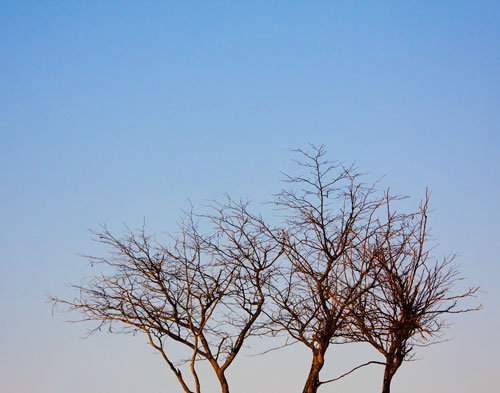
The tree tops were about 80 yards away and the lens was out at 400 mm, hand held.  The lens performed beyond my expectations, I thought there would be significant blurring but there wasn’t.  This lens is going to be a lot of fun.

Here’s the moon, again with the camera and lens hand held.  I’ve never used a lens this long.  The lenses I was used to left a lot to the imagination when photographing the moon, the images were so small.
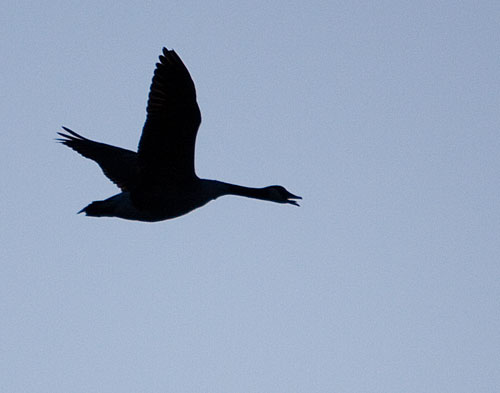
I’ve wanted to get an image of a goose in flight; our church has adopted the Celtic view of the Holy Spirit as something wild and unpredictable, a wild goose.  The first problem was finding the goose in the sky.  It’s one thing to spot it with two eyes and something else to look for it through a long lens.  Next time I’ll open the aperture up a couple of stops to get the color of the goose rather than just a silhouette.

The park in Carmel was very nice, well worth going back to.  Now if I could just remember how to get there.
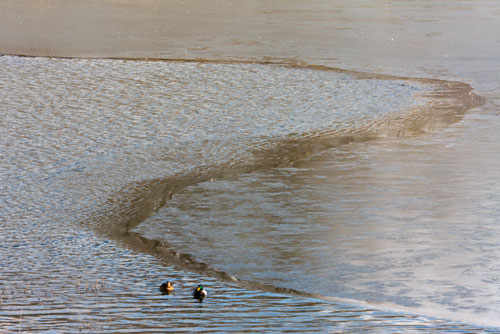
It was cold enough that there was some ice on the water but it wasn’t so cold that it was uncomfortable, probably somewhere in the upper 20’s.  This was when I learned that as much as I like the performance of this lens, it sucks up a good bit of power, especially in cold weather when batteries are especially prone to fail.  A second battery was all that was needed.  I have four altogether and they will all be charged and ready to go any time I go out in cold weather with this lens.

I’ve never had a shot this good of ducks.
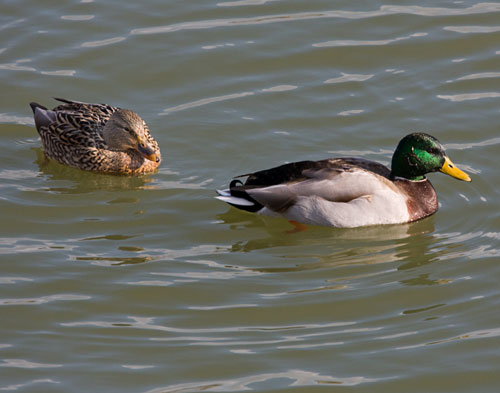
Again, the lens performed very well.

It’s interesting to go out with a new lens that extends capability the way this 400 mm lens did for me.  After a few shots, I start to see the world with this lens in mind and the image possibilities start to multiply.  I never would have thought of making most of the images here before I got this lens.  The world has become a bigger place.

Now, if I can just find that robin that started this whole business of a long lens.

I need a new lens

Golf was one of my dad’s favorite occupations for a good bit of his life.  He and my mother had a house that backed onto a golf course and Pop spent a lot of time out there.  Every once in a while, accompanied I’m going to guess, by a slump in performance, he would say he needed new clubs.  Just to see what he would say, we would ask why he needed new ones, since he had a perfectly good set of clubs already.  He always had an answer to that, and what it lacked in logic,  it more than made up for in conviction.  He got new clubs and he was happy.

I’ve gone for several years with a 17 – 85 mm zoom as the main lens for my Canon digital cameras, first a 20D and now a 40D.  This has worked just fine, even in situations where others might have wanted a longer telephoto lens.  The reason it worked, is that it produced a result that I liked, a rather painterly effect rather than a tack sharp image. 

The image of this reddish egret, shot on Sanibel Island in Florida, accounted for about 10% of the raw image file in size.  Blown up to 15 inches or so, I find it appealing but definitely not sharp.

The same is true for these birds photographed at Muscatatuck National Wildlife Refuge in Indiana.  Seen printed on matte paper, it is hard to tell if they were painted or photographed.

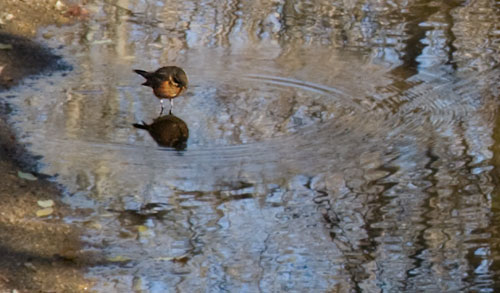
I was out yesterday and saw some robins about 40 feet away (I’m guessing here) bathing in a stream.  I wanted to get them creating circles of ripples as they cleaned themselves and I wanted it sharp.  Naturally they left as I was setting up the camera and tripod.  I was patient though, and they came back. 

I got in a few shots before they left altogether.  Yes, I did get pretty much what I wanted although it would have been better to get the reflection of the head inside the inner ring.  The image is fairly sharp but the problem is it is small.  Cropped out of an image 3888 by 2592 pixels, this image was 619 by 362 pixels, or a little over 2% of the total area of the original.   In other words, pretty small.  This lens is not doing the job.  I need a larger one.

Pop, if you can hear me wherever you are, would you give me a few pointers on making the case for this new lens?

Go to Plan B

The plan yesterday morning was to go out and shoot, come back in and write about it.  I did go out and shoot and I did come back in but that’s when the disappointment started.  raspberry_leaves_8724

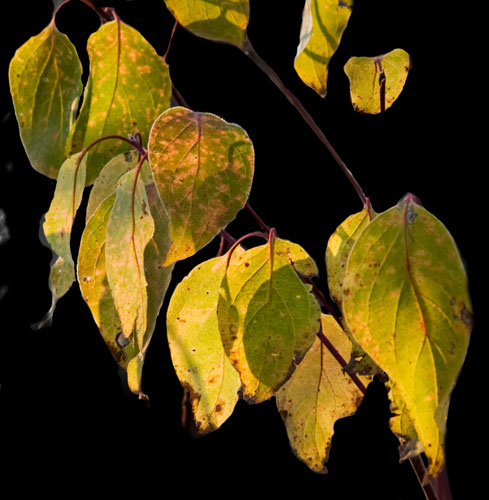
The images were ‘nice’ but not something I would want to hang on the wall or even show anyone.  (So why am I showing them to you?  Stay tuned.)  It wasn’t as if there were no subjects.  Black raspberry leaves in the fall are gorgeous and backlit golden leaves can be treasures.leaves_8747

But that just didn’t seem enough.  These were standard, garden variety fall pictures.  Big deal.

I went to the camera club meeting last night and didn’t have great hopes for that either.  We were going to shoot indoors.  There would be models and good lighting, as well as a set up for macro photography.   These were some fine opportunities but I thought instead I would take my camera and tripod outside.  It was dark and lights were showing up some interesting opportunities.   night_8933

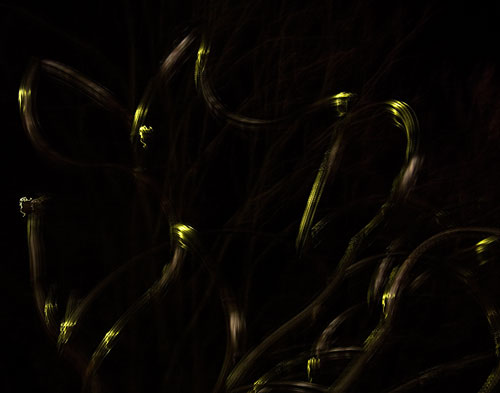
This was a lot better.  I was not able to previsualize what I would get before I opened the shutter, I was just hoping for something interesting (and undefined).night_8957

And that made it a lot more fun.

An appreciation of milkweed

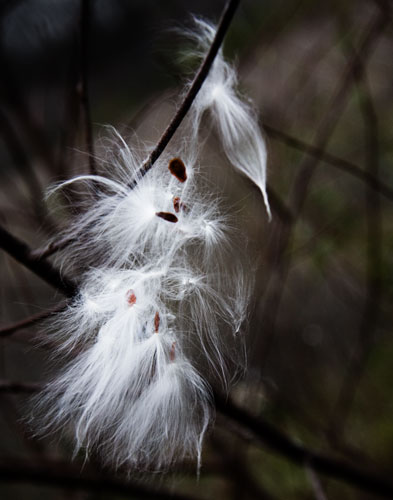
Yesterday I talked about the utility of milkweed – habitat for monarch butterflies, substitute for kapok in World War II – and said I would go back today to gather seeds for our butterfly garden.  I did that.  It was breezy and since I had my camera with me I planted it in front of a nice strand of milkweed floss and took a lot of shots as it danced in the breeze.milkweed_8662

It is easy to walk by milkweed and to notice the floss and seeds in only the most pedestrian way.  Unless we are looking, truly looking, they won’t occupy more than a moment of thought; visually, just a glimpse.

These little creations are striking when you take the time to look at them.  I could go on and on about this but I think the best tribute to them is just to show a few shots.  Words just can’t capture their subtlety and beauty.  (In each case I have darkened the background somewhat to help them stand out.)
milkweed_8637_2

milkweed_8634_2

milkweed_8620_2

They speak for themselves.

Milkweed then and now

Nice overcast sky today and the breeze wasn’t particularly strong so I went out to shoot milkweed.  Milkweed is a favorite subject this time of year, it stands still and the variations in form, texture and luminosity go on and on.Milkweed_8539

Milkweed is valuable today as habitat for monarch butterflies.  My wife reminded me of that and I expect I’ll be going back tomorrow to collect some seeds for our butterfly garden.

In 1944, in World War II, milkweed took on another kind of importance.  The Japanese controlled what today is called Indonesia and that meant they had control of the kapok crop.  Like milkweed, kapok produces a floss that was the main component in making flotation devices such as life jackets and life preservers.  With a lot of the war fought on and over the seas, kapok, and its loss to the Allies, was very important.

Milkweed produces its own floss and it works about as well as kapok.  Unfortunately milkweed was not a commercial crop and so people had to go out into the countryside to gather the seed pods before they burst open in the fall.  With adults off to war or working in the factories, it was up to school children to gather this crop valuable to the war effort.  I remember going out with my aunts and uncles (in junior high and high school) to gather them.  I was five years old at the time.  We knew it was important and a lot of work went into it.  I have no idea how much we gathered.  I do remember the large onion sacks bulging with milkweed pods.  We were doing our part and I got a chance to do something important with the big kids.Milkweed_8526

It will likely rain tomorrow but I will probably go collect milkweed seeds anyway.