I couldn’t help myself

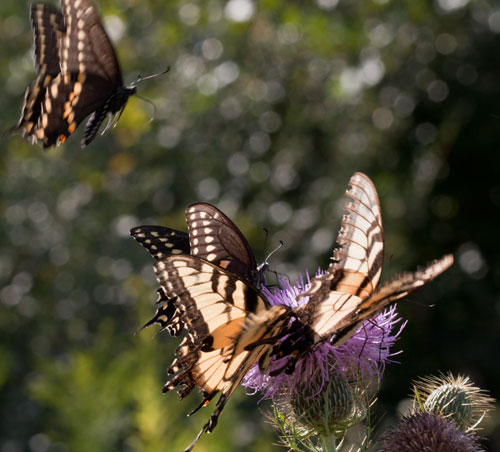
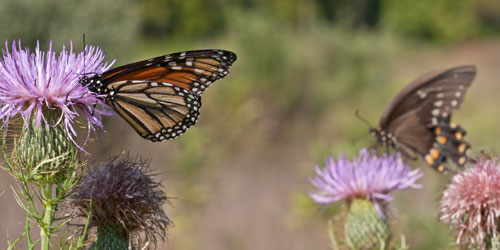
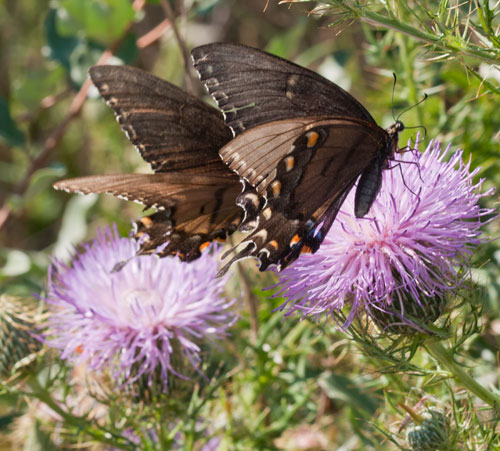
Having published eight images of butterflies in the last couple of days it was time to give them a rest.  Time to move on to other subjects.
Weeds make fine images, lots of texture and even a little drama.  Flowers are good too.

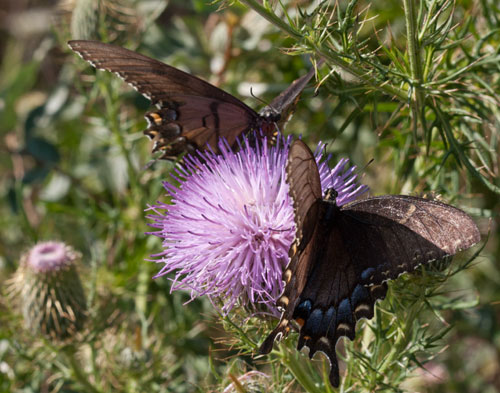
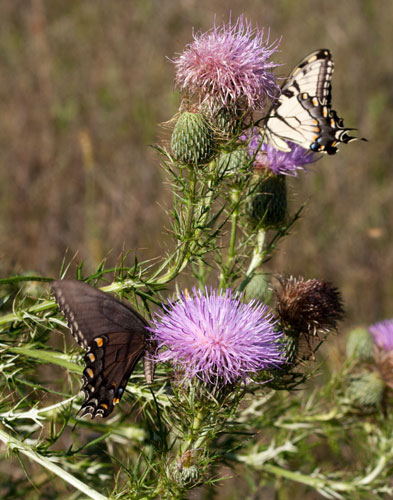
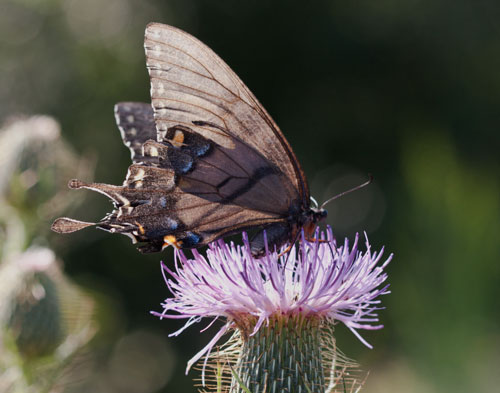
But despite hundreds of acres of foliage, water, birds, etc. at Fort Harrison State Park, I went right back to the butterflies.


They just kept coming.

You may not be able to count them all, but there are nine butterflies in this image:

I suppose I could have called some friends and asked them to talk me out of it but they would have wanted to come along too.

My name is Barry.  I photograph butterflies.

More butterflies

Here are some more butterflies from Fort Harrison State Park yesterday.


Later this morning I’ll go see if the butterflies are still there.  That will be part of the trip, but it is time to look for something new as well.  But I’ll still check out the butterflies.

Gifts: Today it was things with wings

It was William James who spoke of the ‘slow dead heave of the will’ and boy, did that expression come home to me this morning.  I was getting ready to go see my mother and I thought I would stop off at Fort Harrison State Park on the way home and shoot what there was to shoot (with a camera).  I had a good visit with Mom and then it started: do I really want to go shoot or not?  What was I going to shoot?  What would be interesting?  Anything?  Maybe I won’t go.  I’ll go tomorrow.  You get the idea.  And the moral of the story is that the head should not be in charge of some decisions.  Sometimes it is best just to go do it.  Which I did.

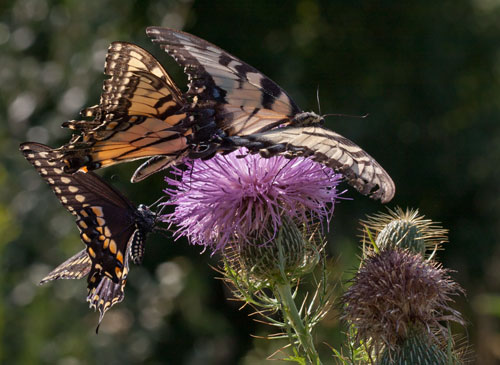
I went over near the walnut plantation and was roaming around among the weeds and I came upon a good sized thistle with lots of blooms and on many of the blooms there was a butterfly.


Hoo boy!  This is the good stuff!  Fortunately the camera was in burst mode where all I had to do was point it and hold the button down and it would take up to six and a half frames a second.  Butterflies were coming and going and everything was changing from one moment to the next.


Bumblebees were getting into the act as well.

And that was when the Canada geese showed up.


Yes, the moon was right there.  I will admit I didn’t even notice it until much later.  Some days we’re just lucky, which is nice because it balances out some of those other days.

To shoot or not to shoot is no longer the question.  My hero is Elwood P. Dowd, the Jimmy Stewart character in the movie ‘Harvey.’   If someone said the two of them ought to go for a drink sometime, Elwood would reply ‘When?’

Photography, haiku, haiga

How often does it happen that you see something, want others to see it too, make a picture of it, and then get it in front of people?  A lot of the time I would guess.  Certainly the millions of photos online are evidence of that wish.  People are saying ‘I shot this, I’m proud of it and I want you to see it.’   I feel the same way.

I was watching a video of Jane Reichhold (highly recommended), an American master of haiku, and the same point came up there.  She said

‘And the way you know a haiku is lurking about is if you see something and say oh!  I want to show that to somebody!’

The way a leaf is falling from a tree, the colors in a sunset, a mother playing with a child and as many other examples as we can think of all point to the same thing:  we see something beautiful or interesting and we want to share it with others in a creative way.  That is true of many of the arts that work in the present but right now I’m thinking especially of photography and haiku.  Photography has little choice but to operate in the present moment and haiku is written in present tense.  It also shares with photography the intention of capturing a moment.  Both are typically achieved quickly at least to the level of the first draft.

We all learned that haiku consists of 17 syllables in a 5, 7, 5 arrangement.  It is true that Japanese haiku consists of 17 sound units in that arrangement but the problem is that Japanese sound units don’t translate directly into English syllables.  For example the word ‘Tokyo’ is three English syllables while it is four sound units in Japanese.  Seventeen syllables would generally be about one third too many in English so a shorter poem is needed here.  Jane Reichhold recommends fewer than 17 in a short, long, short arrangement.  Other English haiku experts simply recommend keeping it short, abandoning the short, long, short recommendation.  Two recommendation that are pretty consistent among experts are that the haiku consist of a (long) phrase and a (short) fragment and that it not be a sentence.  For example:

last fleeting gift
of the sun
cricket song

‘last fleeting gift of the sun’ is the phrase and ‘cricket song’ is the fragment.  What is that haiku saying to you?

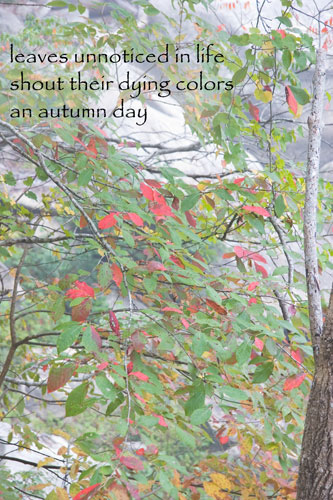
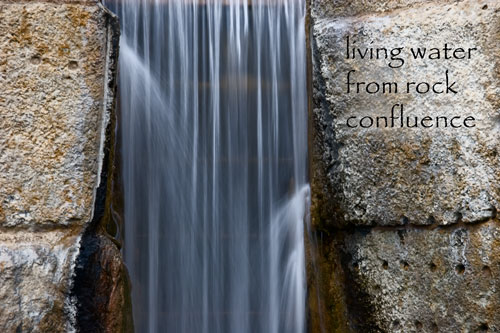
Working in both photography and haiku can produce an interesting combination known as haiga which most simply is image plus haiku.

Some of my images seem to beg for companionship with words.  They seem complete in themselves but they also appear to want something more.  I ran across the idea of haiga  not long ago.  You’ve undoubtedly seen Japanese paintings with calligraphy; the writing is likely haiku; the painting plus the haiku is haiga.  This form is gaining popularity in Western countries and I’ve been experimenting with it recently.last_rays_8922_2

Did your interpretation of the haiku change as a result of pairing it with an image?

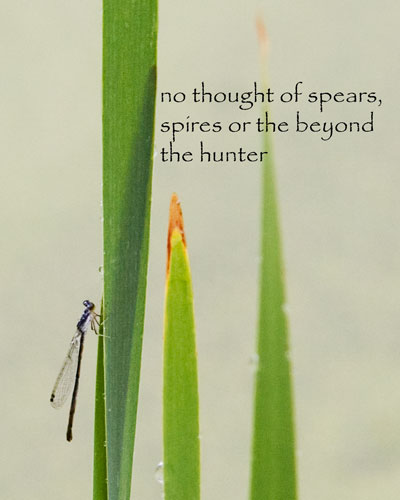
Here are some more examples.
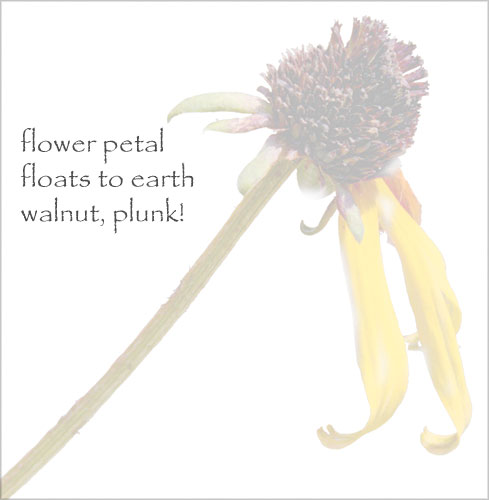

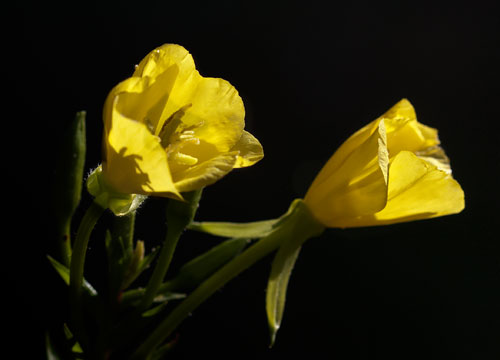
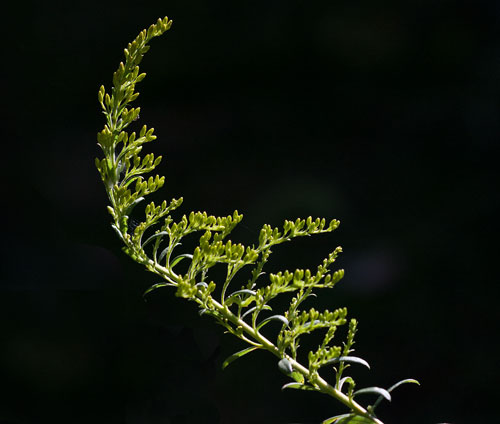
Here the remaining part of the flower (minus the petals) even looks a bit like a walnut.  We have a couple of walnut trees in our front yard and they do make a lot of noise when they fall from the trees and hit the driveway.  Flower petals, not so much.


Confluence here is intended in at least two ways.

On reflection, I don’t know that what I have written would qualify as haiku and I don’t think I really care if I am following a specific form.  The important thing is to get started and work at distilling a thought or a scene into a few words, and if it seems appropriate, pair it with an image.  I enjoy it, you might too.

Meanwhile, back at the Indianapolis Art Center

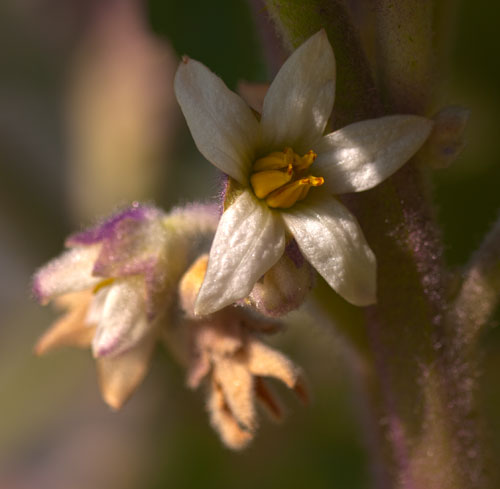
Our camera club meets at the Indianapolis Art Center every week.  I often go early with my camera looking for opportunities.  I had shot flowers on this plant two weeks in a row and I was over there again this morning to shoot this flower.  I have come back to this plant four times.


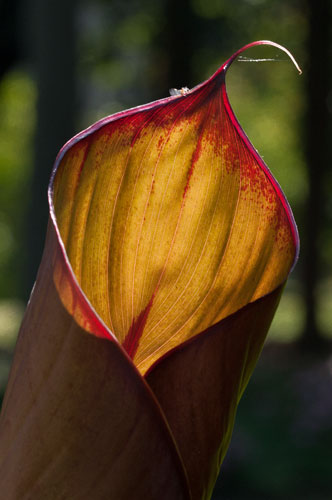
This is a rather small flower, probably less than an inch from the tip of one petal to that of another and it was under a rather large leaf.  But there it was and I kept coming back.  I can’t identify the plant, it is probably exotic, perhaps from Africa or Asia.  Here is the leaf in case you can help identify it – it is about a foot long.


Interesting how one flower can capture us and bring us back repeatedly.  Fortunately it stays fresh for several days.

It was breezy this morning and elsewhere on the grounds of the Art Center these large leaves were waving in the breeze.  I don’t know what plant this is either, the leaves were about three feet long.

That is a new leaf unfurling in front of a mature leaf.  Shooting up close with the the wind blowing the leaves around made for a crap shoot as far as any given image was concerned but with a digital camera and a large CF card, I could take several pictures.  I hate to think of shooting with film under these conditions, one or two shots would have had to suffice; film is expensive.

Here is the mature leaf by itself:


And the new leaf alone:

Worth waiting for.

It was a good morning and I went home satisfied that I had more than I expected to get.  But I will still go back again for that special flower:


One small technical note: both flower shots are actually comprised of three images each shot at different exposures.  They were assembled with the High Dynamic Range tools in Photoshop CS5.  That software is doing its job.

No good excuse

I’ve been away from posting for nearly two months.  Where has the time gone?  And why away at all?  No good reason – I didn’t feel like it.  In fact I preach doing what you love even when you don’t feel like it and I guess I had better pay attention to that.  I suppose that sentence is a bit self contradictory but I think you know what I mean.  What got me going again were two women.  One was Elizabeth Gilbert talking about creativity in the outstanding series of talks available at www.ted.com.  She was making exactly that point – that it is important to keep going with your creative effort whether you feel like it or not.  Well worth seeing.

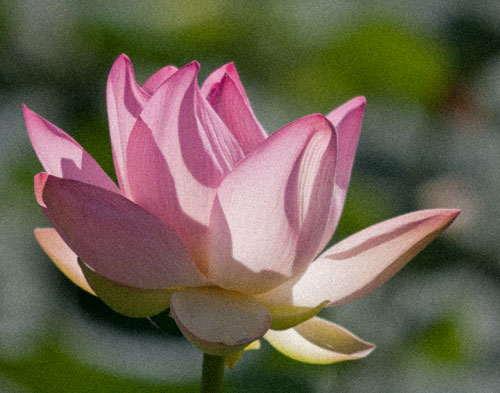
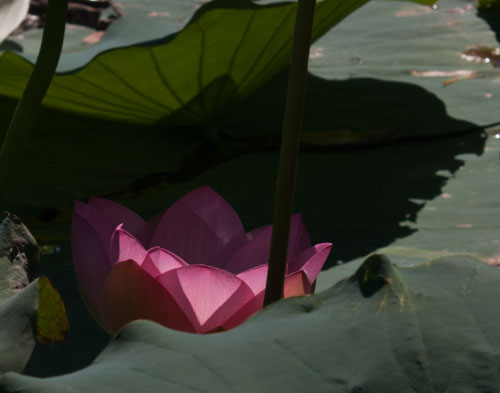
The other woman was my friend Becky who said ‘hey, let’s go shoot some lotus blossoms.’  So we did.


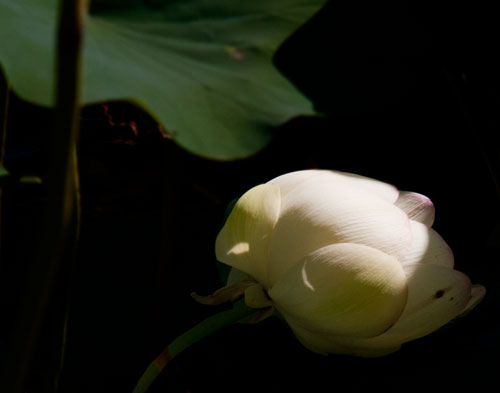
It was a good day for shooting. I say ‘good’ because it was sunny but the light was not too intense and, especially, because we were enjoying a break from a long spell of hot weather.


I keep coming back to images with a lot of light and heavy shadow.


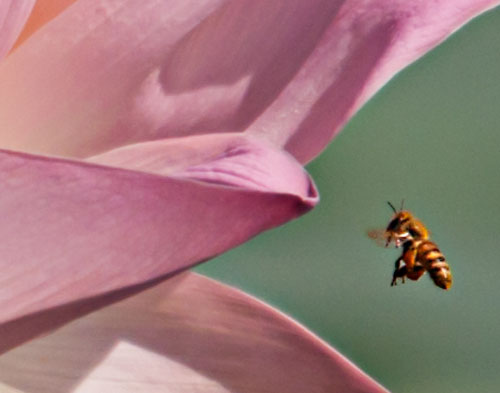
And the bees keep coming back to the blossoms.


More later.  Not much later, I hope.

100 Acres IMA part 2

Our camera club went to the 100 Acres at the Indianapolis Museum of Art last night.  It was almost as much fun watching everyone else shoot as it was to take pictures myself.  Photographers are generally pretty careful about getting in one another’s way but it will happen from time to time.  No loss here, I kind of like it.

These two rings cast shadows exactly superimposed on one another on the ground at the summer equinox.  The rest of the year they are simply interesting to see.

There is a 35 acre lake as part of the 100 acres.  That is where I spent most of my time this trip.

This is called the I-Land, an experimental living space in the middle of the lake.  Two art students are living there this summer.  They, working with Andrea Zittel, the artist who designed it, will modify it in light of their needs.  It is made of fiberglass and is mounted on a small constructed island.

In the midst of exciting modern art we still find examples of art that has been with us how long?  Since before there were humans.

Into the wilds of Ohio

I grew up in southwestern Pennsylvania and the view from Interstate 70 going across Ohio gave the impression of one of the more cultivated states in the country.

Cultivated in the sense of land used for agriculture.  So I wasn’t ready for the Hocking Hills area, about an hour south of Columbus, where Ellie and I spent the last few days celebrating our 48th wedding anniversary.  It is very hilly and covered with forests.  We had a grand time.


There is a lot of sandstone in the area and a lot of gorges cut by streams.  Above, for example is a detail of Ash Cave which was a meeting place for early settlers and most likely before them, for Indian tribes.  And there are lots of waterfalls, the one below is in Conkle’s Hollow.

Ellie being a quilter meant that we looked up quilt shops in the area which gave me the opportunity to wander around the alleys of Nelsonville.

I think that is a set of bars over a window covered with wood.

The Fourth of July is on its way and this flag was near a country quilt shop Ellie found.

We can recommend the Hocking Hills area of Ohio as an excellent place for a get away.  We’ll be going back.

Visiting the 100 Acres

Photo Venture Camera Club, the club I belong to, schedules trips around town to areas of interest to photographers.  The Indianapolis Museum of Art recently opened 100 Acres IMA, an area rich in opportunities for engagement and, for the most part, interaction with large scale art works.  Becky and I went over to scout it out before scheduling our next meeting there.

Interaction with large scale art works.  I got there before Becky and was wandering around shooting whatever caught my eye.  I wanted to get an abstract image of metal and shadow at the first exhibit from the parking lot but kids kept getting in the way.

There’s one of the little critters over to the right in the image above.  His dad is watching from the left.  I tried to out-wait them but they kept showing up.

Here’s one dropping out the sky (although not very far).  It slowly dawned on me that whatever other reason the kids were there, they were also there as teachers.  They knew what to do here, it is not to ‘interact’ but to play.  A much simpler word and far more packed with meaning.  Time to play.

Becky got stuck in traffic and after awhile I sat down on a low wall in the shade to wait for her.  There was a gentleman already there and we struck up a conversation.  He was saying he was pretty tired from walking around the area (100 acres covers a lot of ground).  Then he allowed that he had worked out in the gym for an hour that morning and for someone 92 years of age that plus a long walk was indeed pretty tiring.   I think he was there to play too.

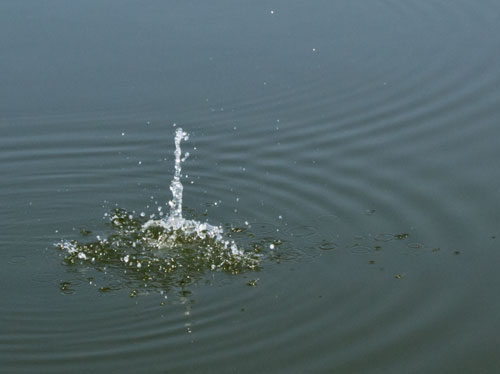
Becky showed up and off we went.  There is a good sized lake (30 acres I believe) and a young boy we saw knew just what to do with it.  He threw rocks into the water and I worked at photographing it.

Play.  I’ve been reading a book about how very creative people create.  A wide range of creative people are introduced ranging from Richard Feynman to Frank Zappa.  It is interesting to see how often the word ‘play’ comes up.  Play is central to the way some creative people work.  It is not a casual kind of play, rather it is intense.  But fun, and out of it, new relationships are discovered and presented.  Kids are pretty intense in their play as well and I suspect that is an important way for them to learn about the world.

I would like to say to my wife that I am off on a creative venture, one whose pure intent is creative work but she knows better.  She’s a quilter and she knows what fun is.

Go create.  Go have fun.

Imagine that

Every once in awhile I find it useful to stop and think about what digital image editing has made possible.  We go out and shoot and then bring the digital files home to the computer.  They are brought up in Photoshop or some other editing program.  In many cases the image is supposed to be pretty close to what was seen.  Contrast might be enhanced a bit, the brightness of the image raised or lowered a little, color is corrected and the image is sharpened.   The image is now ready to go and it does look rather like the original scene.  In other words, what was done was pretty much the digital counterpart to what might have been done in the darkroom a generation ago.

I put an image in my last post that was approached, from the very outset, in a radically different way.  Here’s the final image:

As I said at the time, I had taken the long route to the library.  This took me past a local hospital.

As soon as I saw this I knew what the final image would be.  It was virtually instantaneous.  No question arose about whether that final image was possible, the only questions were whether the clouds and light would still be good after I had gone home and come back with the camera (note to self: always take the camera with you).  They were.  I got this additional image to serve as a background.

I pulled the skyway out of the one image, put it in the other and masked out the ends of the skyway.  It took less than an hour.  What I imagined before taking any photographs was very similar to what I ended up with.

My studio (our daughter’s old room) is on the second floor of our house and I can see lots of trees out the window.  The light was coming up nicely early this morning and I could see that it would be possible to have a shot that emphasized the diagonal strip of light.  Here is what came out of the camera:

This was not what I had in mind.  I had envisioned a lot more contrast between the lighted area and the background.  I knew it wouldn’t show properly in the image as taken, it was  matter of going to Photoshop to complete the image as imagined.  I hadn’t envisioned it as a black and white image, that was a possibility that arose when I got into Photoshop.  Here is the result:
The point of all this is to say that where in the days of film imaginative exploration of what could be done with an image once it came out of the camera was pretty limited unless one were very skilled in the darkroom.  Now, in many but not all cases,  it isn’t much of a hop at all to go from  what we see in our heads to what we see in the final image.

It is unfortunate that the noun Photoshop has been turned into a verb (Photoshopping) and that new word is pejorative.  If one is out to document what was there, it is acceptable to color correct, add or reduce contrast change the brightness and sharpen, all within limits.  If on the other hand, the intent is to show something about the photographer’s emotional reaction to the scene or if what is photographed is to become a set of elements available for inclusion in an imagined final scene, all bets are off on what is included, excluded or changed.

I for one think of myself as a visual poet.  I’m not a documentary photographer.  The photograph as taken is grist for the image that will result.  I don’t always mention what I did because it is usually quite beside the point.  But if you ever have a question about the faithfulness of the images you see here to the image that was stored in the camera, feel free to ask.  I’ll tell you exactly what I did.  So I will leave you with this:

The possibility of doing digital image editing has been a real Godsend to me.  I’ve always lived in my imagination and the possibility of realizing some of that imagining means a lot.