Don’t drive, photograph

‘Hazardous road conditions…., pileups at ……, ambulance called to the scene…, slippery side streets…’   We had an inch of snow in Indianapolis yesterday.  Don’t get me wrong, this kind of havoc is not particular to this part of the country.  Several years ago we lived near Syracuse, NY and before that we lived in Maine.  Same behavior all over in the first snow of the season.  So I drove carefully on my way to photograph how the snow had changed the scene.
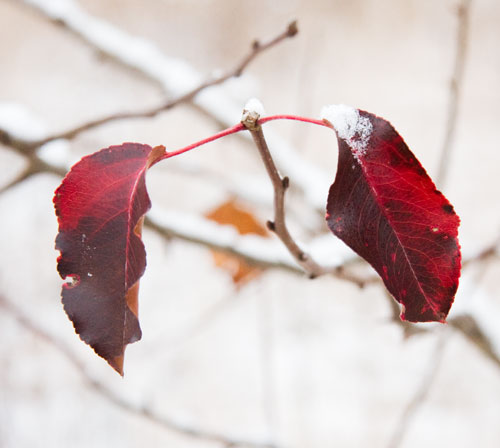
There was just enough snow to make it interesting.  The snowfall yesterday accounted for all the snow so far this month and it is always a surprise to see what it adds for the photographer.
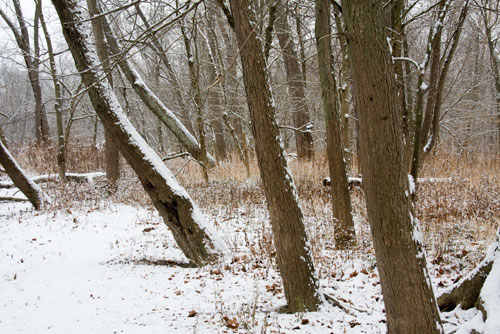
The snow tends to simplify the scene as it offers contrast.  Given that it is fleeting, it’s a good idea to get out there not long after it falls.  I suppose I could say we need to strike while the iron is hot, but that idiom is probably not the best choice for talking about ephemeral snow. 
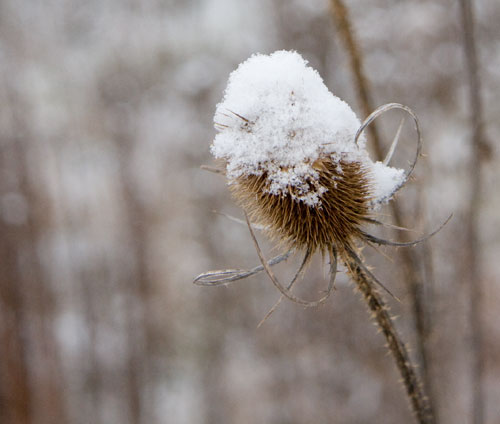
It is beautiful, isn’t it?  I suppose it is all just physics that causes the individual flakes to accumulate the way they do but that doesn’t account for the experience of seeing it, especially the first snow of the season.  It is fresh, it signals a change in season, it decorates and it vanishes.

I’ve photographed this scene several times in the summer and fall but nothing I have done previously compares with the opportunity I had here.  The snow set it off in just the right way and the water was calm enough for the reflection to work.

Irenaeus, a Christian bishop in about the year 200 CE said ‘the glory of God is the human being, fully alive.’  Getting the opportunity to photograph this snow and especially the trees reflected in Fall Creek brought me to, what for me, was an uncommon level of aliveness, which, like the snow, was ephemeral.

It is raining as I write this.  The snow is gone.  But looking at the weather forecast, we may get some more snow in the next few days.  Some more snow would be nice; a lot more is maybe not so good.  Moderation in all things.
Go to Plan B

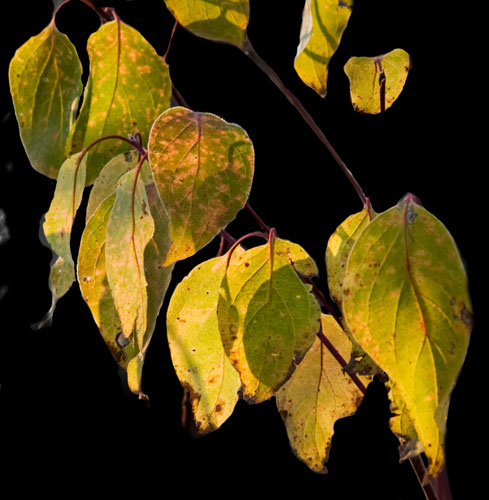
The plan yesterday morning was to go out and shoot, come back in and write about it.  I did go out and shoot and I did come back in but that’s when the disappointment started.  raspberry_leaves_8724

The images were ‘nice’ but not something I would want to hang on the wall or even show anyone.  (So why am I showing them to you?  Stay tuned.)  It wasn’t as if there were no subjects.  Black raspberry leaves in the fall are gorgeous and backlit golden leaves can be treasures.leaves_8747

But that just didn’t seem enough.  These were standard, garden variety fall pictures.  Big deal.

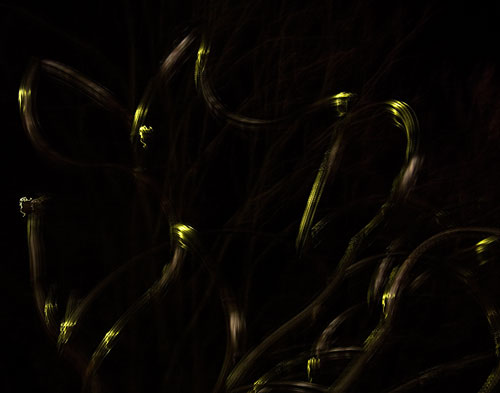
I went to the camera club meeting last night and didn’t have great hopes for that either.  We were going to shoot indoors.  There would be models and good lighting, as well as a set up for macro photography.   These were some fine opportunities but I thought instead I would take my camera and tripod outside.  It was dark and lights were showing up some interesting opportunities.   night_8933

This was a lot better.  I was not able to previsualize what I would get before I opened the shutter, I was just hoping for something interesting (and undefined).night_8957

And that made it a lot more fun.

An appreciation of milkweed

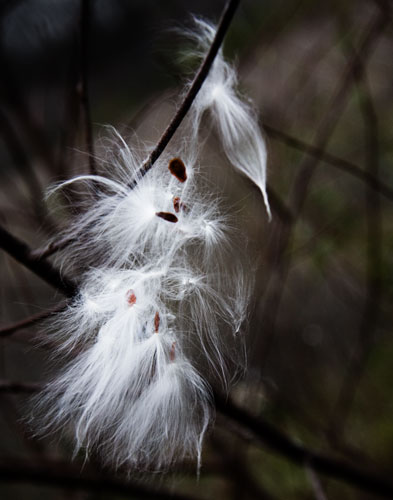
Yesterday I talked about the utility of milkweed – habitat for monarch butterflies, substitute for kapok in World War II – and said I would go back today to gather seeds for our butterfly garden.  I did that.  It was breezy and since I had my camera with me I planted it in front of a nice strand of milkweed floss and took a lot of shots as it danced in the breeze.milkweed_8662

It is easy to walk by milkweed and to notice the floss and seeds in only the most pedestrian way.  Unless we are looking, truly looking, they won’t occupy more than a moment of thought; visually, just a glimpse.

These little creations are striking when you take the time to look at them.  I could go on and on about this but I think the best tribute to them is just to show a few shots.  Words just can’t capture their subtlety and beauty.  (In each case I have darkened the background somewhat to help them stand out.)
milkweed_8637_2

milkweed_8634_2

milkweed_8620_2

They speak for themselves.

Creative typo

My brother and I spent part of  yesterday at Fort Harrison State Park.  A couple who were out for a walk stopped and asked what I was photographing.  I replied ‘Anything that will stand still long enough’ which is true enough that it didn’t seem to require any further explanation.   _MG_8452

What I was really doing would have required a bit more conversation but would probably have been worth the time to say it.  I was out wondering.  Not wandering, but wondering.

About a year ago I was emailing back and forth with a friend.  I was intrigued by a photograph she had done and asked how she got it.  She was busy doing other things and wasn’t paying attention to what she was typing and she wrote that she was ‘wondering’ around and saw the image.  That word ‘wondering’ captures it for me.  It was a typo but when I pointed it out to her and how great a choice of words it was, she agreed and now she goes wondering too.  Or maybe we’ve been wondering all along and didn’t know it.

Wondering.  Sometimes that leads to seeing something we might not have noticed before and sometimes it means asking ‘I wonder what will happen if I move the camera during the exposure?’ or try some other creative technique.  That is what I was doing yesterday beside Fall Creek.  Most of the images weren’t very interesting but some were, at least to me._MG_8455

It’s time to go out again.  I wonder what I’ll see?

Halloween gift

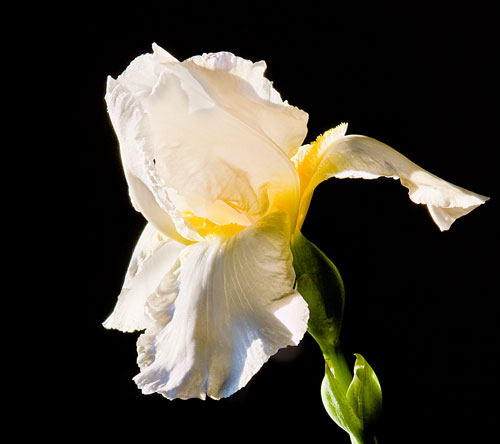
We have iris growing next to the house and we hadn’t gotten around to cutting them back.  Yesterday my wife noticed one with buds.  It was going down into the 30s last night so she cut it and brought it inside.Iris_8305_4

It bloomed during the night and I photographed it in late afternoon sun today.

This, my wife tells me, is a ‘rebloomer.’  It blooms early and then it blooms late.  The squirrels, chipmunks, trees of various persuasion, grass, weeds, most kinds of flowers, are all settling down to winter – gathering food, shedding leaves, bringing sap back to the roots and in general going to sleep.  But this flower is blooming.  That’s extravagantly beautiful isn’t it?

Some believe that the origins of Zen Buddhism lie in what has come to be known as ‘the flower sermon.’  The Buddha held up a white flower before his disciples and said nothing.  The ‘suchness’ of the flower, the way it was at that moment, was the point, saying anything about it would have added nothing.  We need say nothing more about this iris.

This is turning into a favorite place

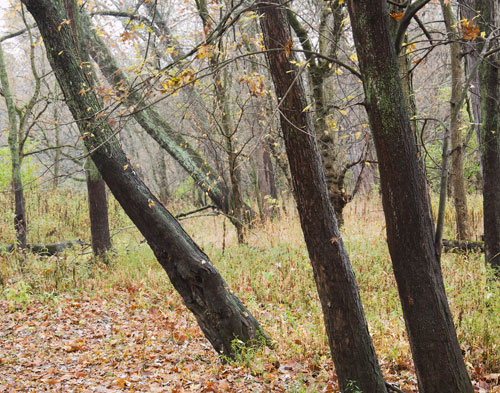
My friend Becky and I went to Fort Harrison State Park the other day to see what there was to see and photograph.trees_7880_2

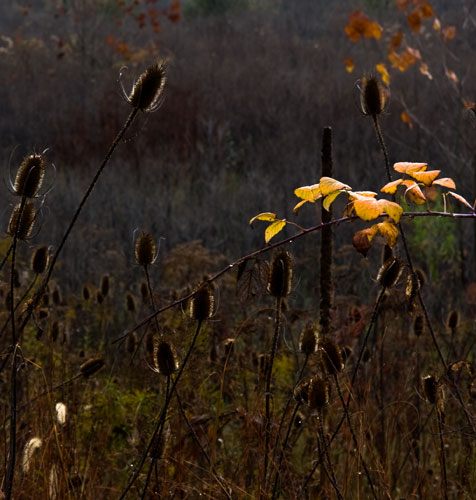
I find that sometimes it’s good to go out with someone else; each of us sees things the other doesn’t.  This doesn’t mean, though, that we end up shooting the same scenes.  Sure, there are some shots that are very similar to one another but the majority aren’t.  We could be standing side by side and the shots would still be very different.teasel_7765

The conversation was good and the shooting opportunities were plentiful.  It is always a source of wonder to me that what I bring back from one of these jaunts is nothing like what I would have anticipated getting.  So I usually just don’t try to anticipate.  Great encouragement for living in the moment.trees_7635_3

It is in those moments in the present that the connection is felt.  After a while the dialog with Becky drops off to brief exchanges as we walk from one place to another and the dialog with the scene picks up.  I have no idea what the content of that dialog is, it obviously isn’t words.  But it is there and it is in the connection.  I’m coming to think that these felt connections are traces and hints of our spiritual identity making contact with the world.  It is something to celebrate.backlight_7800_2

I have/had trouble praying

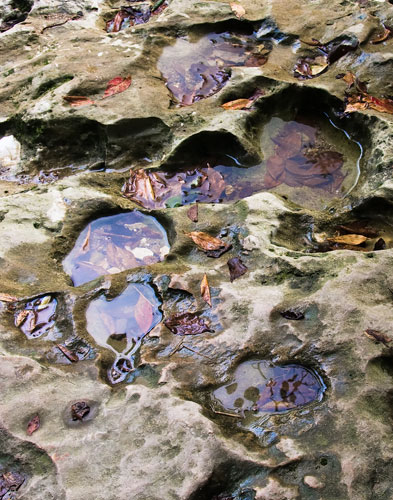
From the time I was small, I’ve had a problem with prayer.  As long as I stick to standard prayers – the Lord’s Prayer and some other memorized prayers- I am alright but as soon as I go off into prayers for specific people or situations I get stuck and my mind wanders.  But that isn’t quite true, my mind also wanders during the Lord’s Prayer, any prayer or any time for that matter.rock_5343_2s

I got into a conversation about this with three of my friends, all of them solid church goers and dedicated contributors to the community.  All four of us admitted to problems with prayer.  All of us are men and one of us is a minister.   Now that I think about it we never did pursue that problem very far, perhaps none of us knew quite what to do.

Some weeks later and in a different context the minister friend recommended Barbara Brown Taylor’s ‘An Altar in the World:  A Geography of Faith.’  Ms. Taylor had been an Episcopal priest for several years before going into writing and teaching full time.  She had been named by Baylor University as one of the 12 most effective preachers in the English speaking world.  I had been prepared to take her seriously anyway but that pushed her book to the top of my reading list.  The deeper I got into the book the more interesting it got.  And then there was this:

‘I would rather show someone my checkbook stubs than talk about my prayer life.  I would rather confess that I am a rotten godmother, that I struggle with my weight, that I fear I am overly fond of Bombay Sapphire gin martinis than confess I am a prayer-weakling.  To say I love God but I do not pray much is like saying I love life but I do not breathe much.’  (p 176)

Now she really had my attention.  And to cap it off a few pages later she took her cue from Brother David Steindl-Rast, author of ‘Gratefulness, The Heart Of Prayer’, in suggesting that

‘Prayer…is waking up to the presence of God no matter where I am or what I am doing.’  (p 178)

Alright!  Prayer isn’t just a recitation of fixed passages or verbal requests for God’s attention.  I knew that all along but for a truly outstanding minister to admit she has trouble praying, as I suspect many of us do, was quite a revelation.  But she went further than our little group of four men had gone by pointing out that just being aware of the presence of God no matter what we are doing is a form of prayer.  And_there_was_light_7289_7289_2

If we are wiping a child’s nose, running a backhoe, mowing the lawn, watching a ball game, helping out in a soup kitchen, playing with the dog, any of these activities – and are aware of the presence of God, we are praying.  I think that would include the activity of photography.

Meanwhile, back at the walnut plantation

I wrote a couple of days ago about a walk through the walnut plantation at the Fort Harrison State Park and how I ended up shooting little things instead of big things such as walnut trees.  I have a bias toward little things but in my defense there is a lot of distracting underbrush around the walnut trees, as beautiful as they themselves are.

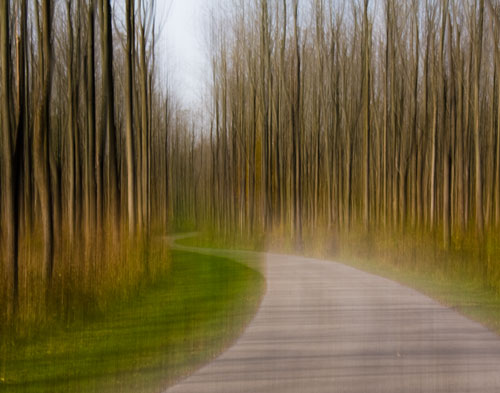
I went back today and much as I would like to say that I was determined to shoot big things and big things only, I just went to shoot.  It occurred to me to try a technique I learned reading William Neill’s ‘Impressions of Light’ which is available as an ebook at his website.  I regularly go back to this book for inspiration.walnut_plantation_7192

The technique is simple.  Slow the shutter speed and move the camera while the shutter is open.  I had done this before with images of water (I’ll cover that in a later post).  I put a four stop neutral density filter and a polarizer on the lens and shot at f/11 and  ISO 100.  This slowed the shutter down to 1/13th to 1/6th of a second for various exposures.walnut_plantation_7140

The camera was on the tripod and I simply moved it up and down more or less vertically to emphasize the trunks of the trees.  The brush is still present but instead of being distracting, it now it adds a bit of color.walnut_plantation_7207

Camera motion can be an artistic tool.  I can’t say that I know how an image is going to turn out as I am setting up the shot; I can’t previsualize with any accuracy what it is going to look like.  The ‘take’ rate, the percentage of images that turn out well, is small but I do like what the technique can do.  And the bonus is that parts of the image that are potential distractions, such as underbrush, can, with some luck, turn into desirable features of the image.

In looking at these images, I get the sense that we are seeing something about the scene that we wouldn’t see any other way.  Somehow, to use Wordsworth’s phrase, we are seeing into the life of things.  We are seeing something for which there is no immediate verbal label, something that for a short while at least, we can treat as new.  That is something we expect of art and something we hope for as spiritual seekers.

Shooting with an agenda?

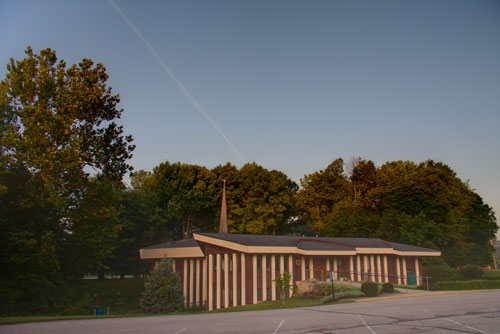
Our little congregation was putting together a cookbook and they needed a picture of the church for it.  Since the  book was going to press on Wednesday, I went up early on Monday hoping to get a nice picture of the sunbathed  front of the church.  Good idea.  The sky was clear and promising.  I set up and got shot after shot over a period of several minutes but  it became clear that the right image was not going to be there.  And the patched parking lot in front wasn’t helping either.  Nothing much of interest as far as the light was concerned and the shot was poorly positioned and composed.

Not very interesting view of Church of the Saviour

Not very interesting view of Church of the Saviour

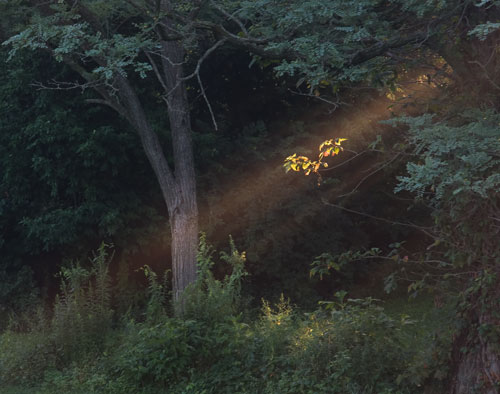
I’m a fan of Dewitt Jones and one of his dicta at this point would have been “turn around Barry, turn around”!  So I did and that’s when I saw this.

God beam

God beam

The church is situated on eight acres of ground and I’m sure I’ve looked back in this area before but there was never anything of interest or, better, anything interesting I was prepared to see.  It would have been difficult to pass up this shot in any case but there was another reason it was important to me.  In a few weeks I would be preaching while our minister was on vacation and I planned a sermon built around the idea of spirit and seeing.  I was looking for shots that I could use.

Religious language is very symbolic since it deals with the transcendent and unimaginable.  It is interesting to a photographer to see how often light is part of the description of the transcendent – ‘Light of the world’, ‘your word is a lamp unto my feet’, etc.  I had thought early on that a picture of a God beam would be a nice addition to the sermon.  And there it was.

We humans always have an agenda.  My ‘front of the head’ agenda that morning had been to get a good shot of the church.  One item in my ‘back of the head’ agenda, that vast pool of hopes, interests, and yearnings we all carry around, was to get a shot of a God beam.  I’m not going to argue that God gave me a present with that shot, the real gifts to me in the present context are the continued existence of Barry Lively and a growing appreciation of what there is to see.

Christians often quote Matthew 3:2 – ‘Repent for the kingdom of God is near.’  For some that can take on an ominous tone;  it is time to straighten out our lives for the end is coming.  A Bible scholar I know said that a better translation than ‘repent’ would have been ‘turn around.’ ‘Turn around for the kingdom of God is near.’  Indeed it was.  And is.

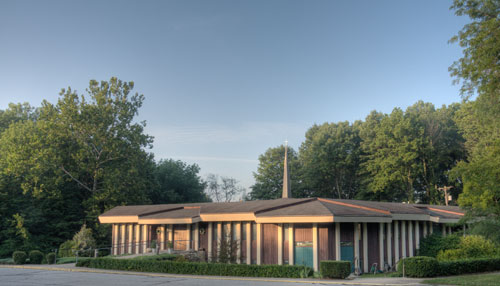
After working the God beam shot I still had to get a picture of the church.  I moved up the parking lot about 200 feet and shot from the other direction.  It was a better composition but the light was still not what I would want so I used a technique called high dynamic range (HDR) where I did the same shot (on a tripod) three times, overexposing, underexposing and exposing as suggested by the auto exposure feature of the camera.  The shots were combined in software to produce this image.

A better picture of Church of the Saviour

A better picture of Church of the Saviour

The light is still not great but the glow that came from the HDR treatment was nice.  And as it turned out the publisher changed the image from color to black and white.  If I had known that was what they wanted, I might have settled for one of the first shots I took at the original position and converted it to black and white myself.  I’m glad I didn’t know that.  Otherwise there would have been no God beam picture and I might have settled for a poorly composed picture of the church.  If ignorance isn’t really bliss, at least sometimes it is blissful.

Why Spirit and Seeing?

The name of this blog is ‘Spirit and Seeing.’  Why isn’t it called ‘Spirit and Photography?’  That’s what it’s really about isn’t it?  The surface reason for not calling it ‘Spirit and Photography’ is that name seemed too long  for people to type in; it’s just a bit more cumbersome than I would like the title to be.  The deeper reason is that, for me at least, seeing is at least 75% of what goes into successful photography.  A good camera is nice, a good lens is always welcome, technique – at least as far as operating the camera is concerned – is also good.  But the selection of what appears in the viewfinder and the way it is composed there is even more important.

Spring impression

Spring impression

A modern digital camera – I’m using a Canon 40D – automates a lot of what used to trip me up.  Autofocus is a boon, image stabilization is great and automatic metering is good too.  Having a histogram adds a critical dimension to image making.  All of that taken care of automatically to one extent or another means that the bulk of the job shifts even more over to image selection and composition, or seeing.

As complex as it is, the English language often compresses multiple meanings into a single word.  Take for example the word ‘seeing.’  If I’m absent-mindedly walking along and managing to avoid running into trees, dogs, people and parked motorcycles, am I ‘seeing’ in the same sense as when I’m composing a picture that people will find interesting?  The answer, obviously, is no.

One of the benefits of a strong interest in photography is that it helps us see more of the world.  Not more square inches of the world, but more per square inch.  When we first start out with a camera and have gotten to the point that we don’t have to think too much about the camera settings, it often happens that we see more and more interesting things when we have the camera in our hands than when we don’t.  With more practice, that difference decreases and we see more ‘photographically’ even when we don’t have a camera with us.

I take our two dogs for a walk around the block every morning at around 5:45.  We’ve been doing this for years.  It is usually dark and there isn’t much that changes from one day to the next but thinking photographically helps me see things I hadn’t noticed before.  The photo below was taken one winter morning.  I had been by that tree hundreds of times but perhaps because of the frost on the ground and who knows what else, it was different.  When we got back home I picked up the camera and tripod and went back to see if it was what I thought it was.

Do you really want to know what is behind that tree?

Do you really want to know what is behind that tree?

The light being obscured behind the tree makes a huge difference.  Moving a few inches to the left or right turns the image into nothing very interesting.  I’ve looked at this tree many times since and the shot just isn’t there for me now.  Maybe when there is frost on the ground, then again, maybe never again.

So yes, this blog is about photography but then photography is largely about seeing.  I’m happy with the title ‘Spirit and Seeing.’

The real voyage of discovery consists of not in seeking new landscapes but in having new eyes.
Marcel Proust