Meanwhile, back at the walnut plantation

I wrote a couple of days ago about a walk through the walnut plantation at the Fort Harrison State Park and how I ended up shooting little things instead of big things such as walnut trees.  I have a bias toward little things but in my defense there is a lot of distracting underbrush around the walnut trees, as beautiful as they themselves are.

I went back today and much as I would like to say that I was determined to shoot big things and big things only, I just went to shoot.  It occurred to me to try a technique I learned reading William Neill’s ‘Impressions of Light’ which is available as an ebook at his website.  I regularly go back to this book for inspiration.walnut_plantation_7192
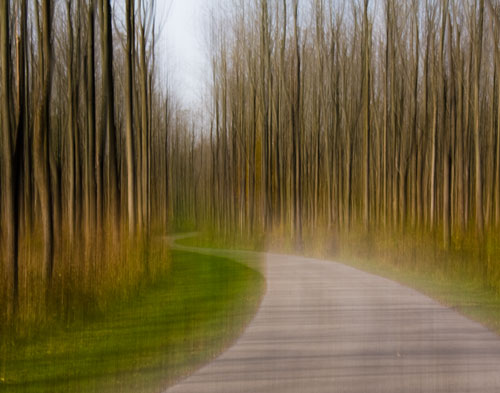
The technique is simple.  Slow the shutter speed and move the camera while the shutter is open.  I had done this before with images of water (I’ll cover that in a later post).  I put a four stop neutral density filter and a polarizer on the lens and shot at f/11 and  ISO 100.  This slowed the shutter down to 1/13th to 1/6th of a second for various exposures.walnut_plantation_7140

The camera was on the tripod and I simply moved it up and down more or less vertically to emphasize the trunks of the trees.  The brush is still present but instead of being distracting, it now it adds a bit of color.walnut_plantation_7207

Camera motion can be an artistic tool.  I can’t say that I know how an image is going to turn out as I am setting up the shot; I can’t previsualize with any accuracy what it is going to look like.  The ‘take’ rate, the percentage of images that turn out well, is small but I do like what the technique can do.  And the bonus is that parts of the image that are potential distractions, such as underbrush, can, with some luck, turn into desirable features of the image.

In looking at these images, I get the sense that we are seeing something about the scene that we wouldn’t see any other way.  Somehow, to use Wordsworth’s phrase, we are seeing into the life of things.  We are seeing something for which there is no immediate verbal label, something that for a short while at least, we can treat as new.  That is something we expect of art and something we hope for as spiritual seekers.

Shooting little things

Fort Harrison State Park is nearby on the northeast side of Indianapolis and I stop by once in awhile to do some shooting.  A couple of friends had been there recently and got some magnificent shots in a stand of walnut trees, a stand large enough to be called a plantation.  I went over this morning to see if I could do as well.

All I found was row after row of trees with a lot of brush growing in between.   I got a few uninspired shots and then started looking at other possibilities.  I’ve noticed that, given a choice, I shoot small things rather than large ones.  My defense is that there are a lot more small things than there are large things and if you are in the woods the range of lighting on small things is a lot broader than it is for large things such as trees.  That’s my argument and I’m sticking with it.

There were back-lit possibilities all over the place.  Here is one:WP_6969

That, by the way, is the bark of a walnut tree.  Two walnut trees in fact.

A problem with shooting small things, and large things for that matter, is the background.  It can be pretty difficult to get the ‘right’ angle for the subject while avoiding a distracting background.   The image above is OK in that regard – the background doesn’t overwhelm the subject.

But here is the problem in spades. Autumn_leaves_7081_pre

There are three leaves that attracted my attention but they are lost against the background.  This has happened so often that some time ago I took up removing the background altogether for some subjects.  Autumn_leaves_7081

Exactly the same image as above but without the background.  Georgia O’Keefe made the comment

Nobody sees a flower – really – it is so small it takes time – we haven’t time – and to see takes time, like to have a friend takes time.  I decided that if I could paint that flower in a huge scale, you could not ignore its beauty.

I don’t do large images, I just remove the distracting part and leave the image relatively small.  Removing the background certainly calls attention to the subject.  Works for me.  Some day I really will make images of large subjects.  Just not today.