Stillness

untitled-5804-2f-Edit

Image and text copyrighted by Barry L. Lively

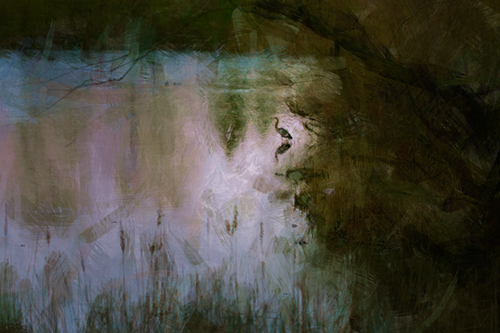
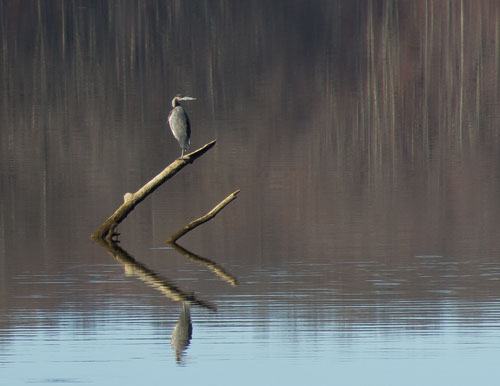
The marsh was beyond quiet, it was still.  It was not asleep, it was still, watchful.  Nothing moved.

If we could speed up our perception and look more closely at the intervals between what we think of as events, perhaps we could experience stillness there.  Possibly a “flavored” stillness which in some way reflects the most recent events.  But we are usually thinking about something in the past or anticipating something else in the future.   Appreciation of stillness means living in the Now.

Claude Debussy is credited with saying that “Music is the silence between the notes.”   Now that might also be “flavored” stillness, stillness in and of music.

I moved on.  We later walked back the same way and the heron was gone.  The surface of the water was ruffling in the breeze.

In the Window

untitled-5468-Edit-Edit-Edit_2s-Edit

Fiction: image and text copyrighted by Barry L. Lively

I’ve passed this egg in the window of the Second Use store every day for the last three months, as long as it’s been there.  I’ve not gone in to check on the price but I know it will be more than I can afford.  Maybe someday, if it’s still there.

A lot of people have walked by this dusty store window but no one has bought it yet.  It probably doesn’t mean much to them but my mother used to have one something like this and it always fascinated me.

The egg was a gift from my dad to my mom.  I wasn’t born yet so I didn’t see him give it to her.   I know it was precious to her because I often saw her smile at it as she was dusting the top of her dressing table or brushing her hair in front of the rather cloudy mirror behind the table.

We didn’t have much so this was extra special.

It was special to me, too.  From when I was very little I can remember staring at the egg, making up stories about it.  I was going to give it to the Queen of America, not knowing that we didn’t have a queen.

There were other items, a small vase, a statuette of Mozart and perhaps other things I can’t remember that I picked up and promptly dropped, breaking them.  I knew this so I was very careful when I touched the egg.

Mom let me touch it and I was even allowed to pick it up when she was there.  For the most part I didn’t even touch it when she wasn’t around.

It was heavier than it looked and the painted flowers were beautifully done.  It was smooth and cool to the touch.  I don’t know where the scent came from but it even smelled like one of Mom’s perfumes.

That egg was on her dressing table when I was little, and when I was in grade school and high school.  It was still there when I graduated from college and left home to get married.  In recent years it had been on her bedside stand in a dementia unit.  Often when I would visit, she would pick it up and smile.  I held it once in a while too and I smiled.

Mom died one morning at 3:00.  There was a little smile on her face and the egg was on the floor, unbroken.  I don’t know what happened to the egg.  The staff on the unit was very good about leaving things alone.  But someone took it, I guess. I hope it brings them  the happiness that it did Mom.

That egg in the window.  I think that would make a nice gift for my wife.  I’ll check on it.  I smiled.

Greeting God with a camera

Taking pictures is a spiritual experience for me.  It is a raw point of contact between something within and a moment in the flow of life out in the world.  That contact is brief, often in the range of 1/1000th to perhaps two seconds.
A friend of mine and I will go out to shoot and if you give us two acres in which to roam, we will bring back very different sets of images.  Why do we point our cameras in different directions?  We are different people and that which is within each of us is different and those differences guide our creative rudders in different directions.

After a long period of slow awakening, I have come to understand that spirituality is at the core of my photography.  My personal definition of spirituality is a seeking of contact with God coupled with an awareness of God’s hand in creation.  Going out with a camera encourages me to look at the world while spirituality guides what I see.  If the life experiences of my friend and I are different and our spiritualalities are not the same, it is not surprising that our creative rudders point us in different directions.

The spiritual framework is always present but something I see or hear is often useful for me to become aware of it.  For example, going out early in the morning of a beautiful day might bring to mind the first verse of a hymn known to many:

When morning gilds the skies my heart awaking cries:
May Jesus Christ be praised!

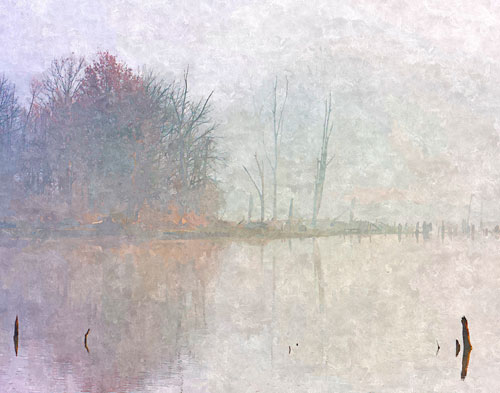
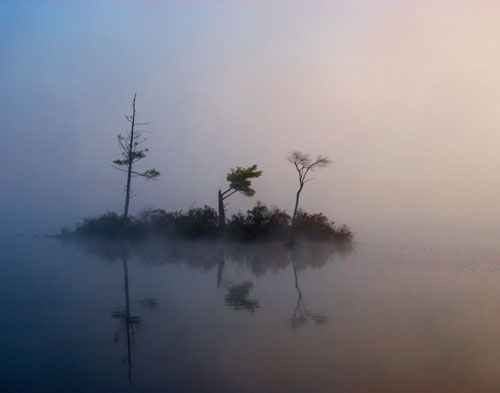
Being as fully present to the moment as possible is essential.  “Multitasking”, that peculiar human penchant for doing more than one thing more or less simultaneously and always almost competently, doesn’t work here.  The most intense spiritual awareness often comes in a brief period of time and there isn’t time to switch attention.  For example, the good lighting for this island in the mist was there for well under a minute.
This backlit spider web and leaf was “good” for only a few seconds.
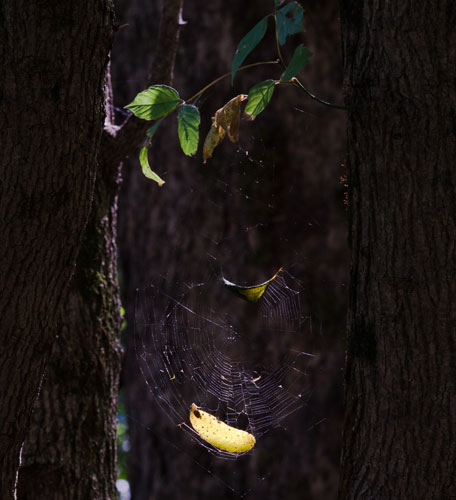
One is not likely to hear the “still small voice” when juggling tasks.

I think it is no accident that light is a metaphor for God and God’s teaching (e.g. “It is you who light my lamp; the Lord, my God, lights up my darkness” Psalm 18:28) while it is often light that makes or breaks the image in photography.  The two are connected for me.  God’s presence is especially noticeable in the viewfinder when the light is good.

But photography also nourishes spirituality.  I am not good at prayer, my prayers are stale.  A breakthrough came when Barbara Brown Taylor, in her “An Altar in the World”, pointed out that just about any activity could be a prayer if God is at the center of it.  One of those activities for me is photography.  So going out to shoot can be a communion with God.  This doesn’t always happen and I’ve found that the best preparation for it is to simply be there and nowhere else.  My camera is not also a telephone.  It does one thing and it does it well.  It points and when I am fully present, God’s creation is there in the viewfinder.
I’ll bet that you have a camera too.  If what is written here is of interest to you, a camera-aided spiritual experience can also be there for you.  Practice the photography and know what the buttons do.  Then go out and greet God.
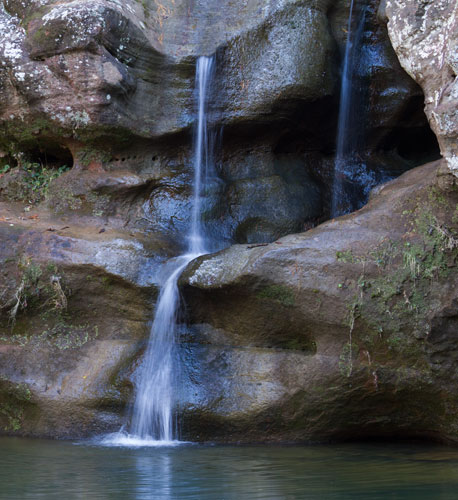
And it’s for free!

Ever since I started in photography many years ago, I’ve wanted to create a “painterly” effect.  That is, an effect that is more a poetic expression of a scene than a literal recording of it.  I’ve talked about this before.  The Corel Painter products I have now are very good but rather complicated and expensive unless you are really dedicated.  I haven’t achieved the skill level I need to show you much with those programs but I recently found free photo sketching software that I find exciting.  I want to show it to you, and if you are also interested in a painterly effect, you might want to try it too.  It is simple to use.  This software works on Windows computers but not Macs.


This was a shot at Muscatatuck National Wildlife Refuge in southern Indiana year ago November.  I liked it without the painterly treatment but I like it even more after running it through FotoSketcher.  I don’t know why David Thoiron, the developer of the software, hasn’t charged even a nominal amount for it.

If you try it you will find there are many choices in painting styles and variations within those styles.  I find it liberating.

Try it, you’ll like it.

Macro photography: Come closer

Yesterday I talked about a recent program on macro photography at our camera club.  I prepared for that meeting by putting my macro lens on the camera and going out over a couple of days to get back in practice with it.  The lens I use does not permit focusing any closer than about a foot away.  We won’t be doing insect retinography with this lens because it can’t get that close but it does offer other possibilities at this kind of middle distance that I prefer.

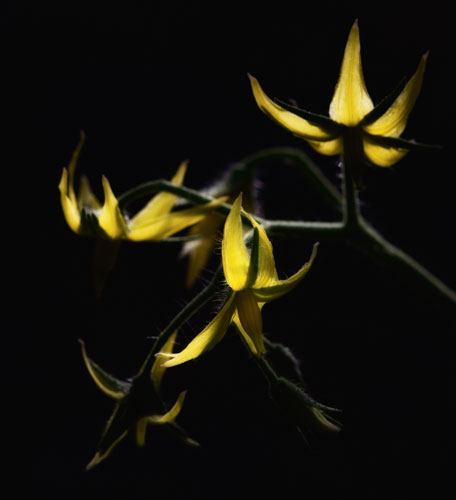
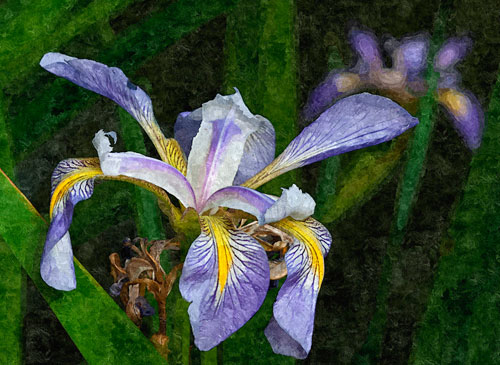
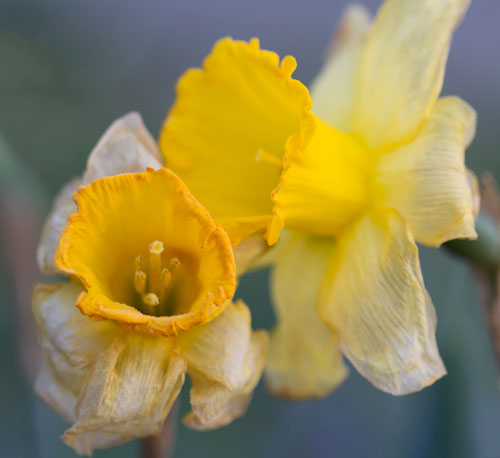
What struck me  was relationships between flowers.  At an objective level there is nothing more there than the juxtaposition of two flowers.  But images tell stories.  We, as observers, become co-authors with the photographer in developing those stories.  What stories do these images tell you?

Flowering tree


Do scenes or images of scenes communicate with you?

Our camera club was meeting last night at the Indianapolis Art Center and the topic was macro or close-up photography.  This was as much workshop as lecture and a lot of people were inside taking close-ups of small objects.  This is a great technique for seeing what is very small and not at all obvious to the eye busy with other sights.  They were using flash and other artificial lights because it was rather dark in there.   Because I don’t usually like to shoot with anything but natural light, I got out of their way and went outside.  They were having a good time and doing fine work.  I would find my good time outside.

I can’t tell you what kind of flowering tree this is, there are many species at the Art Center.  But I did find it hugely attractive.  At the time, it said “Japanese garden” to me.  Getting it home and seeing it on the screen brought out  a larger story.

I had started reading Jonah Lehrer’s “Imagine” the other day and this image contributed one understanding of what Mr. Lehrer was talking about.  His book is about creativity.  It brings in neuropsychology, personality, “mental illness” and many other areas of research in trying to better understand this most precious and human capacity that, truly, is so dimly understood.  One of his points is that it’s not  just the case that creativity can take any number of paths but that there are many kinds of creativity.  Let’s leave it at that for the present so we can get on with this post.  Read the book.

When I first saw the tree I thought I would eliminate the building and just show the tree with perhaps some flowers at the bottom.  But the more I looked at it, the more I thought the building was contributing to the image.  The horizontal lines in the wall and the vertical drain pipe form a frame for the tree.  But while most of the tree fits within the boundaries of the frame, some of it doesn’t.  And that is one part of what a lot of creativity is about.  It fits to some extent in the conventional frame of reference but at the same time is moving out of the frame.  If it catches on with the populace, the frame might expand.

This was not macro photography but it was made with a 100 mm f/2.8 Canon macro lens.  This translates into “good lens”.  More on macro work tomorrow.

Each look, the first

In his poem ‘A Guide to the Field’, David Wagoner writes

‘Our first strange steps
On a path that leads us down on a path to its end in water.
Each look, the first.’

‘Each look, the first.’  That’s the way it felt this morning as I went out to shoot.  Aside from the trip to Gary last Sunday, I haven’t been out with a camera in some time.  So in a way it was ‘Each look, the first.’


I didn’t go far, just to the azalea bush out front, to start.


And then along the driveway.


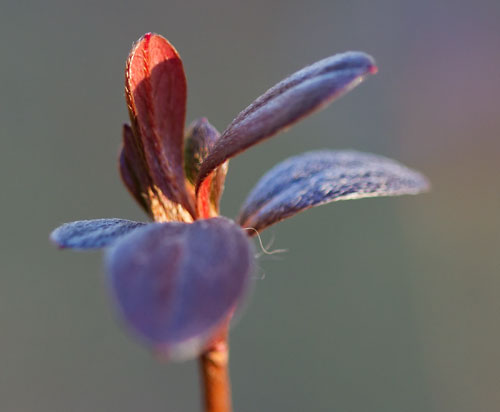
Winter is supposed to be drab.  That’s not what I saw.


There’s a lot of color if we just look.


‘Each look, the first.’  But I won’t wait so long for the next outing.

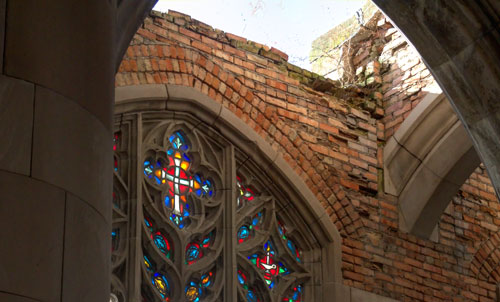
Gary First Methodist Church

The competition topic this month at the Photo Venture Camera Club is ‘Spirit and Place’.  Having spotted an old Methodist Church in Gary that is beyond disrepair, three of us decided to go see if we could find spirit in the place.


The construction of this church was underwritten by US Steel back in the mid-twenties and at one time had thousands in the congregation.  At its highest point it is nine stories tall.


But the congregation is gone.


Not much is left.

Nature is taking over.


Is there still spirit here?  I was reminded of the Apostle’s Creed, especially the line that says “He descended into Hell and on the third day he rose from the dead”.  With this in mind, the title for the next image


is “…and He left his cross behind.”  Yes the Spirit is here.