Spirit and seeing, spirituality and photography. I believe that each nourishes the other. Right, but how does that work? How do they fit together and nourish one another?
This is one of those things I know to be true but it is mysterious and I find it difficult to put into words. I’ll begin by repeating what I have written before about the nature of spirituality. Here’s the working definition:
‘the pattern of beliefs, attitudes and feelings about the Sacred and the world – a pattern that defines who you are at the profoundest level.’ (From Skylight Paths, Who Is My God?: An Innovative Guide to Finding Your Spiritual Identity, Skylight Paths Publishing; March 2004, p5)
This is essentially the definition of personality with the addition that the Sacred is placed at the center. Viewed most broadly, an individual’s spirituality is always a part of what that individual thinks or does. It doesn’t have to be a thought or an act with spirituality actively in mind, it is there whether we recognize it or not. In an important way then, our spirituality as well as our personality colors and frames the way we think and behave. Of course there are times when we don’t act according to our best spiritual selves. The apostle Paul made this point when he wrote
We know that the law is spiritual; but I am carnal, sold under sin.
I do not understand my own actions. For I do not do what I want, but I do the very thing I hate.
Romans 7: 14-15
I would be surprised if all major religions did not share this lament. So we don’t always act according to who we are at the profoundest level.
In my simple spirituality, everything is interconnected. God is in all, all is in God. So when I go out to shoot, there is a strong sense of wonder at God’s creation. Looking through the viewfinder of a camera intensifies that sense of wonder. I see this most strongly with close up, or macro, photography.
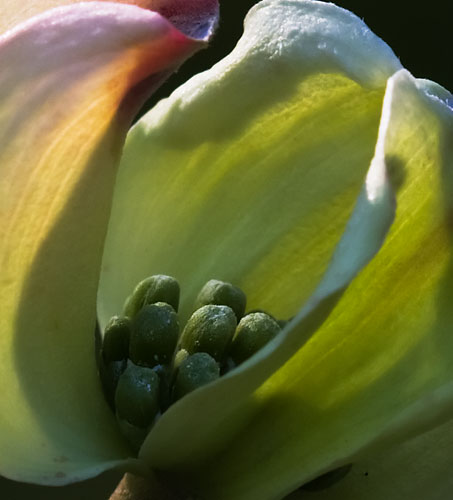
Getting close to a flower opens up a new world. Flowers are small, and if we think of the distance between our eye and the bloom in terms of diameters of the bloom (e.g. this flower is half an inch across) we are almost always at least 10 diameters away and more often, when we are walking past them, perhaps hundreds of diameters away. So when we are close we see a lot more of what the flower is about. And there is more to it. We aren’t just close, we are looking at it through the viewfinder which considerably restricts our field of view. If we are close enough, we see just the flower and little, or nothing, else. A sense of wonder is then all but inevitable.

But the sense of wonder is not restricted to just flowers. A flower just provides one good example. Looking closely at a flower readily gives rise to wonder in just about anyone. Most things we see, hear, feel or otherwise sense can be a source of wonder. The quote from Meister Eckhart in the banner at the top of this page says it very well:
This then, is salvation: to marvel at the beauty of created things and to marvel at the beauty of their Creator

What feeds wonder in me probably wouldn’t be the same as it would be for you. That’s why we could stand next to one another with cameras and come back with different portfolios.

I believe that sense of wonder is an expression of spirituality. It is God in me seeking God in the world. So is it surprising that spirituality would nourish photography? Or that photography nourishes spirituality? I’ll write more on this soon.
 Spirit and Seeing
I really enjoyed this post. I will be spending more time reading and thinking through this one. I am in total agreement, but want to analyze me within the text. Beautiful analogy. B
I hope it is OK to send this on to a couple of friends whom I think may want to be on your list
The pictures are so beautiful and the words speak to my heart. Such an uplifting experienc to read ans look at your blog!
I cannot more than agree: GOD is in everything, and we’re able to see and feel it, if we are willing to open up for that mysterium. I mainly work with flowers and I try to make that what I call the “inner light” visible, also in areas where we humans can’t see it, but a little bee or butterfly can.