Stillness

untitled-5804-2f-Edit

Image and text copyrighted by Barry L. Lively

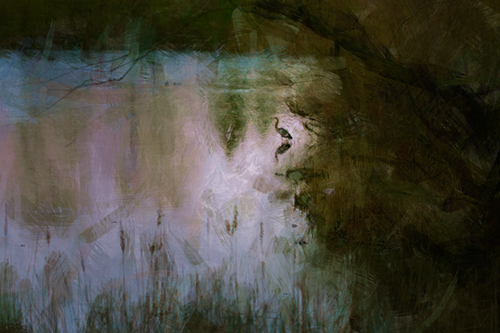
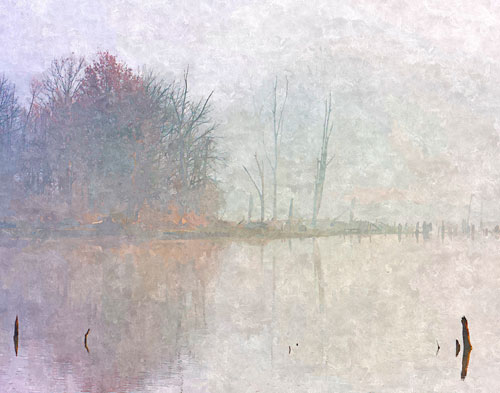
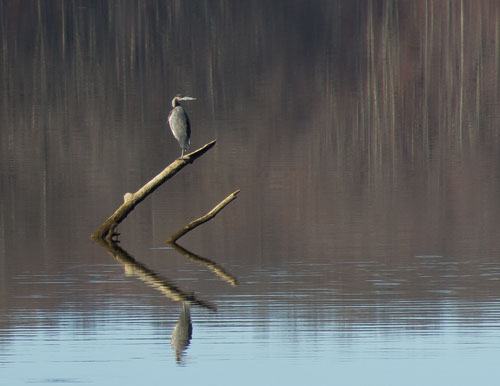
The marsh was beyond quiet, it was still.  It was not asleep, it was still, watchful.  Nothing moved.

If we could speed up our perception and look more closely at the intervals between what we think of as events, perhaps we could experience stillness there.  Possibly a “flavored” stillness which in some way reflects the most recent events.  But we are usually thinking about something in the past or anticipating something else in the future.   Appreciation of stillness means living in the Now.

Claude Debussy is credited with saying that “Music is the silence between the notes.”   Now that might also be “flavored” stillness, stillness in and of music.

I moved on.  We later walked back the same way and the heron was gone.  The surface of the water was ruffling in the breeze.

In the Window

untitled-5468-Edit-Edit-Edit_2s-Edit

Fiction: image and text copyrighted by Barry L. Lively

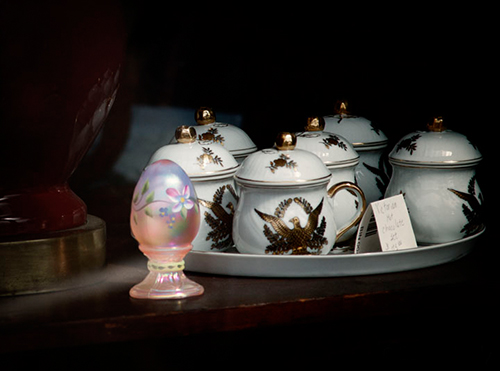
I’ve passed this egg in the window of the Second Use store every day for the last three months, as long as it’s been there.  I’ve not gone in to check on the price but I know it will be more than I can afford.  Maybe someday, if it’s still there.

A lot of people have walked by this dusty store window but no one has bought it yet.  It probably doesn’t mean much to them but my mother used to have one something like this and it always fascinated me.

The egg was a gift from my dad to my mom.  I wasn’t born yet so I didn’t see him give it to her.   I know it was precious to her because I often saw her smile at it as she was dusting the top of her dressing table or brushing her hair in front of the rather cloudy mirror behind the table.

We didn’t have much so this was extra special.

It was special to me, too.  From when I was very little I can remember staring at the egg, making up stories about it.  I was going to give it to the Queen of America, not knowing that we didn’t have a queen.

There were other items, a small vase, a statuette of Mozart and perhaps other things I can’t remember that I picked up and promptly dropped, breaking them.  I knew this so I was very careful when I touched the egg.

Mom let me touch it and I was even allowed to pick it up when she was there.  For the most part I didn’t even touch it when she wasn’t around.

It was heavier than it looked and the painted flowers were beautifully done.  It was smooth and cool to the touch.  I don’t know where the scent came from but it even smelled like one of Mom’s perfumes.

That egg was on her dressing table when I was little, and when I was in grade school and high school.  It was still there when I graduated from college and left home to get married.  In recent years it had been on her bedside stand in a dementia unit.  Often when I would visit, she would pick it up and smile.  I held it once in a while too and I smiled.

Mom died one morning at 3:00.  There was a little smile on her face and the egg was on the floor, unbroken.  I don’t know what happened to the egg.  The staff on the unit was very good about leaving things alone.  But someone took it, I guess. I hope it brings them  the happiness that it did Mom.

That egg in the window.  I think that would make a nice gift for my wife.  I’ll check on it.  I smiled.

Greeting God with a camera

Taking pictures is a spiritual experience for me.  It is a raw point of contact between something within and a moment in the flow of life out in the world.  That contact is brief, often in the range of 1/1000th to perhaps two seconds.
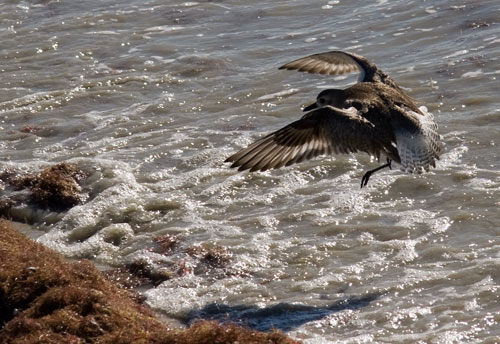
A friend of mine and I will go out to shoot and if you give us two acres in which to roam, we will bring back very different sets of images.  Why do we point our cameras in different directions?  We are different people and that which is within each of us is different and those differences guide our creative rudders in different directions.

After a long period of slow awakening, I have come to understand that spirituality is at the core of my photography.  My personal definition of spirituality is a seeking of contact with God coupled with an awareness of God’s hand in creation.  Going out with a camera encourages me to look at the world while spirituality guides what I see.  If the life experiences of my friend and I are different and our spiritualalities are not the same, it is not surprising that our creative rudders point us in different directions.

The spiritual framework is always present but something I see or hear is often useful for me to become aware of it.  For example, going out early in the morning of a beautiful day might bring to mind the first verse of a hymn known to many:

When morning gilds the skies my heart awaking cries:
May Jesus Christ be praised!

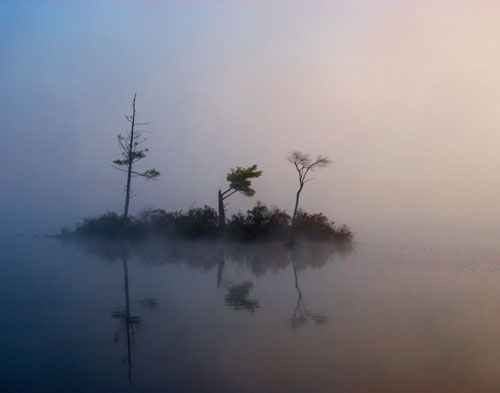
Being as fully present to the moment as possible is essential.  “Multitasking”, that peculiar human penchant for doing more than one thing more or less simultaneously and always almost competently, doesn’t work here.  The most intense spiritual awareness often comes in a brief period of time and there isn’t time to switch attention.  For example, the good lighting for this island in the mist was there for well under a minute.
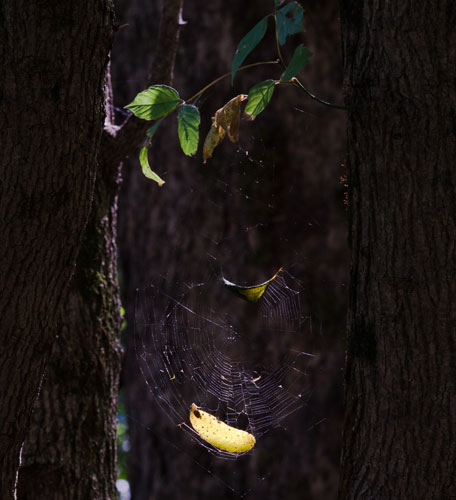
This backlit spider web and leaf was “good” for only a few seconds.
One is not likely to hear the “still small voice” when juggling tasks.

I think it is no accident that light is a metaphor for God and God’s teaching (e.g. “It is you who light my lamp; the Lord, my God, lights up my darkness” Psalm 18:28) while it is often light that makes or breaks the image in photography.  The two are connected for me.  God’s presence is especially noticeable in the viewfinder when the light is good.

But photography also nourishes spirituality.  I am not good at prayer, my prayers are stale.  A breakthrough came when Barbara Brown Taylor, in her “An Altar in the World”, pointed out that just about any activity could be a prayer if God is at the center of it.  One of those activities for me is photography.  So going out to shoot can be a communion with God.  This doesn’t always happen and I’ve found that the best preparation for it is to simply be there and nowhere else.  My camera is not also a telephone.  It does one thing and it does it well.  It points and when I am fully present, God’s creation is there in the viewfinder.
I’ll bet that you have a camera too.  If what is written here is of interest to you, a camera-aided spiritual experience can also be there for you.  Practice the photography and know what the buttons do.  Then go out and greet God.
Wabi Sabi

I don’t know where I first heard of it but I’ve recently been intrigued with the idea of wabi sabi, which appears to be so deeply embedded in Japanese culture that native Japanese don’t, and possibly can’t, give a clear picture of what it is.  For them it just is.  I’ve read several books about it, all by Western authors.  One of these authors says that he has found no book on wabi sabi written by a Japanese.  Perhaps in one culture there is only a need to experience and not explain while in our culture there is a need to explain just about everything.

The description that, so far, I find most satisfying is given by Andrew Juniper:

If an object or expression can bring about, within us, a sense of serene melancholy and a spiritual longing, then that object could be said to be wabi sabi.

Perhaps it is better to illustrate the idea rather than talk too much about it.  I am a novice concerning this concept and what I write will be the thoughts of a novice.  Might be better to show what it could mean and write about it just a little bit.

One of the defining features of wabi sabi is impermanence.  This morning I had seen the light falling on a leaf just so.  It was perfect.  I went into the house, got my camera and tripod, came out and the light had changed.  That moment of perfection of light and leaf was gone.  But there were others.  This one didn’t look like much at first but then the light touched it.

Another defining feature is simplicity.

But there is more in this image than simplicity, there are also other key features of wabi sabi, imperfection and impermanence.  This car from a train is rusting away and will be dust someday.

Impermanence operates on every time scale.  The backwash of water in the lower left in this image from the White River was gone in under a second.  I am sure the leaves moved on when the water rose again.  The rock and concrete are wearing down.

Simplicity, imperfection, impermanence.  All these are part of life.  There is beauty in all of it, if we’ll just stop and look.  But what beauty was there when my father was dying from cancer?  Where I saw beauty was in his dignity and his newly formed relationships with the hospice nurses.  There was much beauty there.  If there can be be beauty there, there can be beauty just about anywhere.  Melancholy?  Yes.  Serenity in awareness?  Yes.

Rescued dogs

This past weekend we visited our son and his family.  They had adopted a German shepherd puppy a few months back and it was time for us to visit Axl.  His mother is a white shepherd and his father most likely a black and tan.  White shepherds have especially large ears as you can see with Axl.  If he were running into a headwind, it would be a good idea to trim his sails; he’d probably pick up three or four miles an hour.

Axl was one of nine puppies that Echo Dogs White Shepherd Rescue had taken in.  Well that’s not quite accurate;  they took in his mom who was pregnant. Axl and his brothers and sisters came along shortly after that.

We had lost our dog in the mid ’90’s and were dogless for a long time.  But then our friend Joyce, president of Echo Dogs, visited us with Powder, a white GS who had been rescued from a puppy mill and who was down to 43 pounds before she was saved.  Powder made quite an impression on that and many later visits, some at our house and some at Joyce’s in Downers Grove, IL.  At Joyce’s, Joyce would sleep in her bedroom with Powder and another dog, Jazz; my wife Ellie slept in the guest bedroom and I slept on the couch in the living room (it is rumored that I snore).  All these rooms are close together.  When Joyce would get up in the middle of the night, Powder would visit her good friend Barry on the couch.  This would be around 3:00 AM.  I would wake up with a very earnest nose about two inches from mine and Powder would be telling me that we needed a dog too, preferably a white shepherd, and more preferably, one that was up for adoption.

For one reason or another, we ended up getting Prince from a breeder but he was bored after a year or so and we got him a brother who was a white GS rescue.  This is Prince (on the ground) meeting Tuck for the first time.

So we have followed Powder’s recommendations in two generations of our family.  Ellie and I have Prince and Tuck while our son and his family have Axl.  And we still have our friend Powder.

If you are looking for a dog, please consider your local rescue organizations.  They have some great companions for you.

And it’s for free!

Ever since I started in photography many years ago, I’ve wanted to create a “painterly” effect.  That is, an effect that is more a poetic expression of a scene than a literal recording of it.  I’ve talked about this before.  The Corel Painter products I have now are very good but rather complicated and expensive unless you are really dedicated.  I haven’t achieved the skill level I need to show you much with those programs but I recently found free photo sketching software that I find exciting.  I want to show it to you, and if you are also interested in a painterly effect, you might want to try it too.  It is simple to use.  This software works on Windows computers but not Macs.


This was a shot at Muscatatuck National Wildlife Refuge in southern Indiana year ago November.  I liked it without the painterly treatment but I like it even more after running it through FotoSketcher.  I don’t know why David Thoiron, the developer of the software, hasn’t charged even a nominal amount for it.

If you try it you will find there are many choices in painting styles and variations within those styles.  I find it liberating.

Try it, you’ll like it.

Macro photography: Come closer

Yesterday I talked about a recent program on macro photography at our camera club.  I prepared for that meeting by putting my macro lens on the camera and going out over a couple of days to get back in practice with it.  The lens I use does not permit focusing any closer than about a foot away.  We won’t be doing insect retinography with this lens because it can’t get that close but it does offer other possibilities at this kind of middle distance that I prefer.

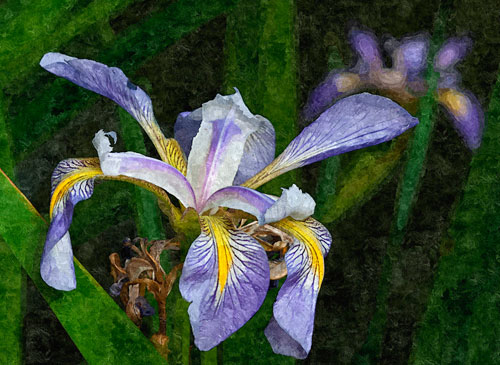
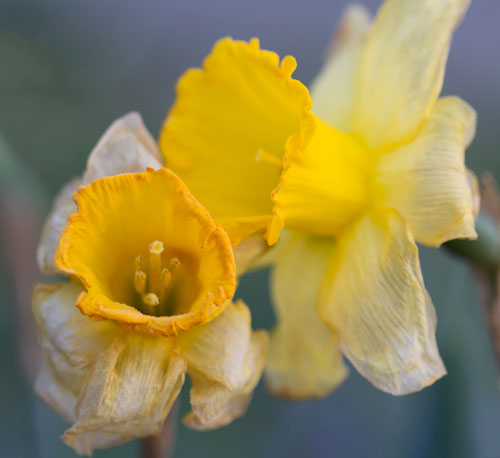
What struck me  was relationships between flowers.  At an objective level there is nothing more there than the juxtaposition of two flowers.  But images tell stories.  We, as observers, become co-authors with the photographer in developing those stories.  What stories do these images tell you?