Photography as conversation

Have you ever been in a conversation where the other party was obviously thinking up what they were going to say instead of listening to you?  Of course you have.  Far too often.  And it’s not as if we aren’t guilty of the same behavior ourselves.  ‘What I have to say is far more important than what you have to say’ is a prevalent attitude although it is seldom directly voiced.  That wouldn’t be polite. On the other hand, how has it felt when someone has genuinely listened to you?  What was that like?  That was a gift, wasn’t it?
This problem of not listening isn’t restricted to conversations. In an interview, the jazz musician Wynton Marsalis complained about the problem of pulling a small jazz ensemble together.  As you know, in many pieces the musicians in the ensemble will play together and then they will take solos and go back to playing together.  Everybody gets a turn at solo.  The problem Marsalis saw was that while one musician was playing solo the others would be off somewhere else in their heads, working their own agendas,  maybe getting ready for their own solos.  It isn’t really an ensemble when that happens.  This, after all, is jazz and the performance is not going to be exactly the same from one day to the next.  It’s a different day, the people are different and the music will be different.  Listening to the other members of the ensemble, really listening, will likely affect how one plays.  After all, it is a kind of conversation.
Photography has a lot in common with conversation, although initially it may not appear that way.  We go out, we see something we like, we take a picture.  Wham, bam, thank you ma’am.  When you are actively listening to someone, really listening, you put your own agenda aside.  Over a period, an agenda, a theme, does develop in the conversation but it very likely isn’t the one you might have predicted – the other individual is contributing to the conversation too.  If you are both listening to one another, really listening, a sense of oneness might develop.  You are each reflecting something about the other individual.
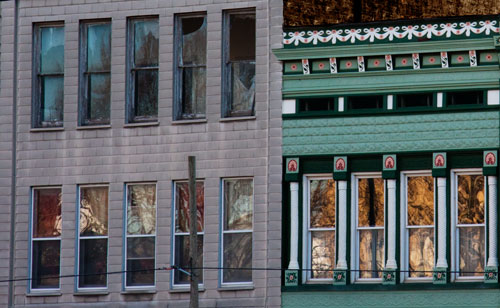
When going out to shoot, even if it is for a specific assignment, why not relax the reins of the going-in-agenda, if you have one, and let the scene communicate with you.  Minor White captured it in this quote:

‘Be still with yourself.  Let the subject generate its own composition.  When the photograph is a mirror of the man, and the man is a mirror of the world, then Spirit might take over.’

Losing one’s self means letting the scene speak to you in its fashion.  This isn’t a matter of walking up to the scene and saying ‘Hi, how are you?’  The form of communication is subtle and I doubt that it can be put into words.  There is no doubt this is difficult and it takes practice, lots and lots of practice, just as active listening in a conversation takes practice.  It takes patience.  When out on a shoot, a place to begin might be to just find a subject and spend some time with it, just looking.  I find that the image I might make changes as I look at it more closely.  Frederick Franck, author of ‘The Zen of Seeing/Drawing as Meditation’, urged students in art workshops to spend two hours with the subject and draw it looking only at the subject and not the paper on which they were drawing.  I would suggest just spending time with the subject.  This isn’t always possible what with the light and conditions changing almost constantly but it is a way of ‘letting the subject generate its own composition.’

We can do some preparation for this kind of photography even when we don’t have a camera with us, even when all we are doing is talking with another individual.   I think that active listening is good practice for developing active looking.  In both cases that agenda, that ego statement is relaxed and something larger and more meaningful can take its place.  Better conversations result and, I believe, better photography comes of it when you pick up your camera.
A trip to New Harmony

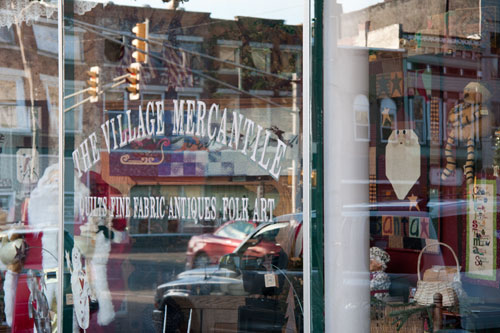
Ellie and I recently spent a few days in New Harmony and enjoyed it immensely.  On the way down, as is her wont, Ellie needed to go to a quilt shop.  This is not something we do on every trip out the door but Ellie does comb her sources for these places and when we have time we stop.  This time the shop was The Village Mercantile in Boonville, IN.


As a seasoned escort to Ellie on these trips I know that I have to find ways of entertaining myself while she does whatever she does in there.  A camera is very useful in this respect.


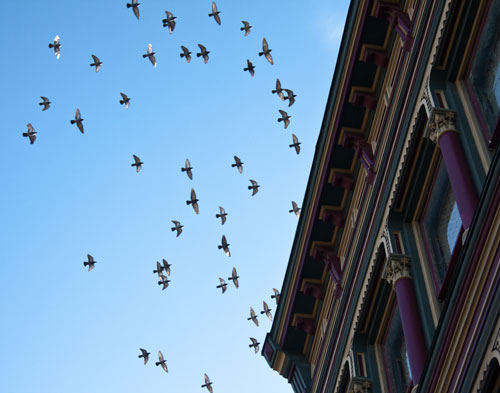
The pigeons were wheeling about and that made a fine subject.  Ellie pronounced this a good quilt shop and we continued to New Harmony.

New Harmony is a beautiful and quiet place, excellent for meditating and sorting things out.  That’s the main reason we go there.


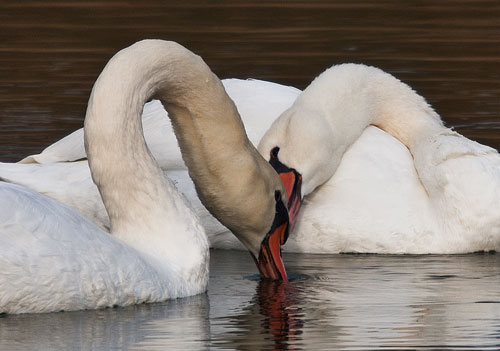
As you can see, there are birds there.  We were out for a walk along the Wabash River and I was composing a shot of the sweep of a bend in the river when Ellie exclaimed ‘There’s a bald eagle!’  ‘Where?’ I asked.  ‘Right over your head!’  Ellie doesn’t always speak with exclamation points but this called for them.  Sure enough, there was the eagle.


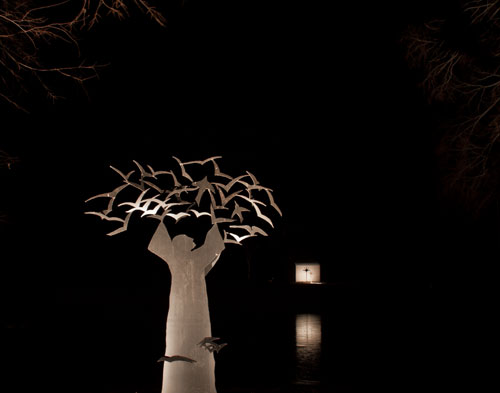
Continuing the bird theme,  they’ve added a metal sculpture of St. Francis and the birds behind the New Harmony Inn.  Here’s a night shot with a small chapel dedicated to St. Francis across the small lake.


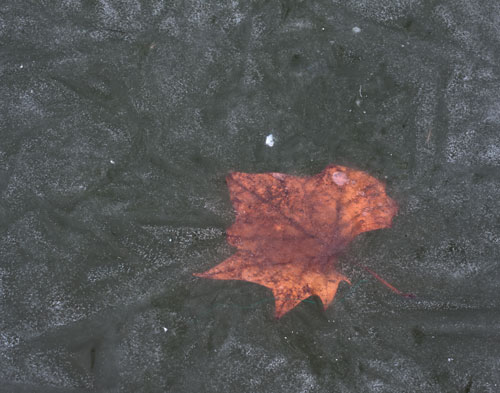
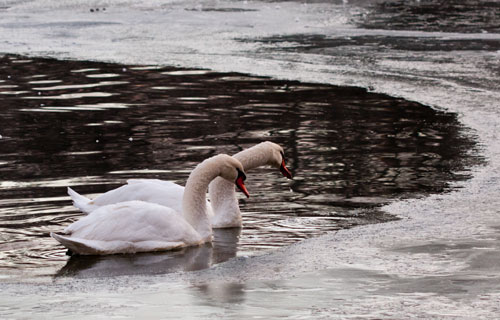
Most of the lake had a thin coating of ice.


Photographic opportunities in the area are good any time of the year.

Highly recommended.


A special day: Afternoon

When I got back from shooting yesterday morning there was a message waiting saying my friend Sally was ready to go shoot.  Was I ready?  Yes.  We went over to Fort Harrison State Park.  A World War II re-enactment was going on so we chose a different part of the park.


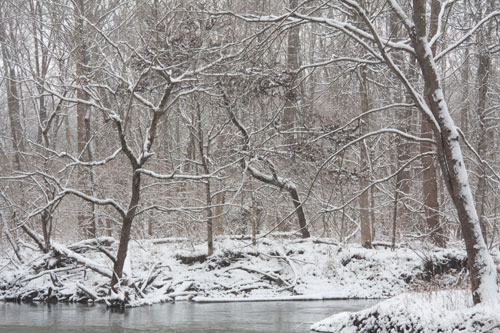
We walked up along Fall Creek and, as was the case in the morning, there were lots of opportunities.


I wonder what today will bring?

A special day: Morning

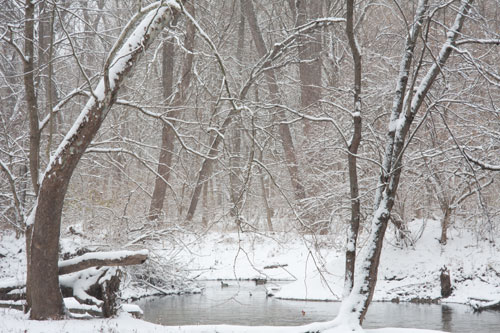
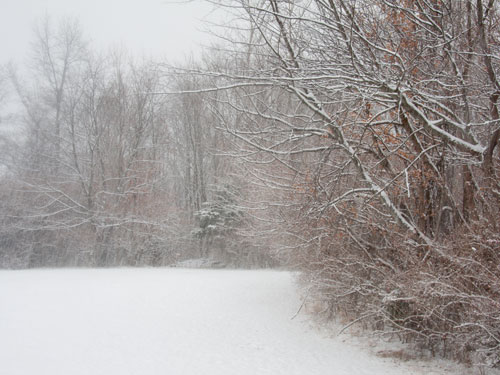
We had our first decent snow of the year yesterday, I suppose it was three or four inches.  I got out to shoot three times.  The opportunities were so many that I am dividing this post into two parts.


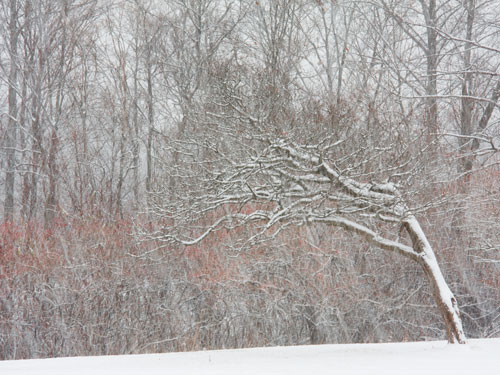
I had gone to see my mother fairly early and stopped along the way home.  This was at the bark park where we take our dogs.  I like how the falling snow is angled parallel to the trunk of the tree.


All of these images will receive a lot more attention before they are ready to print.  I brought them in this morning to celebrate the season.   But wait, there’s more.

Looking for the light

Composition in photography requires a compelling subject shown in ‘good’ light.  Good light for one subject might not be the same as good light for another.  But in any event the light is hugely important and photographers work at finding the right combinations of light and subject.  Some photographers would even argue that the light is the subject.

Sometimes the light comes from the side.


And sometimes from the back.


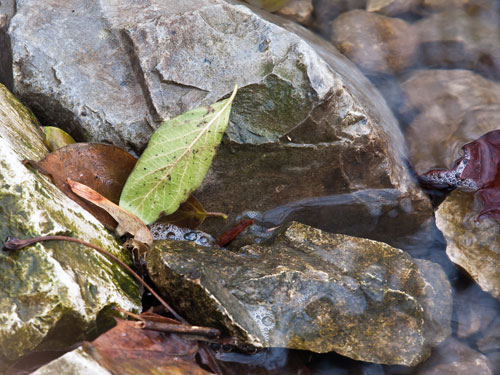
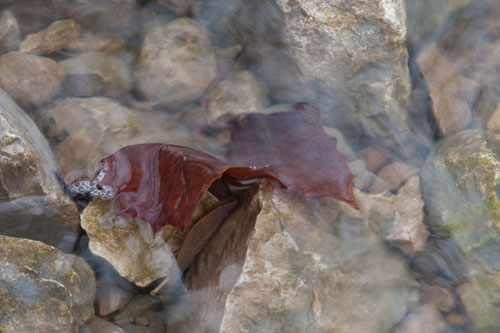
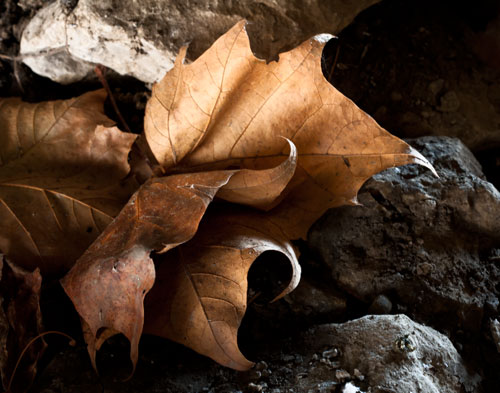
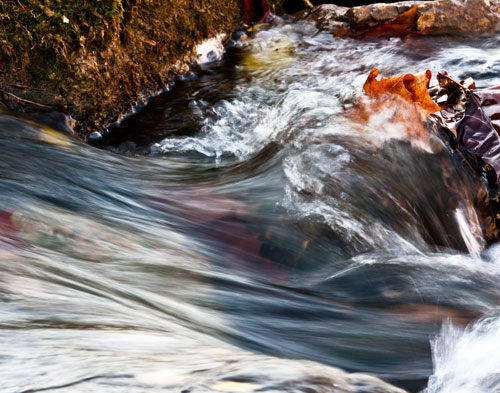
Obviously it can come from the front as well.  Yesterday I stumbled onto a different kind of light, at least different from that I am accustomed to using.  I was walking along Fall Creek (that walk is where all these images came from) and I walked under the bridge supporting I465 to get to some small waterfalls I like.  There are drains in the bridge to prevent puddles of water from building up and there is a course of rock under the bridge to catch the dripping water and carry it to Fall Creek.  The bridge here is more than eleven lanes wide so the area under it is something like a wide tunnel.  It is quite shaded under there and as I was crossing the course of rocks, I noticed some leaves down among them.  Since I had my tripod I could work in the dim light and I was curious to see what images of leaves against rocks would look like.  I was impressed.


The exposures on these shots range from a half second to a second in duration.  The light is mostly diffuse but somewhat directional and I spent a few minutes shooting.


This next one is an HDR shot (a sandwich of three shots – overexposed, underexposed and metered shot) which allows a wider range of exposures to be compressed into a range that can be shown on a screen.


I’m impressed and I will be going back there.

Don’t expect too much

I find that it is best not to expect too much when I go out to shoot.  It narrows the focus and I almost never see exactly what I had hoped to see. 
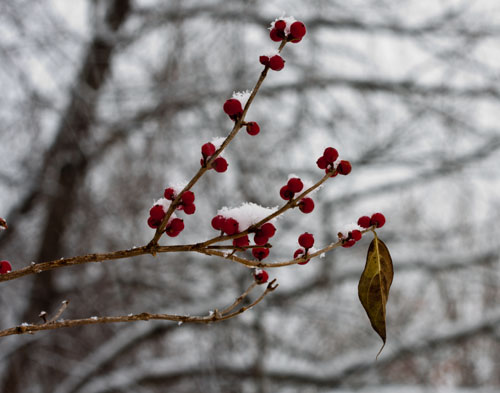
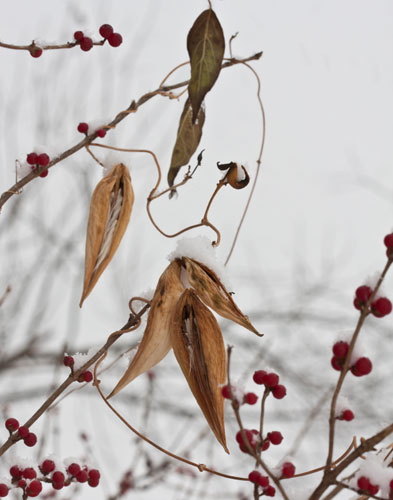
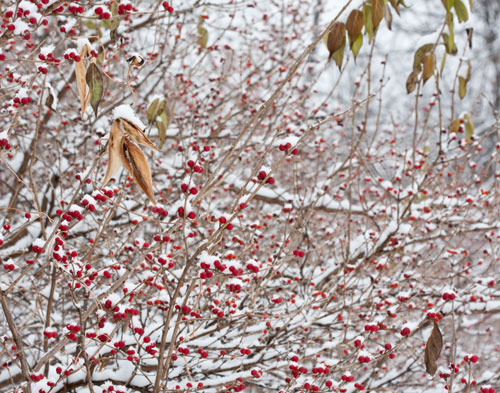
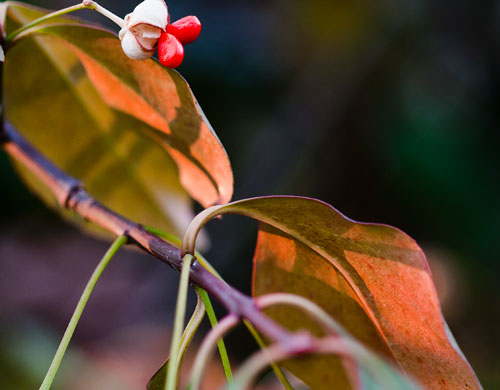
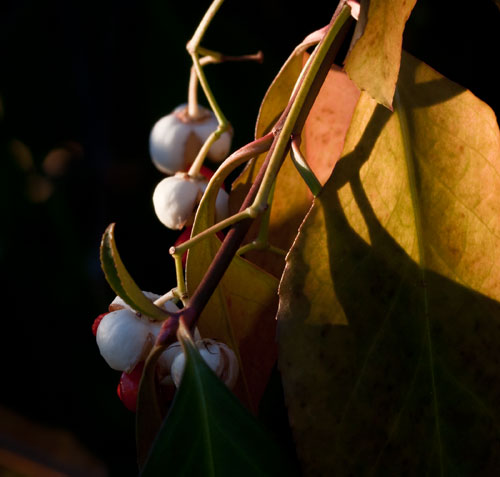
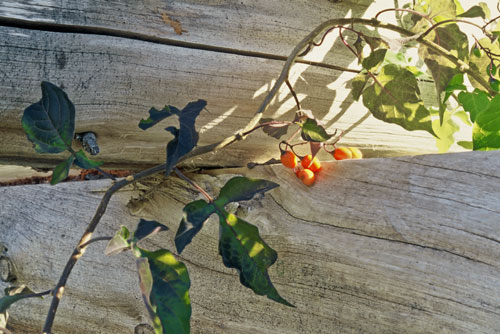
I had gone out to shoot the emerging berries and ended up shooting mainly the leaves.  That was the other day and this is all I have to show for it.

Today was different.  I had no expectations and it was a more satisfying day.


Those are insects in there.  It went down to 23 degrees last night, the first hard frost of the year.  They may have survived.


The last three shots were done outside an orthopedic veterinarian’s office in Franklin.  I had driven a friend and her dog down there.  The dog, 12 years old, had torn a cruciate ligament chasing school buses (inside a fence while the buses were on the street).  She won’t be doing that anymore but the other day the dog went for a ride, saw a school bus from in the car and barked at it.  So now she has a car and a driver, no more running after the buses.


Today the berries look fine but the leaves are wilted.

And then there is this shot, entirely unexpected:


I guess that is what wondering is all about.  If I only saw what I expected to see, what would there be to wonder about?

The infinite in the finite

A friend of mine, the one who got me started using the term ‘wondering around’, recently sent me a poem by Rabindranath Tagore, who was the first Asian to win the Nobel Prize for Literature (1913).  Here’s the poem:

There is a point where in the mystery of
existence contradictions meet;
where movement is not all movement
and stillness is not all stillness;
where the idea and the form,
the within and the without, are united;
where infinite becomes finite,
yet not losing its infinity.

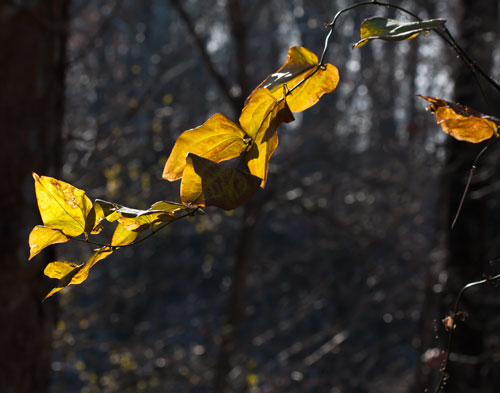
About 10 years ago I took a workshop with Freeman Patterson.  In the course of the workshop, he made a point of talking with each participant and discovering something that was of particular interest to that individual.  It was in October and I said something about the upcoming  Spirit and Place festival in Indianapolis.  The day before the end of the workshop he gave each of us a photo essay assignment to be completed in 24 hours.  Mine was ‘Spirit and Leaves’.  Here are a couple of images from that trip:


Ever since then I have worked at finding external correlates to internal states.  Or, more to the point, I want to reflect states of being such as peace, stillness, reflection, spirituality etc. in photographs.

When my friend – I’ll call her S – sent me the Tragore poem I was moved to treat it as a source of ideas for photographs.  For example, what single image would best reflect what I was getting out of the poem?  I’m sure my answer to that will change over time and I will keep coming back to it because I love the poem.  Here’s today’s version of the image, I don’t know what I will think tomorrow.  The poem is repeated below the image.  You might try this exercise yourself.  Let me know you make out with it.

There is a point where in the mystery of
existence contradictions meet;
where movement is not all movement
and stillness is not all stillness;
where the idea and the form,
the within and the without, are united;
where infinite becomes finite,
yet not losing its infinity.

Thanks, Freeman, I’m still working on the assignment.

The leaves are just about gone

We have a lot of trees around our house; that is one of the reasons we bought it 30 years ago.  The walnut leaves have been gone for some time as have most of the hickory leaves.  Some oak leaves are hanging on but they are coming down too.  I went out today to work on finishing getting the leaves off the ‘lawn’ but  it was so windy I decided to wait.  No point having to do it twice.

The leaves at Fort Harrison are largely gone.


I expect these will be gone in the next few days.


But as leaves are falling the sycamores are standing out more.  And there are still a few hangers on.


Their going is not without its beauty as well.


Sic transit gloria.
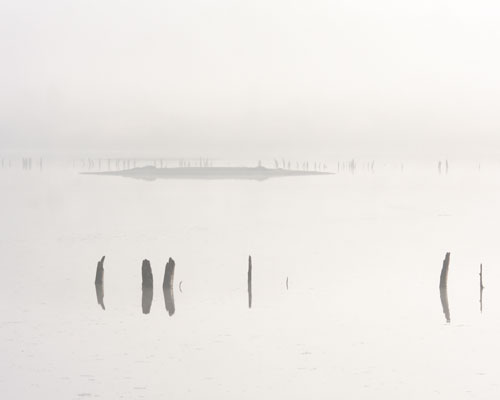
Great day in the morning

The average episode of going out to shoot is at least satisfying.  There are a few times that don’t get up to that level, but there are others that exceed it.  Today set a new standard.


Four of us from Photo Venture Camera Club went to Muscatatuck National Wildlife Refuge this morning.  It is hunting season there and we were confined to just a part of the area.  This, however, was more than enough.

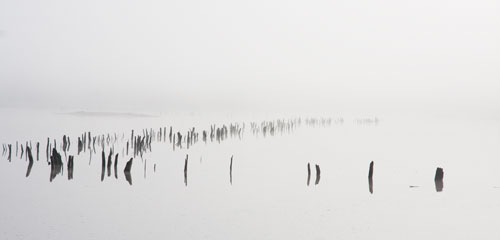
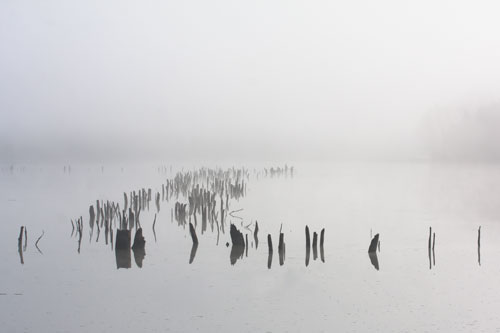
There was a nice fog this morning which fortunately was still largely present when we arrived.  It helped produce photographs reminiscent of Michael Kenna’s work.


As the morning went on the fog lifted and the light was sweet.


The opportunity to be there was a great reward and to actually bring home images that in some way reflect what it was like is over the top.


What a great way to spend a morning.


I’ll be going back.