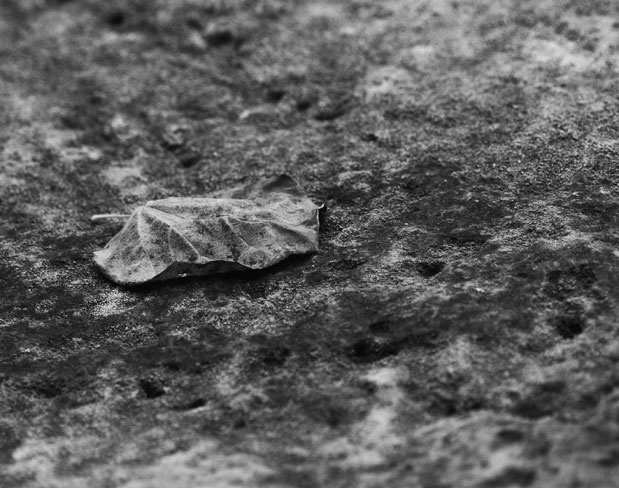
leaf passing by
sea turned to rock

leaf passing by
sea turned to rock

A bright, warm Saturday afternoon in October, what could be better than going for a ride in the country to find apples and black walnut fudge?
Alex and Claire had been married a year now and whatever they did, they plunged in and found the fun in it. Responsible people on their jobs during the week, they walled off the weekend for their time together. Work hard, play hard together, that’s Alex and Claire.
Apple in the cup holder and fudge in his right hand, Alex steered with his left. “Oh this fudge is good” he said. “There’s nothing that sets it off better than black walnuts, a dark, delicious taste.”
Claire agreed.
Alex and Claire had never been back in here, along this road. A dirt road but well kept.
Alex was perhaps concentrating a little too much on the fudge as they went around the bend.
Sheep! A herd of sheep in the road! Alex slammed on the brake, fishtailed and corrected but not fast enough to save one of the sheep. It was pretty clearly dead as it lay in the road.
Alex jumped out of the car and the farmer yelled “What are doin’ Mister, drivin’ so fast on these roads? You killed one of my favorite ewes.”
Alex was speechless. He tried to swallow but couldn’t. He pulled himself together and said “I’m very sorry and I know that is not nearly enough. What can I do to make up for this?”
The farmer scratched his chin with a broken finger nail, looked up at the sky and said “I know you didn’t mean to do that but I’m out one good ewe. $200 would help.”
Alex and Claire counted out their money and handed the farmer ten $20 bills.
The farmer took them, licked his finger and counted the money. “OK. I’ll move the herd and you can go on. But you be more careful.”
Just then a police car came around the bend and just missed the closest sheep before it stopped. It was a county cop and he took down Alex’s license number and checked it before getting out of his cruiser. He opened the door and got out, his belt creaking with the pistol, baton, bullet case, flashlight and handcuffs he had on it. He walked, not fast, not slow, over to Alex and the farmer.
Ignoring Alex, the cop turned to the farmer and said “Orvie, we’ve talked about this in the past. You’ve pulled this trick once too often. Get those sheep back in the field. You and I are going for a little ride.”
The cop turned to Alex and said “Well, you were going too fast coming around that curve weren’t you? How much did Orvie take you for?”
“$200.” Alex said, rather abashed.
“There’s a lesson for you. Why don’t you go on your way and just be more careful, will you?”
I don’t know where I first heard of it but I’ve recently been intrigued with the idea of wabi sabi, which appears to be so deeply embedded in Japanese culture that native Japanese don’t, and possibly can’t, give a clear picture of what it is. For them it just is. I’ve read several books about it, all by Western authors. One of these authors says that he has found no book on wabi sabi written by a Japanese. Perhaps in one culture there is only a need to experience and not explain while in our culture there is a need to explain just about everything.
The description that, so far, I find most satisfying is given by Andrew Juniper:
If an object or expression can bring about, within us, a sense of serene melancholy and a spiritual longing, then that object could be said to be wabi sabi.
Perhaps it is better to illustrate the idea rather than talk too much about it. I am a novice concerning this concept and what I write will be the thoughts of a novice. Might be better to show what it could mean and write about it just a little bit.

One of the defining features of wabi sabi is impermanence. This morning I had seen the light falling on a leaf just so. It was perfect. I went into the house, got my camera and tripod, came out and the light had changed. That moment of perfection of light and leaf was gone. But there were others. This one didn’t look like much at first but then the light touched it.
Another defining feature is simplicity.

But there is more in this image than simplicity, there are also other key features of wabi sabi, imperfection and impermanence. This car from a train is rusting away and will be dust someday.
Impermanence operates on every time scale. The backwash of water in the lower left in this image from the White River was gone in under a second. I am sure the leaves moved on when the water rose again. The rock and concrete are wearing down.

Simplicity, imperfection, impermanence. All these are part of life. There is beauty in all of it, if we’ll just stop and look. But what beauty was there when my father was dying from cancer? Where I saw beauty was in his dignity and his newly formed relationships with the hospice nurses. There was much beauty there. If there can be be beauty there, there can be beauty just about anywhere. Melancholy? Yes. Serenity in awareness? Yes.
Several members of our camera club went down to the Red River Gorge a few weeks ago. We had beautiful weather and many of the leaves were still on the trees.

If the weather had been like that of the previous week – rain, rain and more rain – we might have spent a lot of time indoors playing checkers or something. But the weather was a gift.
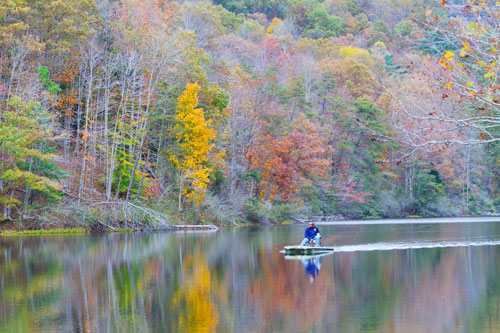
I don’t think this fellow caught anything but then I don’t think he cared.

We spend a lot of moments thinking about the future or the past. With a scene like this there is a strong call to stay right here in the present.
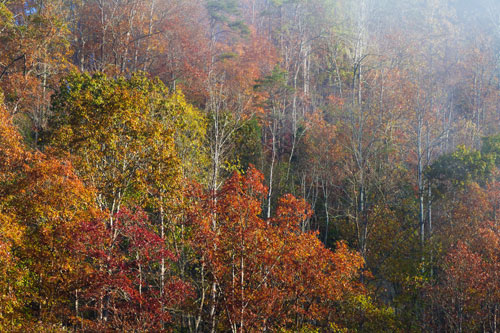


I’m ready to go again.
This last month and a half has been quite busy and I brought down the level of activity with a retreat in southwestern Indiana last week.

This was at Willow Pond Retreat, a small retreat center owned by Charles and Sarah Gipson. Charles had been pastor at Church of the Saviour in Indianapolis in the period just before my wife and I joined that community. I was at the retreat center for several days and while I spent a lot of time photographing the beautiful landscape, I found myself concentrating on the one acre pond that is part of the retreat center and within the pond, just along the shore.
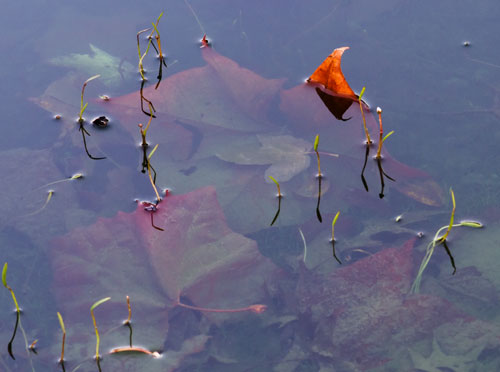
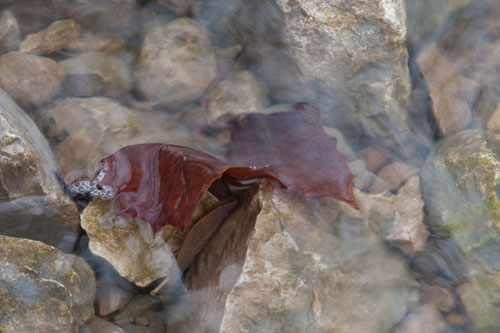
Leaves in water are fascinating.

I suppose one could see melancholy in photographing in the autumn but it is enormously inspiring to me.

Inspiring because there is beauty in both the life and death of these leaves and beyond that, regeneration will follow.
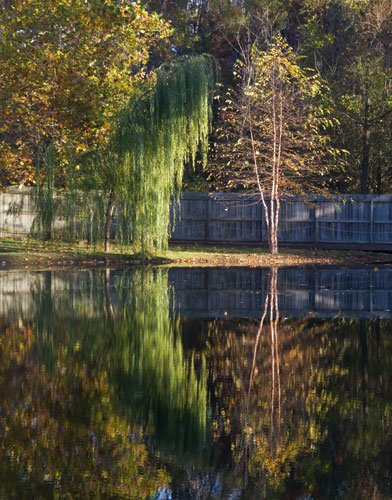
Is this a metaphor for our own lives? We can see beauty in life all around us and my mother in some respects became even more beautiful as she was dying. Mom remains as a gift that will be with me for the rest of my life.

But what about regeneration, life after death? My religion teaches that there is life beyond but I can’t speak from personal experience.
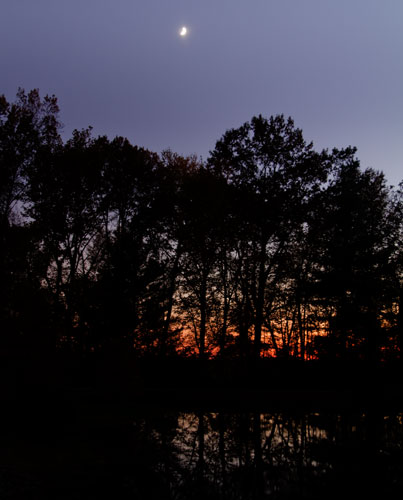
All I can say for sure is that there is life here and now and our sacred job is to live it. Thank you, Charles and Sarah.
Might tunnel vision give us just a glimpse of the larger world?

Just looking helps a lot.

Have you ever been in a conversation where the other party was obviously thinking up what they were going to say instead of listening to you? Of course you have. Far too often. And it’s not as if we aren’t guilty of the same behavior ourselves. ‘What I have to say is far more important than what you have to say’ is a prevalent attitude although it is seldom directly voiced. That wouldn’t be polite. On the other hand, how has it felt when someone has genuinely listened to you? What was that like? That was a gift, wasn’t it?
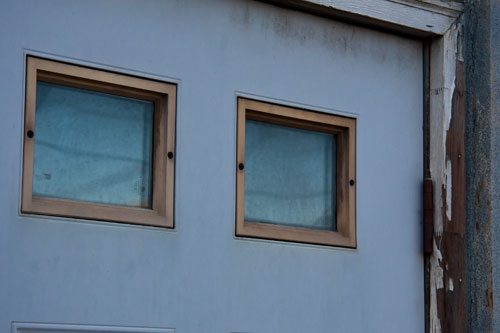
This problem of not listening isn’t restricted to conversations. In an interview, the jazz musician Wynton Marsalis complained about the problem of pulling a small jazz ensemble together. As you know, in many pieces the musicians in the ensemble will play together and then they will take solos and go back to playing together. Everybody gets a turn at solo. The problem Marsalis saw was that while one musician was playing solo the others would be off somewhere else in their heads, working their own agendas, maybe getting ready for their own solos. It isn’t really an ensemble when that happens. This, after all, is jazz and the performance is not going to be exactly the same from one day to the next. It’s a different day, the people are different and the music will be different. Listening to the other members of the ensemble, really listening, will likely affect how one plays. After all, it is a kind of conversation.
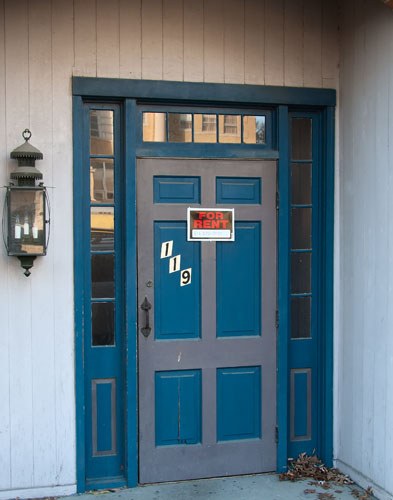
Photography has a lot in common with conversation, although initially it may not appear that way. We go out, we see something we like, we take a picture. Wham, bam, thank you ma’am. When you are actively listening to someone, really listening, you put your own agenda aside. Over a period, an agenda, a theme, does develop in the conversation but it very likely isn’t the one you might have predicted – the other individual is contributing to the conversation too. If you are both listening to one another, really listening, a sense of oneness might develop. You are each reflecting something about the other individual.
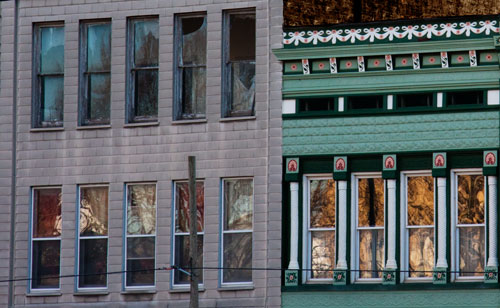
When going out to shoot, even if it is for a specific assignment, why not relax the reins of the going-in-agenda, if you have one, and let the scene communicate with you. Minor White captured it in this quote:
‘Be still with yourself. Let the subject generate its own composition. When the photograph is a mirror of the man, and the man is a mirror of the world, then Spirit might take over.’
Losing one’s self means letting the scene speak to you in its fashion. This isn’t a matter of walking up to the scene and saying ‘Hi, how are you?’ The form of communication is subtle and I doubt that it can be put into words. There is no doubt this is difficult and it takes practice, lots and lots of practice, just as active listening in a conversation takes practice. It takes patience. When out on a shoot, a place to begin might be to just find a subject and spend some time with it, just looking. I find that the image I might make changes as I look at it more closely. Frederick Franck, author of ‘The Zen of Seeing/Drawing as Meditation’, urged students in art workshops to spend two hours with the subject and draw it looking only at the subject and not the paper on which they were drawing. I would suggest just spending time with the subject. This isn’t always possible what with the light and conditions changing almost constantly but it is a way of ‘letting the subject generate its own composition.’
We can do some preparation for this kind of photography even when we don’t have a camera with us, even when all we are doing is talking with another individual. I think that active listening is good practice for developing active looking. In both cases that agenda, that ego statement is relaxed and something larger and more meaningful can take its place. Better conversations result and, I believe, better photography comes of it when you pick up your camera.
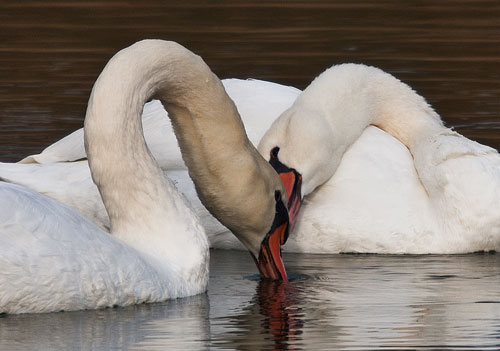
Ellie and I recently spent a few days in New Harmony and enjoyed it immensely. On the way down, as is her wont, Ellie needed to go to a quilt shop. This is not something we do on every trip out the door but Ellie does comb her sources for these places and when we have time we stop. This time the shop was The Village Mercantile in Boonville, IN.
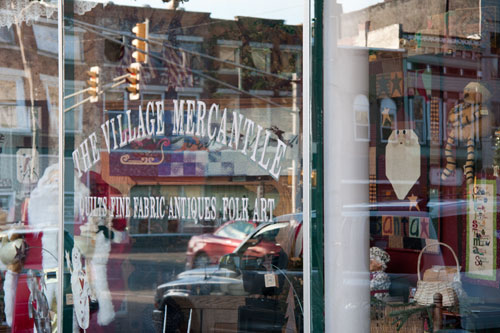
As a seasoned escort to Ellie on these trips I know that I have to find ways of entertaining myself while she does whatever she does in there. A camera is very useful in this respect.
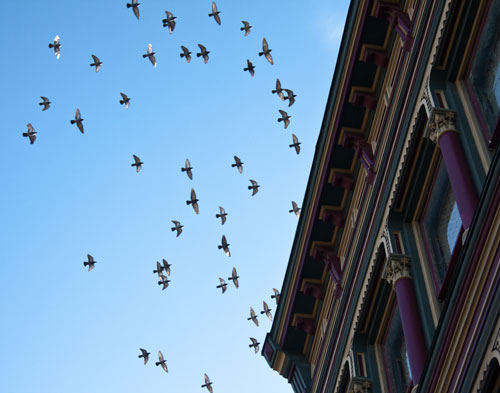
The pigeons were wheeling about and that made a fine subject. Ellie pronounced this a good quilt shop and we continued to New Harmony.
New Harmony is a beautiful and quiet place, excellent for meditating and sorting things out. That’s the main reason we go there.
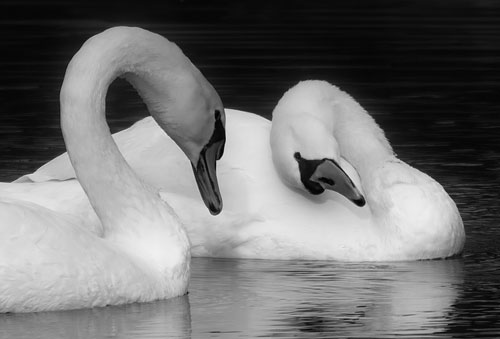
As you can see, there are birds there. We were out for a walk along the Wabash River and I was composing a shot of the sweep of a bend in the river when Ellie exclaimed ‘There’s a bald eagle!’ ‘Where?’ I asked. ‘Right over your head!’ Ellie doesn’t always speak with exclamation points but this called for them. Sure enough, there was the eagle.

Continuing the bird theme, they’ve added a metal sculpture of St. Francis and the birds behind the New Harmony Inn. Here’s a night shot with a small chapel dedicated to St. Francis across the small lake.
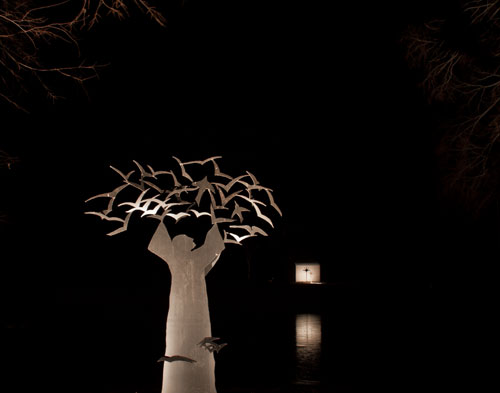
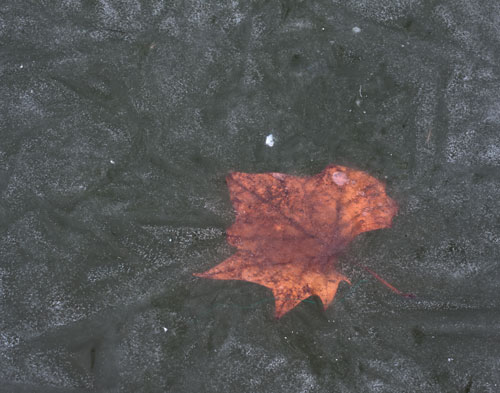
Most of the lake had a thin coating of ice.
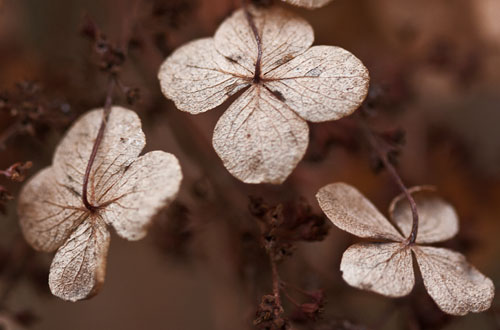
Photographic opportunities in the area are good any time of the year.
Highly recommended.

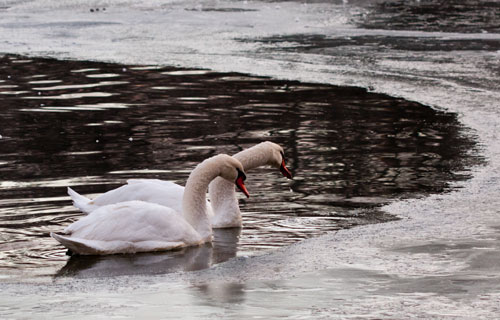
When I got back from shooting yesterday morning there was a message waiting saying my friend Sally was ready to go shoot. Was I ready? Yes. We went over to Fort Harrison State Park. A World War II re-enactment was going on so we chose a different part of the park.
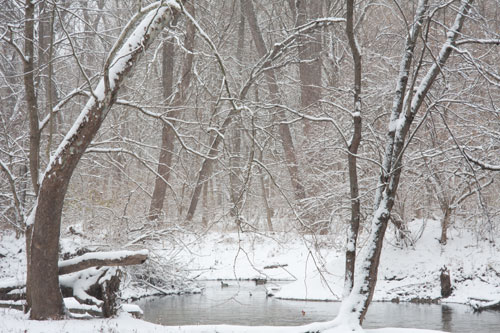
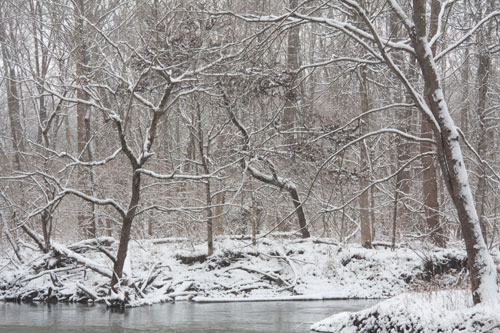
We walked up along Fall Creek and, as was the case in the morning, there were lots of opportunities.
I wonder what today will bring?
 Spirit and Seeing