Macro photography: Come closer

Yesterday I talked about a recent program on macro photography at our camera club.  I prepared for that meeting by putting my macro lens on the camera and going out over a couple of days to get back in practice with it.  The lens I use does not permit focusing any closer than about a foot away.  We won’t be doing insect retinography with this lens because it can’t get that close but it does offer other possibilities at this kind of middle distance that I prefer.

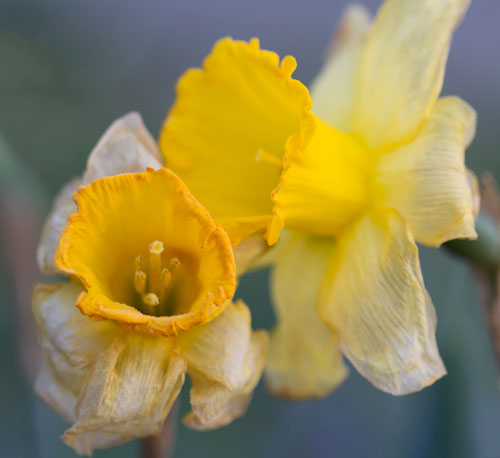
What struck me  was relationships between flowers.  At an objective level there is nothing more there than the juxtaposition of two flowers.  But images tell stories.  We, as observers, become co-authors with the photographer in developing those stories.  What stories do these images tell you?

Flowering tree


Do scenes or images of scenes communicate with you?

Our camera club was meeting last night at the Indianapolis Art Center and the topic was macro or close-up photography.  This was as much workshop as lecture and a lot of people were inside taking close-ups of small objects.  This is a great technique for seeing what is very small and not at all obvious to the eye busy with other sights.  They were using flash and other artificial lights because it was rather dark in there.   Because I don’t usually like to shoot with anything but natural light, I got out of their way and went outside.  They were having a good time and doing fine work.  I would find my good time outside.

I can’t tell you what kind of flowering tree this is, there are many species at the Art Center.  But I did find it hugely attractive.  At the time, it said “Japanese garden” to me.  Getting it home and seeing it on the screen brought out  a larger story.

I had started reading Jonah Lehrer’s “Imagine” the other day and this image contributed one understanding of what Mr. Lehrer was talking about.  His book is about creativity.  It brings in neuropsychology, personality, “mental illness” and many other areas of research in trying to better understand this most precious and human capacity that, truly, is so dimly understood.  One of his points is that it’s not  just the case that creativity can take any number of paths but that there are many kinds of creativity.  Let’s leave it at that for the present so we can get on with this post.  Read the book.

When I first saw the tree I thought I would eliminate the building and just show the tree with perhaps some flowers at the bottom.  But the more I looked at it, the more I thought the building was contributing to the image.  The horizontal lines in the wall and the vertical drain pipe form a frame for the tree.  But while most of the tree fits within the boundaries of the frame, some of it doesn’t.  And that is one part of what a lot of creativity is about.  It fits to some extent in the conventional frame of reference but at the same time is moving out of the frame.  If it catches on with the populace, the frame might expand.

This was not macro photography but it was made with a 100 mm f/2.8 Canon macro lens.  This translates into “good lens”.  More on macro work tomorrow.

Life beyond butterflies

I went over to Fort Harrison State Park this morning and instead of heading to the area where I’ve seen the most butterflies, I went in another direction.  It wasn’t that I didn’t expect to see butterflies in the old location, the question was whether I could find happiness in subjects other than butterflies (soft plaintive violins in the background).


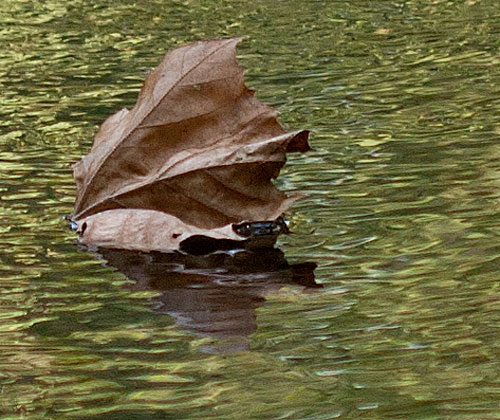
A leaf in the water.  Not bad if all we want to do is aim the camera away from butterflies.  But not too good either.  Try again.


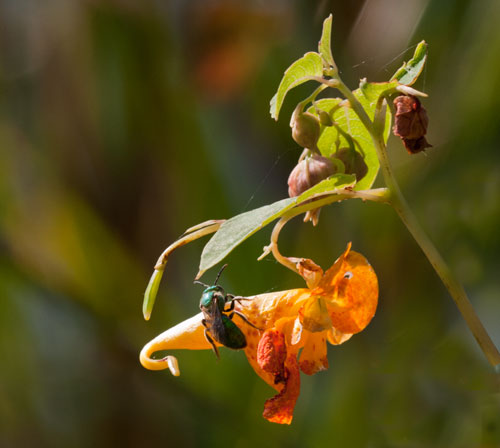
Jewelweed is nice, very bright and I can’t say I have ever noticed an insect like that before; one of the benefits of macro photography.


Now I like that.  I can’t count the number of times I’ve walked by little beauties like this.  Once again, a benefit of going out with a macro lens.  I’ve noticed that when I have a telephoto lens on the camera, I tend to see more telephoto opportunities.  Today I was using my 100 mm macro lens.  This lens works as a moderate telephoto but I tend to think of it more in its macro application.

Here’s the high point of the morning.


I love back lit shots.  A very important lesson came out of this morning’s jaunt.  I was headed east on the Fall Creek Trail because I picked up the trail at its western end – walking toward the sun, accidentally creating the opportunity for back lit shots.  There were many opportunities.  I went a couple of hundred yards past the area of this shot and turned around looking for what other opportunities I could find.  There weren’t many.  If you like back lighting try going east in the morning and west in the evening.  Writing this down is a little embarrassing.  Of course that is what we would do to get back lit shots.  This is one of those points that is so obvious it needs to be stated.

And yes, there is happiness beyond butterflies.