Meanwhile, back at the Indianapolis Art Center

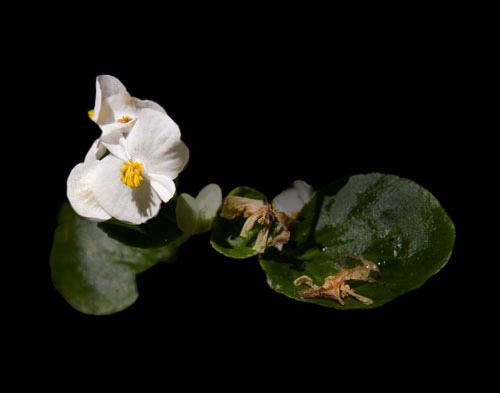
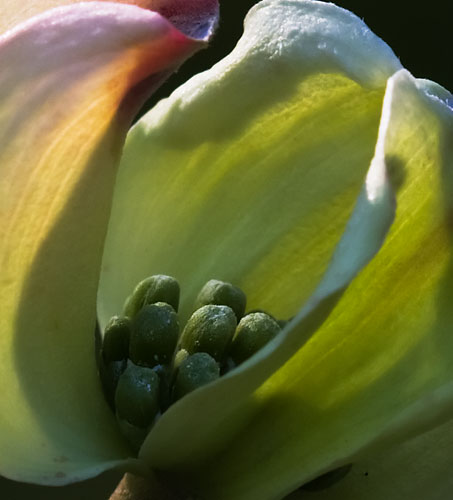
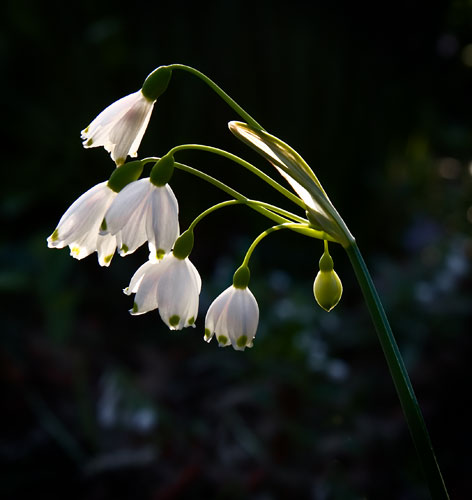
Our camera club meets at the Indianapolis Art Center every week.  I often go early with my camera looking for opportunities.  I had shot flowers on this plant two weeks in a row and I was over there again this morning to shoot this flower.  I have come back to this plant four times.
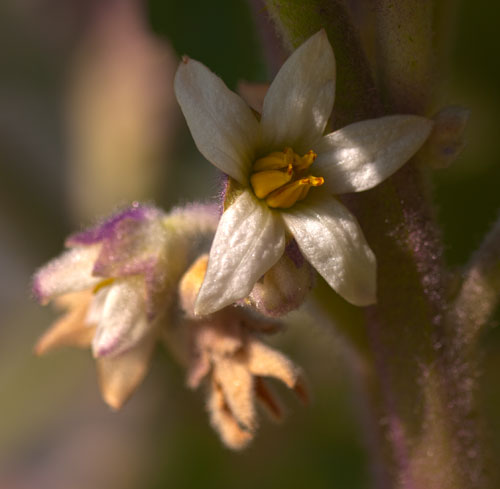

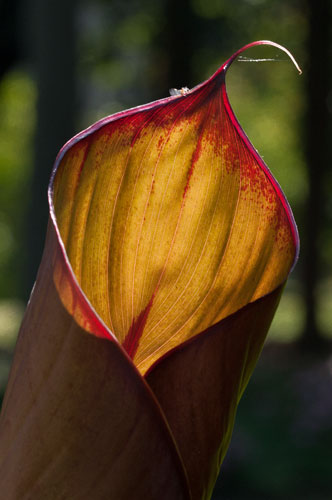
This is a rather small flower, probably less than an inch from the tip of one petal to that of another and it was under a rather large leaf.  But there it was and I kept coming back.  I can’t identify the plant, it is probably exotic, perhaps from Africa or Asia.  Here is the leaf in case you can help identify it – it is about a foot long.


Interesting how one flower can capture us and bring us back repeatedly.  Fortunately it stays fresh for several days.

It was breezy this morning and elsewhere on the grounds of the Art Center these large leaves were waving in the breeze.  I don’t know what plant this is either, the leaves were about three feet long.

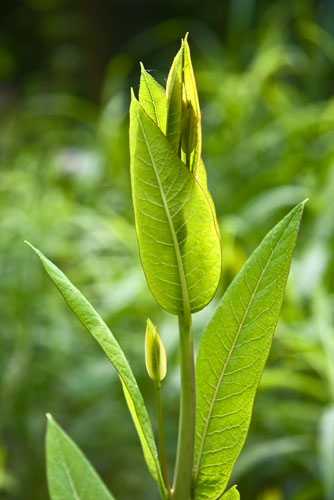
That is a new leaf unfurling in front of a mature leaf.  Shooting up close with the the wind blowing the leaves around made for a crap shoot as far as any given image was concerned but with a digital camera and a large CF card, I could take several pictures.  I hate to think of shooting with film under these conditions, one or two shots would have had to suffice; film is expensive.

Here is the mature leaf by itself:


And the new leaf alone:
Worth waiting for.

It was a good morning and I went home satisfied that I had more than I expected to get.  But I will still go back again for that special flower:


One small technical note: both flower shots are actually comprised of three images each shot at different exposures.  They were assembled with the High Dynamic Range tools in Photoshop CS5.  That software is doing its job.
No good excuse

I’ve been away from posting for nearly two months.  Where has the time gone?  And why away at all?  No good reason – I didn’t feel like it.  In fact I preach doing what you love even when you don’t feel like it and I guess I had better pay attention to that.  I suppose that sentence is a bit self contradictory but I think you know what I mean.  What got me going again were two women.  One was Elizabeth Gilbert talking about creativity in the outstanding series of talks available at www.ted.com.  She was making exactly that point – that it is important to keep going with your creative effort whether you feel like it or not.  Well worth seeing.
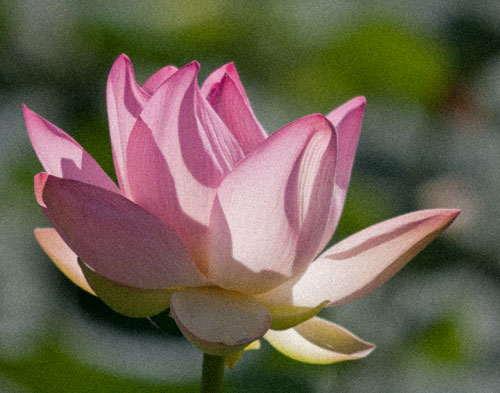
The other woman was my friend Becky who said ‘hey, let’s go shoot some lotus blossoms.’  So we did.


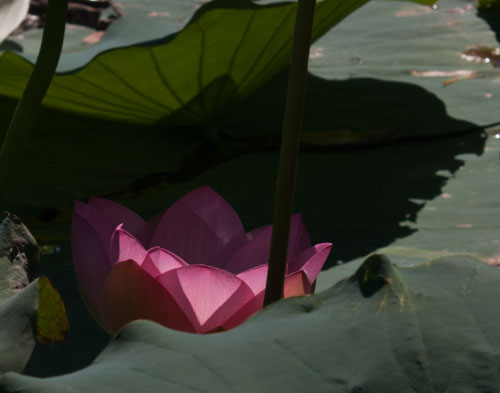
It was a good day for shooting. I say ‘good’ because it was sunny but the light was not too intense and, especially, because we were enjoying a break from a long spell of hot weather.


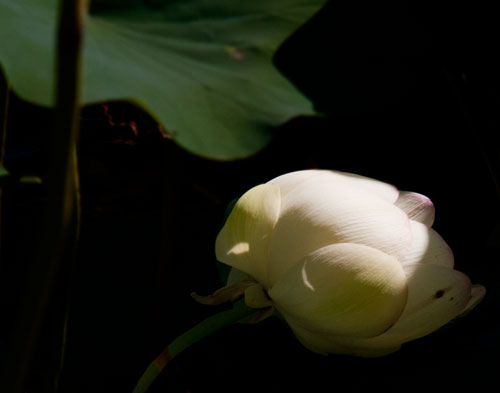
I keep coming back to images with a lot of light and heavy shadow.


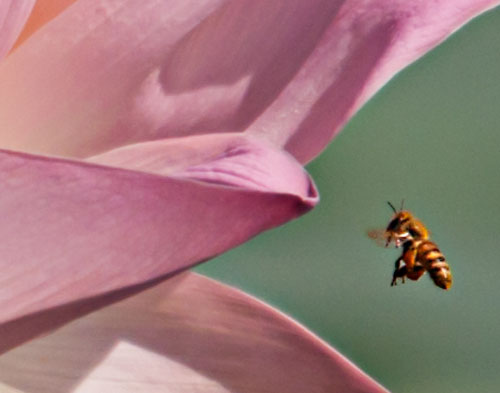
And the bees keep coming back to the blossoms.


More later.  Not much later, I hope.

100 Acres IMA part 2

Our camera club went to the 100 Acres at the Indianapolis Museum of Art last night.  It was almost as much fun watching everyone else shoot as it was to take pictures myself.  Photographers are generally pretty careful about getting in one another’s way but it will happen from time to time.  No loss here, I kind of like it.

These two rings cast shadows exactly superimposed on one another on the ground at the summer equinox.  The rest of the year they are simply interesting to see.

There is a 35 acre lake as part of the 100 acres.  That is where I spent most of my time this trip.

This is called the I-Land, an experimental living space in the middle of the lake.  Two art students are living there this summer.  They, working with Andrea Zittel, the artist who designed it, will modify it in light of their needs.  It is made of fiberglass and is mounted on a small constructed island.

In the midst of exciting modern art we still find examples of art that has been with us how long?  Since before there were humans.

Into the wilds of Ohio

I grew up in southwestern Pennsylvania and the view from Interstate 70 going across Ohio gave the impression of one of the more cultivated states in the country.

Cultivated in the sense of land used for agriculture.  So I wasn’t ready for the Hocking Hills area, about an hour south of Columbus, where Ellie and I spent the last few days celebrating our 48th wedding anniversary.  It is very hilly and covered with forests.  We had a grand time.


There is a lot of sandstone in the area and a lot of gorges cut by streams.  Above, for example is a detail of Ash Cave which was a meeting place for early settlers and most likely before them, for Indian tribes.  And there are lots of waterfalls, the one below is in Conkle’s Hollow.

Ellie being a quilter meant that we looked up quilt shops in the area which gave me the opportunity to wander around the alleys of Nelsonville.

I think that is a set of bars over a window covered with wood.

The Fourth of July is on its way and this flag was near a country quilt shop Ellie found.

We can recommend the Hocking Hills area of Ohio as an excellent place for a get away.  We’ll be going back.

Imagine that

Every once in awhile I find it useful to stop and think about what digital image editing has made possible.  We go out and shoot and then bring the digital files home to the computer.  They are brought up in Photoshop or some other editing program.  In many cases the image is supposed to be pretty close to what was seen.  Contrast might be enhanced a bit, the brightness of the image raised or lowered a little, color is corrected and the image is sharpened.   The image is now ready to go and it does look rather like the original scene.  In other words, what was done was pretty much the digital counterpart to what might have been done in the darkroom a generation ago.

I put an image in my last post that was approached, from the very outset, in a radically different way.  Here’s the final image:

As I said at the time, I had taken the long route to the library.  This took me past a local hospital.

As soon as I saw this I knew what the final image would be.  It was virtually instantaneous.  No question arose about whether that final image was possible, the only questions were whether the clouds and light would still be good after I had gone home and come back with the camera (note to self: always take the camera with you).  They were.  I got this additional image to serve as a background.

I pulled the skyway out of the one image, put it in the other and masked out the ends of the skyway.  It took less than an hour.  What I imagined before taking any photographs was very similar to what I ended up with.

My studio (our daughter’s old room) is on the second floor of our house and I can see lots of trees out the window.  The light was coming up nicely early this morning and I could see that it would be possible to have a shot that emphasized the diagonal strip of light.  Here is what came out of the camera:

This was not what I had in mind.  I had envisioned a lot more contrast between the lighted area and the background.  I knew it wouldn’t show properly in the image as taken, it was  matter of going to Photoshop to complete the image as imagined.  I hadn’t envisioned it as a black and white image, that was a possibility that arose when I got into Photoshop.  Here is the result:
The point of all this is to say that where in the days of film imaginative exploration of what could be done with an image once it came out of the camera was pretty limited unless one were very skilled in the darkroom.  Now, in many but not all cases,  it isn’t much of a hop at all to go from  what we see in our heads to what we see in the final image.

It is unfortunate that the noun Photoshop has been turned into a verb (Photoshopping) and that new word is pejorative.  If one is out to document what was there, it is acceptable to color correct, add or reduce contrast change the brightness and sharpen, all within limits.  If on the other hand, the intent is to show something about the photographer’s emotional reaction to the scene or if what is photographed is to become a set of elements available for inclusion in an imagined final scene, all bets are off on what is included, excluded or changed.

I for one think of myself as a visual poet.  I’m not a documentary photographer.  The photograph as taken is grist for the image that will result.  I don’t always mention what I did because it is usually quite beside the point.  But if you ever have a question about the faithfulness of the images you see here to the image that was stored in the camera, feel free to ask.  I’ll tell you exactly what I did.  So I will leave you with this:

The possibility of doing digital image editing has been a real Godsend to me.  I’ve always lived in my imagination and the possibility of realizing some of that imagining means a lot.

Time to get back to it

The last several days we have been having an unsettled but recurring weather pattern.

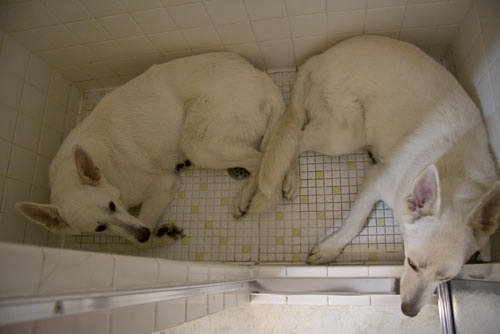
The clouds go dark in the early evening, the wind whips up to as much as 50 or 60 miles an hour and a deluge starts with lightning and thunder accompaniment.  After a few minutes the wind dies down and the rain stops.  The thunder rolls into the distance.   It’s all quite dramatic.  Too dramatic for the dogs:

They head for the stall shower and stay there well into the night.

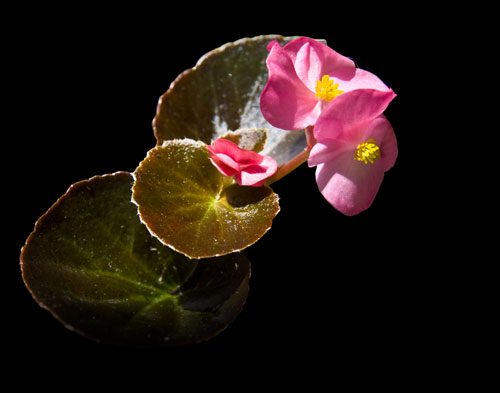
Unsettled would describe my photography recently as well.  I’m not seeing the opportunities that I know are there.  Flowers, such as these begonias are alright but I’d like something a little different.

The opportunity came today in the form of taking the long way around to go to the library.

The tentative name for this is ‘Can I get there from here?’ which might be symbolic of my slump recently.  Perhaps the best thing to do is close my eyes, take a deep breath, open the eyes and look around.  Who knows what there is to see and wonder about?

That calls for some reflection.

A simple spirituality: Part 4

Spirit and seeing, spirituality and photography.  I believe that each nourishes the other.  Right, but how does that work?  How do they fit together and nourish one another?

This is one of those things I know to be true but it is mysterious and I find it difficult to put into words.  I’ll begin by repeating what I have written before about the nature of spirituality.  Here’s the working definition:

‘the pattern of beliefs, attitudes and feelings about the Sacred and the world – a pattern that defines who you are at the profoundest level.’ (From Skylight Paths, Who Is My God?: An Innovative Guide to Finding Your Spiritual Identity, Skylight Paths Publishing; March 2004, p5)

This is essentially the definition of personality with the addition that the Sacred is placed at the center.  Viewed most broadly, an individual’s spirituality is always a part of what that individual thinks or does.  It doesn’t have to be a thought or an act with spirituality actively in mind, it is there whether we recognize it or not.  In an important way then, our spirituality as well as our personality colors and frames the way we think and behave.  Of course there are times when we don’t act according to our best spiritual selves.  The apostle Paul made this point when he wrote

We know that the law is spiritual; but I am carnal, sold under sin.
I do not understand my own actions. For I do not do what I want, but I do the very thing I hate.
Romans 7: 14-15

I would be surprised if all major religions did not share this lament.  So we don’t always act according to who we are at the profoundest level.

In my simple spirituality, everything is interconnected.  God is in all, all is in God.  So when I go out to shoot, there is a strong sense of wonder at God’s creation.  Looking through the viewfinder of a camera intensifies that sense of wonder.  I see this most strongly with close up, or macro, photography.

Getting close to a flower opens up a new world.  Flowers are small, and if we think of the distance between our eye and the bloom in terms of diameters of the bloom (e.g. this flower is half an inch across) we are almost always at least 10 diameters away and more often, when we are walking past them, perhaps hundreds of diameters away.  So when we are close we see a lot more of what the flower is about.  And there is more to it.  We aren’t just close, we are looking at it through the viewfinder which considerably restricts our field of view.  If we are close enough, we see just the flower and little, or nothing, else.   A sense of wonder is then all but inevitable.

But the sense of wonder is not restricted to just flowers.  A flower just provides one good example.  Looking closely at a flower readily gives rise to wonder in just about anyone.  Most things we see, hear, feel or otherwise sense can be a source of wonder.  The quote from Meister Eckhart in the banner at the top of this page says it very well:

This then, is salvation: to marvel at the beauty of created things and to marvel at the beauty of their Creator

What feeds wonder in me probably wouldn’t be the same as it would be for you.  That’s why we could stand next to one another with cameras and come back with different portfolios.

I believe that sense of wonder is an expression of spirituality.  It is God in me seeking God in the world.  So is it surprising that spirituality would nourish photography?  Or that photography nourishes spirituality?  I’ll write more on this soon.

Image processing is important too

Back when we shot slides, there usually wasn’t much that happened after the slides came back from being developed.  Some were accepted, many were rejected and for those that were accepted there was often some little thing about it that would have benefited from the digital image processing we now have.

Becky and I went over to Fort Harrison State Park this morning to see what there was to see (and shoot).  We were both happy with what we found and instead of spending two hours, we spent three hours wondering around.

There were a lot of shots where it was clear there was something there but more needed to be done to look into the life of it.

It came to a head for me when we went to an area called the Duck Pond.  Yes, there were ducks on the pond when we got there, but  I was more interested in some landscape possibilities.

This image wasn’t bad but it was lacking something.  I converted it to black and white and that helped, but it wasn’t quite there yet.  I added some filters and adjusted the blending mode and was much happier with the result.

This looks a little like an infrared image but it isn’t.  Now this is talking to me.  I tried the same technique on some other images and was pleased with them too.  Here’s another one from this morning.

That was nice too.  Finally, I tried this with some older images that didn’t stand on their own but were good enough that I wasn’t going to throw them out.  Here is an example.

Some object to all of this digital image processing but I don’t think of myself as a documentary photographer, rather I’m a kind of photo poet.  The poetry (for me) is in the interpretation of the image.  Modern digital image processing allows a wide range of interpretations and the main limit now, rather than the image itself, is our own imagination.  More on photography and written poetry in a later post.

Back to photographing little things

Last fall I wrote a post about shooting little things.  Winter came and I set about shooting big things.

But not all of the images were of large things.

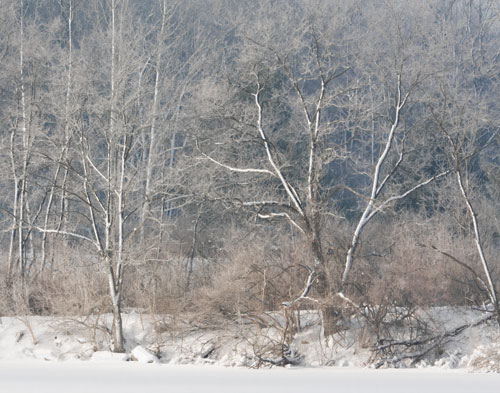
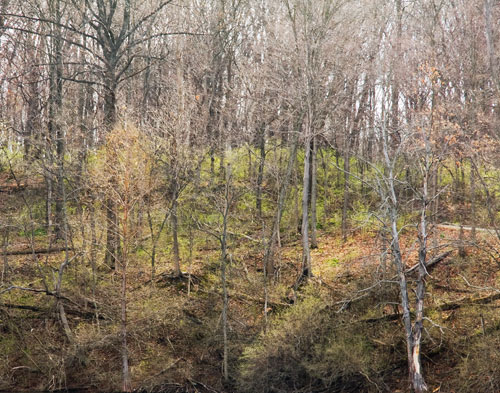
Spring is here and I find that the large scenes I had photographed before are not as interesting as they were when the snow was on the ground.  Compare this

with this.

The scenes are roughly the same and neither was given much treatment in Photoshop; that’s the way they came out.  The only reason for making the springtime image was to compare it with the winter interpretation.  But if it is unfair to directly compare the same scene at different times of the year, it is also the case that, for me, I find I do much better with the smaller subjects in the spring.

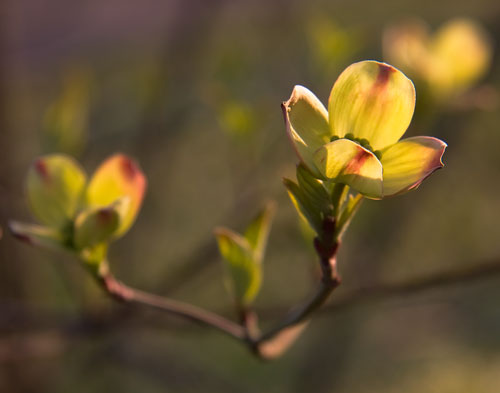
I’m recycling through flowers again now but I find I am looking at them a little differently than last spring.  Who knows what next spring will bring?

No herons for you today, would you take some nice Canada geese?

Becky and I went over to Fort Harrison State Park this morning.   I wanted to see how the trees were starting to come out across Lake Delaware.  I had taken a similar shot a couple of days ago and this time of year, things change pretty quickly.  That earlier shot was included in my last post.

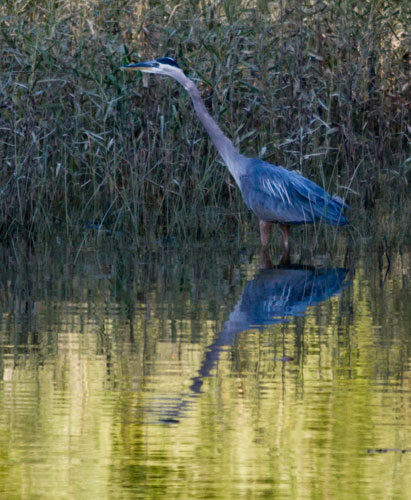
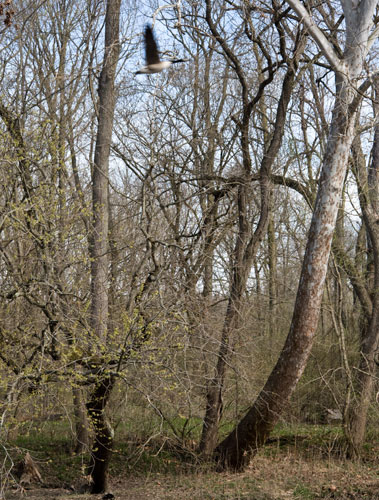
The trees are starting to turn green and I was glad to be there to record it.  As I was setting up for this shot I was showing Becky where the heron was that I wrote about last time.  It had come in from the left and swept across right in front of me.  But because of the camera settings I had forgotten about, I blew the shot.  As I was talking she was nodding rather vigorously and when I was through she said a heron had just flown behind me.  This was April 2, not April 1.  She was telling the truth.    OK, I can be philosophical about these things but then Mother Nature rubbed it in.  She gave me Canada geese.

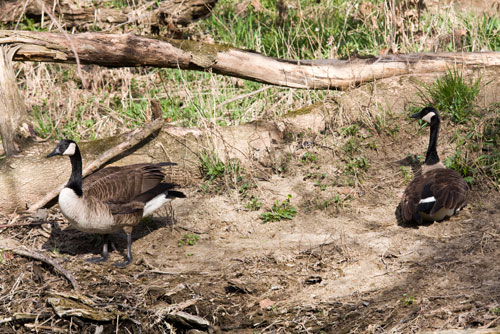
There was a nesting pair across Fall Creek and why not get a shot of them?

The nesting pair attracted others and we counted nine geese.  There were probably more.  They were everywhere.

The occasional Canada goose is nice but I’m holding out for the heron.  Next time I’ll be ready.  Unless she (or he) is readier.