Living in a shell

This is a reworking of a reworking of a story by Maurice Nicoll.

Once upon a time there was a great and ancient forest.  In the middle of the forest there lived an old and majestic oak tree.  Its limbs were home to birds, its acorns fed many animals.  Generation after generation of acorns fell to the ground and after awhile they formed a community and they had their own way of looking at the world.  For example, for one to say to another ‘you’re nuts!’ was quite a complement and much prized.  The goal of nearly every acorn was to have a bright, shiny, blemish-free shell.  Much work went into this: visits to the buffer’s shop to be cleaned and buffed; visits to the nut doctor to mend cracked shells;  group therapy sessions to deal with issues such as fear of falling, etc.

As you can imagine, condition of the shell was a primary factor in one’s social position and acorns are nuts about social position.

Then one day a bird dropped an old, dirty cracked acorn from the sky right into the middle of the acorn community.  His thoughts were not nutty, they were crazy.  ‘We can be that!’ he said, motioning to the oak tree.  ‘The first step is for our shells to crack and us to sink into the ground!’  How far was that going to get him in the acorn community?  ‘We would no longer be acorns if we did that!’ they argued.  He agreed.


Winter came and then the spring.  We don’t know what happened to all the acorns.  Some were taken away by animals, one in particular though, shunned by the others and now largely without a shell, sank into the ground.  At the same time the old oak was beyond its normal span of years and that spring it didn’t leaf out as it always had, but a sprout of an oak came up near the old tree.  Who knows what happened after that?

On offering a mostly opaque criticism of art

Let’s suppose I create this piece of art and it appears in an art exhibition.


Let’s further suppose that you attend this exhibition and someone asks your opinion of this particular work.  Your reaction to it is visceral (positive or negative) but difficult to put into words.  Friends and relations, I have the answer for you.  Go to The Instant Art Critique Phrase Generator at Pixmaven.com, enter any five digit number in the box and a critique will appear.  Here are  some examples of what you might get:

“With regard to the issue of content, the disjunctive perturbation of the negative space seems very disturbing in light of the eloquence of these pieces. ”

“As an advocate of the Big Mac Aesthetic, I feel that the metaphorical resonance of the figurative-narrative line-space matrix spatially undermines the exploration of montage elements. ”

Memorize a couple of these so you will be ready.  If ever called on to use them though, be sure to confidently announce them in a clear voice and then keep moving.  Take no questions and don’t turn your back on the artist.

Red River Gorge, Kentucky

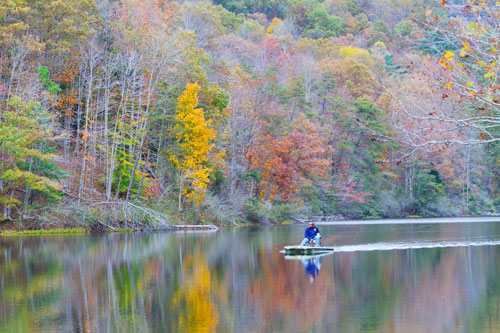
Several members of our camera club went down to the Red River Gorge a few weeks ago.  We had beautiful weather and many of the leaves were still on the trees.


If the weather had been like that of the previous week – rain, rain and more rain – we might have spent a lot of time indoors playing checkers or something.  But the weather was a gift.


I don’t think this fellow caught anything but then I don’t think he cared.


We spend a lot of moments thinking about the future or the past.  With a scene like this there is a strong call to stay right here in the present.


I’m ready to go again.

A time for contemplation

This last month and a half has been quite busy and I brought down the level of activity with a retreat in southwestern Indiana last week.

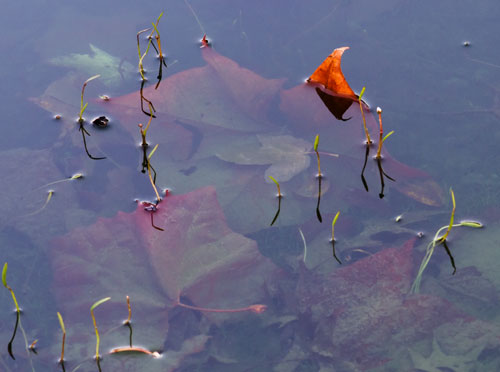
This was at Willow Pond Retreat, a small retreat center owned by Charles and Sarah Gipson.  Charles had been pastor at Church of the Saviour in Indianapolis in the period just before my wife and I joined that community.  I was at the retreat center for several days and while I spent a lot of time photographing the beautiful landscape, I found myself concentrating on the one acre pond that is part of the retreat center and within the pond, just along the shore.


Leaves in water are fascinating.


I suppose one could see melancholy in photographing in the autumn but it is enormously inspiring to me.


Inspiring because there is beauty in both the life and death of these leaves and beyond that, regeneration will follow.


Is this a metaphor for our own lives?  We can see beauty in life all around us and my mother in some respects became even more beautiful as she was dying.  Mom remains as a gift that will be with me for the rest of my life.


But what about regeneration, life after death?  My religion teaches that there is life beyond but I can’t speak from personal experience.


All I can say for sure is that there is life here and now and our sacred job is to live it.  Thank you, Charles and Sarah.

Massachusetts Avenue, Indianapolis

Members of the camera club participated in a world wide photo walk a few weeks ago.  It was brisk when we got started at 9:30 but it warmed up after a bit.

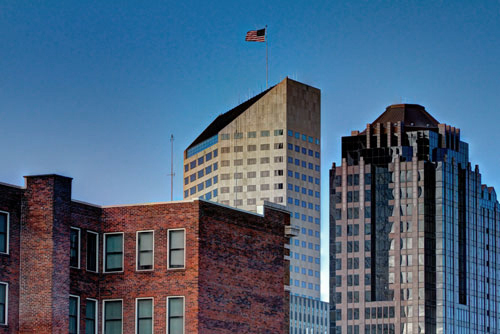
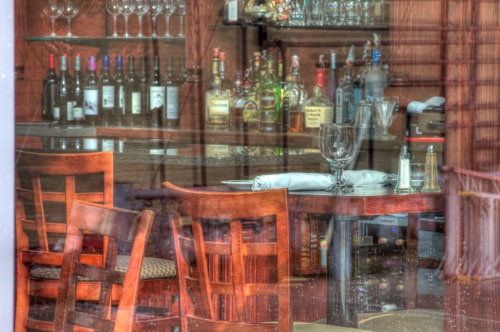
We worked in the Massachusetts Avenue area of Indianapolis, a historic area with many artists.  A lot of the images I have here were created by combining images shot at different exposures (High Dynamic Range or HDR).  High saturation, which is often a part of HDR images,  just seemed the right thing to include with many of them.

It was a go-go kind of morning.

I liked seeing these three kinds of architecture together.

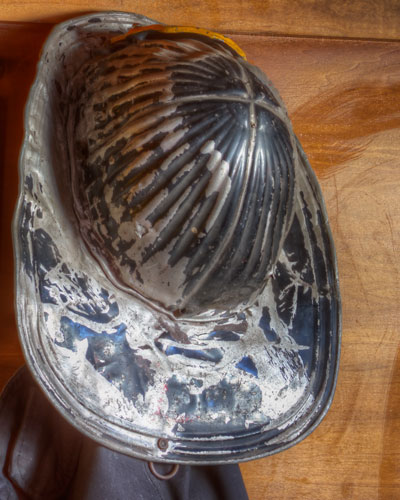
Indianapolis Fire Department Station 7.

At the Indianapolis Fire Museum up the street from the fire station.

Many years ago, when I first started working at AT&T’s Bell Laboratories in Holmdel NJ, I worked on automating Directory Assistance.  I learned that the DA offices often served areas far removed from their physical location.  A few years after we moved to Indianapolis, my wife and I started going to the Agio Restaurant.  It moved around some in those early years and when we stopped by at the last known location, it was dark on a Friday night.  Moved again, but where?  I called Directory Assistance and asked for the number for Agio and the operator replied “I was by there the other night and it was dark.  I guess they moved.”  Not the answer I expected.  I’m glad to know where it is now, it’s a good restaurant.


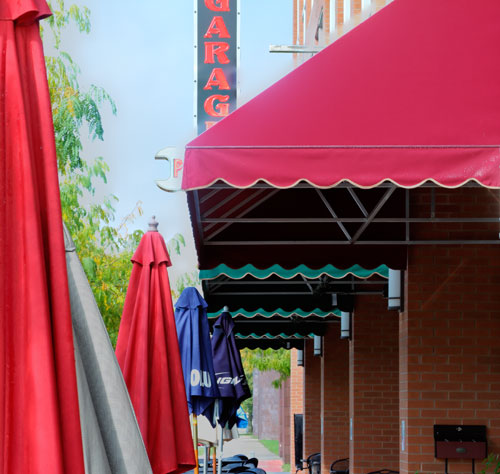
Mass Ave.  An excellent place to go with a camera.

Columbus, Indiana

Photo Venture Camera Club went to Columbus, IN last Saturday to shoot architecture but it was raining.  Are cell phones waterproof?


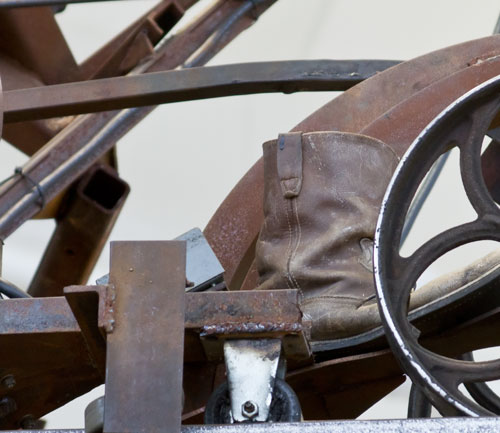
We had met at The Commons, home of Chaos, a piece designed by Swiss sculptor Jean Tinguel.  I didn’t get any shots of Chaos as a whole, there were too many interesting details.  You can see it at the link to The Commons above.  Given that it was raining, we stayed there for a couple hours which encouraged shooting details.


Including a boot that is part of it.


The water fountains are not part of it.


This hook isn’t either.


Still raining.


It did eventually clear up and we wandered around outside.


Nice interaction of water drops, granite and a leaf.


I wasn’t going to have time to get around to see the buildings designed by the likes of Eero Saarinen, I. M. Pei and others.  With a population of just 39000, Columbus is ranked sixth in terms of architectural interest behind Chicago, New York, Boston, San Francisco and Washington.  Not bad, not bad at all.


So I just stayed in the neighborhood.


Shooting through a window can add interest.


Philip Roth wrote ‘Goodbye Columbus’.  Many photographers and other visitors say ‘Hello Columbus’.  Some of us will go back in a few weeks.

Kaleidoscope images? Sure, why not?

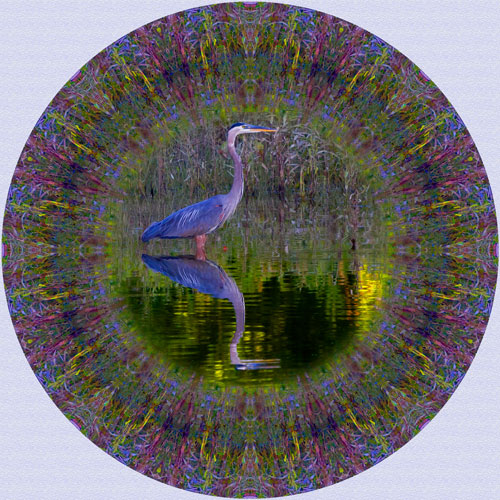
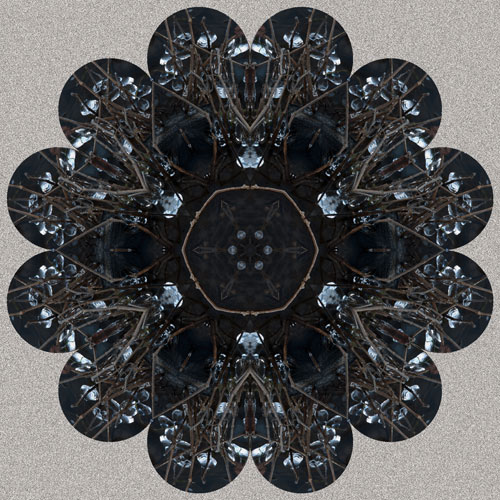
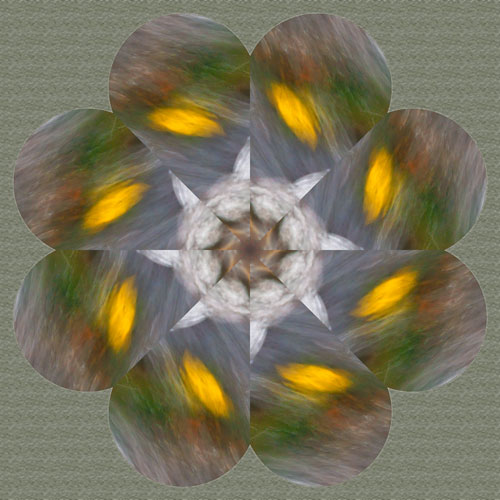
The other evening a friend mentioned that someone was doing kaleidoscope images with photographs.  This sounded interesting and in this day and age, the first thing to do would be to check for software that does that.  There is such software and it does an interesting job.  Here are some examples:


Some are clearly better than others but I’m learning more and I hope the next batch will be better.  I don’t know how creative this is, but it’s fun.

Once upon a time

Once upon a time there was a beautiful princess in the flower of her youth.

As she matured, it became clear that she was going to be a tomato.

A red hot tomato.

The princess, aware of her beauty, decided to go to the big city where the pickings ought to be good.  There, she had four suitors, all named Basil.

The Basils, really quite crude if attractive and smelling good, couldn’t agree on who should have her so they cut her up.  All would marry their piece and so they called the parson.
The parson had never married vegetables before and since he was hungry, he ate them all.  The moral of the story is that it is not wise to leave home if you have the sense of a vegetable, you might become an ingredient in someone’s salad.  Which will happen at home too but at least you won’t have to travel so far.
Special thanks to Edward Gorey.