Imagine that

Every once in awhile I find it useful to stop and think about what digital image editing has made possible.  We go out and shoot and then bring the digital files home to the computer.  They are brought up in Photoshop or some other editing program.  In many cases the image is supposed to be pretty close to what was seen.  Contrast might be enhanced a bit, the brightness of the image raised or lowered a little, color is corrected and the image is sharpened.   The image is now ready to go and it does look rather like the original scene.  In other words, what was done was pretty much the digital counterpart to what might have been done in the darkroom a generation ago.

I put an image in my last post that was approached, from the very outset, in a radically different way.  Here’s the final image:

As I said at the time, I had taken the long route to the library.  This took me past a local hospital.

As soon as I saw this I knew what the final image would be.  It was virtually instantaneous.  No question arose about whether that final image was possible, the only questions were whether the clouds and light would still be good after I had gone home and come back with the camera (note to self: always take the camera with you).  They were.  I got this additional image to serve as a background.
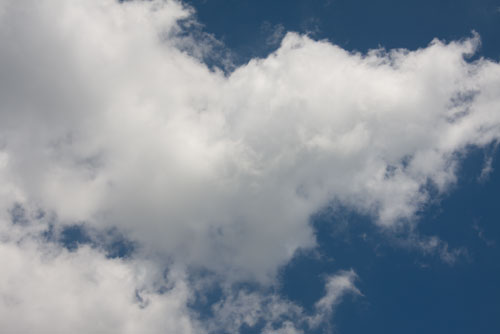
I pulled the skyway out of the one image, put it in the other and masked out the ends of the skyway.  It took less than an hour.  What I imagined before taking any photographs was very similar to what I ended up with.

My studio (our daughter’s old room) is on the second floor of our house and I can see lots of trees out the window.  The light was coming up nicely early this morning and I could see that it would be possible to have a shot that emphasized the diagonal strip of light.  Here is what came out of the camera:

This was not what I had in mind.  I had envisioned a lot more contrast between the lighted area and the background.  I knew it wouldn’t show properly in the image as taken, it was  matter of going to Photoshop to complete the image as imagined.  I hadn’t envisioned it as a black and white image, that was a possibility that arose when I got into Photoshop.  Here is the result:
The point of all this is to say that where in the days of film imaginative exploration of what could be done with an image once it came out of the camera was pretty limited unless one were very skilled in the darkroom.  Now, in many but not all cases,  it isn’t much of a hop at all to go from  what we see in our heads to what we see in the final image.

It is unfortunate that the noun Photoshop has been turned into a verb (Photoshopping) and that new word is pejorative.  If one is out to document what was there, it is acceptable to color correct, add or reduce contrast change the brightness and sharpen, all within limits.  If on the other hand, the intent is to show something about the photographer’s emotional reaction to the scene or if what is photographed is to become a set of elements available for inclusion in an imagined final scene, all bets are off on what is included, excluded or changed.

I for one think of myself as a visual poet.  I’m not a documentary photographer.  The photograph as taken is grist for the image that will result.  I don’t always mention what I did because it is usually quite beside the point.  But if you ever have a question about the faithfulness of the images you see here to the image that was stored in the camera, feel free to ask.  I’ll tell you exactly what I did.  So I will leave you with this:

The possibility of doing digital image editing has been a real Godsend to me.  I’ve always lived in my imagination and the possibility of realizing some of that imagining means a lot.
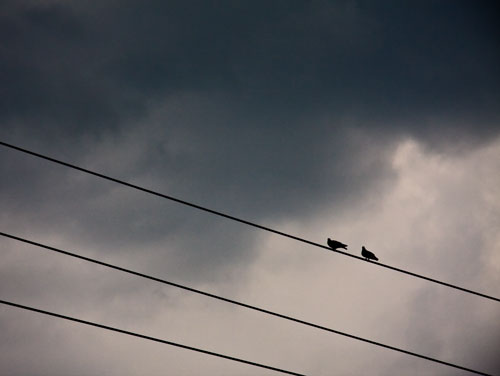
Time to get back to it

The last several days we have been having an unsettled but recurring weather pattern.

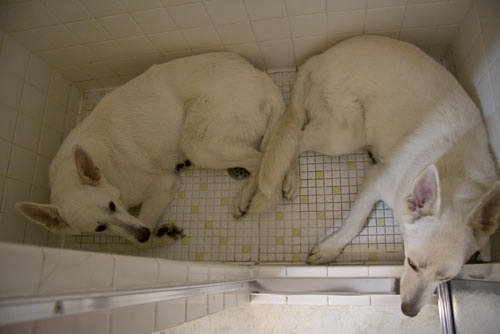
The clouds go dark in the early evening, the wind whips up to as much as 50 or 60 miles an hour and a deluge starts with lightning and thunder accompaniment.  After a few minutes the wind dies down and the rain stops.  The thunder rolls into the distance.   It’s all quite dramatic.  Too dramatic for the dogs:

They head for the stall shower and stay there well into the night.

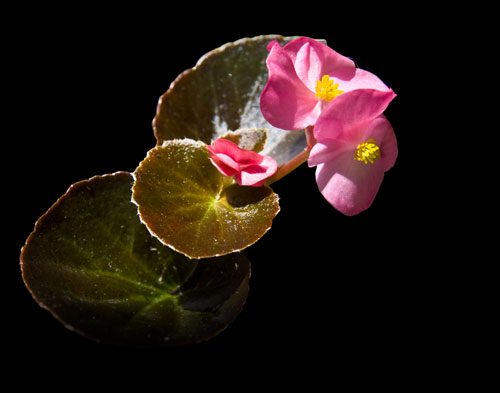
Unsettled would describe my photography recently as well.  I’m not seeing the opportunities that I know are there.  Flowers, such as these begonias are alright but I’d like something a little different.

The opportunity came today in the form of taking the long way around to go to the library.

The tentative name for this is ‘Can I get there from here?’ which might be symbolic of my slump recently.  Perhaps the best thing to do is close my eyes, take a deep breath, open the eyes and look around.  Who knows what there is to see and wonder about?

That calls for some reflection.

Geometry

We could talk a long time about what makes a good image.  We could list criteria and features, we could have rules, we could have recommendations.  But when it comes down to it, rigidly following rules and meeting criteria just don’t hack it.  An acceptable image would probably result but it would likely be as memorable as the artwork on the wall in a hotel room.  Visual Muzak.

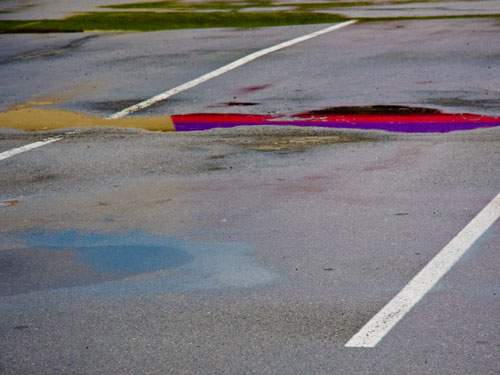
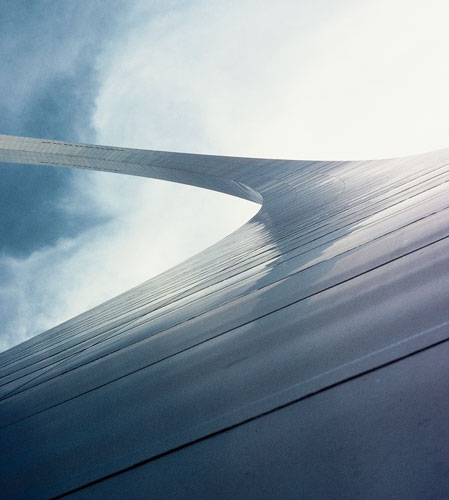
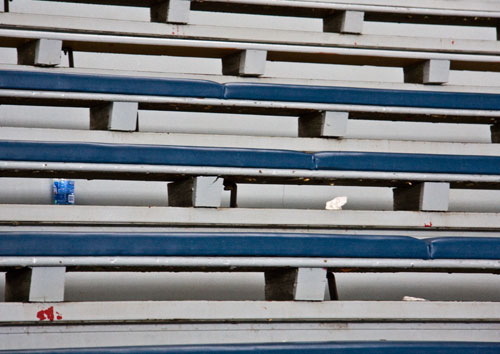
All of the criteria, features, rules and recommendations have their place and we can certainly point to spectacularly good images that share at least some of them.  There is one criterion that, at this moment anyway,  I would like to pursue a bit,  if only to see where it goes.  The criterion is simplicity, especially geometric or graphic simplicity.  Human structures provide excellent material.  Here, for example, is the arch in St. Louis:

And part of the entrance to the Georgia Aquarium in Atlanta:

Here are some structures in Indianapolis:

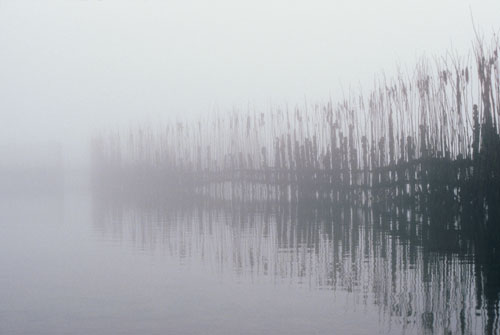
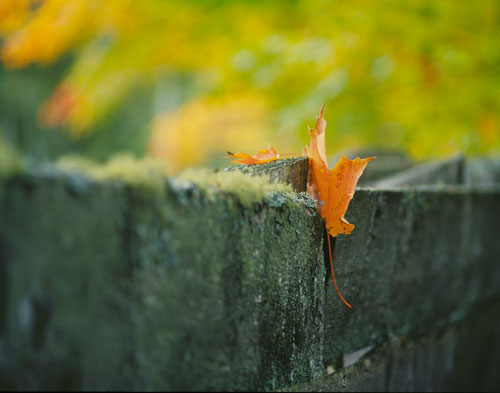
Interesting geometry is not limited to buildings.  Here are a couple of examples from nature:

When looking at a photograph a common question is ‘what is the subject?’   Sometimes the subject is simply the texture and there is no specific area of the photograph that is more important than any other area.   This, however, is not often the case.  Most often, there is a specific main subject in the image and with geometric, or graphic simplicity, it is easy to find.  If you want to make good picture making as simple as possible, simplicity itself is a good place to start.   As is the case with other rules and suggestions, simplicity isn’t the be all and end all of composition but more often than not it helps.

A simple spirituality: Part 4

Spirit and seeing, spirituality and photography.  I believe that each nourishes the other.  Right, but how does that work?  How do they fit together and nourish one another?

This is one of those things I know to be true but it is mysterious and I find it difficult to put into words.  I’ll begin by repeating what I have written before about the nature of spirituality.  Here’s the working definition:

‘the pattern of beliefs, attitudes and feelings about the Sacred and the world – a pattern that defines who you are at the profoundest level.’ (From Skylight Paths, Who Is My God?: An Innovative Guide to Finding Your Spiritual Identity, Skylight Paths Publishing; March 2004, p5)

This is essentially the definition of personality with the addition that the Sacred is placed at the center.  Viewed most broadly, an individual’s spirituality is always a part of what that individual thinks or does.  It doesn’t have to be a thought or an act with spirituality actively in mind, it is there whether we recognize it or not.  In an important way then, our spirituality as well as our personality colors and frames the way we think and behave.  Of course there are times when we don’t act according to our best spiritual selves.  The apostle Paul made this point when he wrote
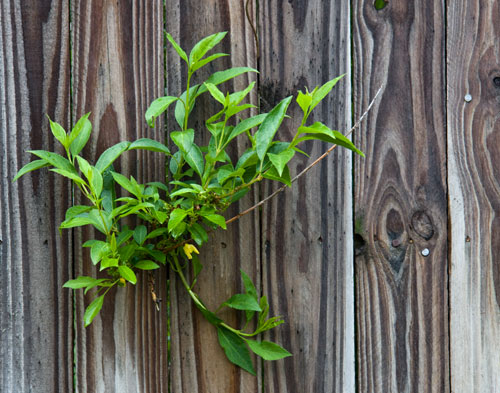
We know that the law is spiritual; but I am carnal, sold under sin.
I do not understand my own actions. For I do not do what I want, but I do the very thing I hate.
Romans 7: 14-15

I would be surprised if all major religions did not share this lament.  So we don’t always act according to who we are at the profoundest level.
In my simple spirituality, everything is interconnected.  God is in all, all is in God.  So when I go out to shoot, there is a strong sense of wonder at God’s creation.  Looking through the viewfinder of a camera intensifies that sense of wonder.  I see this most strongly with close up, or macro, photography.

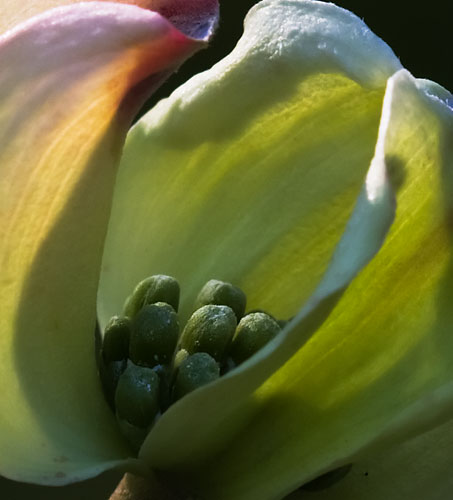
Getting close to a flower opens up a new world.  Flowers are small, and if we think of the distance between our eye and the bloom in terms of diameters of the bloom (e.g. this flower is half an inch across) we are almost always at least 10 diameters away and more often, when we are walking past them, perhaps hundreds of diameters away.  So when we are close we see a lot more of what the flower is about.  And there is more to it.  We aren’t just close, we are looking at it through the viewfinder which considerably restricts our field of view.  If we are close enough, we see just the flower and little, or nothing, else.   A sense of wonder is then all but inevitable.

But the sense of wonder is not restricted to just flowers.  A flower just provides one good example.  Looking closely at a flower readily gives rise to wonder in just about anyone.  Most things we see, hear, feel or otherwise sense can be a source of wonder.  The quote from Meister Eckhart in the banner at the top of this page says it very well:

This then, is salvation: to marvel at the beauty of created things and to marvel at the beauty of their Creator

What feeds wonder in me probably wouldn’t be the same as it would be for you.  That’s why we could stand next to one another with cameras and come back with different portfolios.

I believe that sense of wonder is an expression of spirituality.  It is God in me seeking God in the world.  So is it surprising that spirituality would nourish photography?  Or that photography nourishes spirituality?  I’ll write more on this soon.

Two graduations

We went to the Butler University graduation this morning, a young friend of ours was making the transition to a different life, a life as a free standing adult.  The graduation took place in the Hinkle Field House, home of the Butler Bulldogs basketball team that played in the final game of the 2010 NCAA tournament against Duke.  Butler came in second while Duke finished next to last in that game.

This is a large field house and the graduation was well attended.  We got there early because we rode with our friend’s parents (also friends);  his mother, a member of the staff at Butler, would be giving him his diploma so she needed to be there early.

Nearly 900 graduated today.

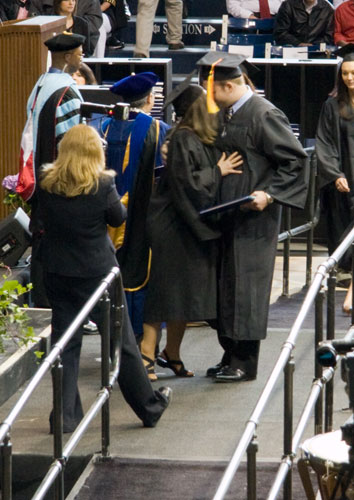
It was an excellent graduation, well organized and the speakers were the best I’ve heard in a long time.  One of the best quotes of the day said that the purpose of a college education is to move us from cocky ignorance to thoughtful uncertainty.  I think I’ve gotten past the cocky ignorance part, I’m just not sure how thoughtful my uncertainty is.  The big moment came and Keith received his diploma from his mom.  Along with a hug.

As the ceremony unfolded, I was thinking of another graduation, this one much smaller in size and although I wasn’t graduating that day, enduringly meaningful over the intervening 40 years.  I was teaching psychology at Bowdoin College in Maine, an excellent liberal arts college.  The math department had developed a masters degree program for math teachers who attended classes over several summers.  It was time for the first graduation.  Dan Christie was the head of the math department at the time.  Dan was a gentleman out of the old school;  worldly, compassionate, witty and very good at his work.   During a college wide faculty meeting concerned with language requirements, Dan one time proposed including mathematics as a language: in his view math was the queen of languages.

As graduation day approached for the summer math program, Dan sent a request around to all faculty asking us to attend the graduation in academic regalia.  Dan had taught at Bowdoin for many years and of course had his robe.  I called him to say that I would be happy to attend the graduation but that I didn’t have academic regalia.  He said of course I should attend.  Arriving at the ceremony all the faculty were wearing their robes with two exceptions – Dan Christie and me.  This young faculty member was not alone through the grace of a gentleman of the old school.  One doesn’t forget something like that.

There are many trees in the forest.  Some grow straighter than others.

Image processing is important too

Back when we shot slides, there usually wasn’t much that happened after the slides came back from being developed.  Some were accepted, many were rejected and for those that were accepted there was often some little thing about it that would have benefited from the digital image processing we now have.

Becky and I went over to Fort Harrison State Park this morning to see what there was to see (and shoot).  We were both happy with what we found and instead of spending two hours, we spent three hours wondering around.

There were a lot of shots where it was clear there was something there but more needed to be done to look into the life of it.

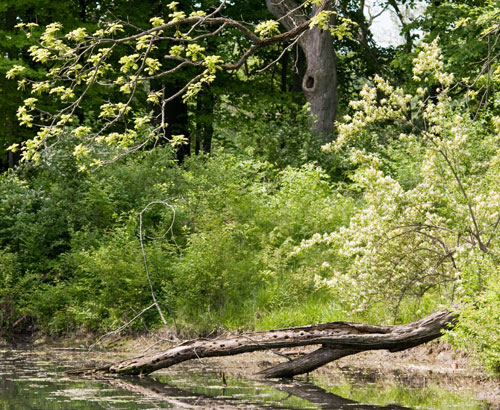
It came to a head for me when we went to an area called the Duck Pond.  Yes, there were ducks on the pond when we got there, but  I was more interested in some landscape possibilities.

This image wasn’t bad but it was lacking something.  I converted it to black and white and that helped, but it wasn’t quite there yet.  I added some filters and adjusted the blending mode and was much happier with the result.

This looks a little like an infrared image but it isn’t.  Now this is talking to me.  I tried the same technique on some other images and was pleased with them too.  Here’s another one from this morning.

That was nice too.  Finally, I tried this with some older images that didn’t stand on their own but were good enough that I wasn’t going to throw them out.  Here is an example.

Some object to all of this digital image processing but I don’t think of myself as a documentary photographer, rather I’m a kind of photo poet.  The poetry (for me) is in the interpretation of the image.  Modern digital image processing allows a wide range of interpretations and the main limit now, rather than the image itself, is our own imagination.  More on photography and written poetry in a later post.

A trip to Clifty Falls and more

My wife Ellie and I had talked about it for some time and we finally got the chance to spend a few days at Clifty Falls, a state park in southern Indiana. 

We went down Sunday and came back Tuesday.  We’ve been married nearly 48 years and since it is easy, over that span, to take each other for granted, I thought I would have flowers waiting for her in our room.  Last week I called the Clifty Inn where we would be staying and yes, they would take care of putting the flowers in the room if I would order them from a florist.  I asked for numbers for some florists in the area and they provided them.  The first one I called said they don’t deliver on Sunday so I called the second number.  A guy answered the phone and I asked if they could deliver a dozen roses to the Clifty Inn on Sunday.  He said no, he couldn’t deliver roses but he could deliver 12 cans of motor oil.   I replied that I hadn’t thought of that as a gift.  It turns out the number I dialed did belong to the florist at one time but that it now went to a car repair shop.  The fellow who answered the phone had received other calls like mine and he was waiting for me.  We had a good laugh about that.  None of the florists delivered on Sunday so I set it up for some durable flowers to be delivered on Saturday and they would still be fresh on Sunday.  All was in order and Ellie loves the flowers.  I told her that flowers are nice but they wouldn’t last like motor oil would.  After all, what says romance better than a couple of oil changes?  She just smiled and said ‘Yes, dear.’

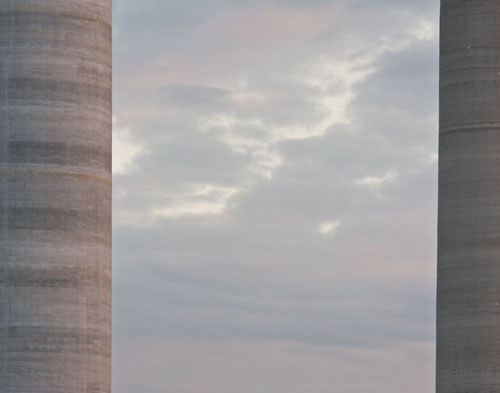
It was rainy when we arrived and overcast when we left but we had a good time.  There was one short period of sunshine on Monday evening and three photographers popped out of their rooms at the inn to get some shots.  There is a generating station near the inn with three smoke stacks.  I liked the soft light on the left stack and in the sky.

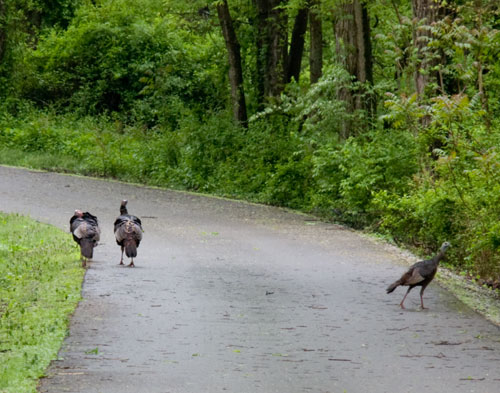
It rained most of the time but that didn’t matter, we had a good time.  We saw some wild turkeys in the park Monday morning so we stopped to get in a shot.  They saw me and headed in the other direction but I clicked anyway.  Ellie looked at the shot and said ‘Hey, great turkey butts, Barry!’  They aren’t all mooning me, one is offering a side view.

I partially redeemed myself a few minutes later.  A little soft, but better although there again are two butts and a side view.

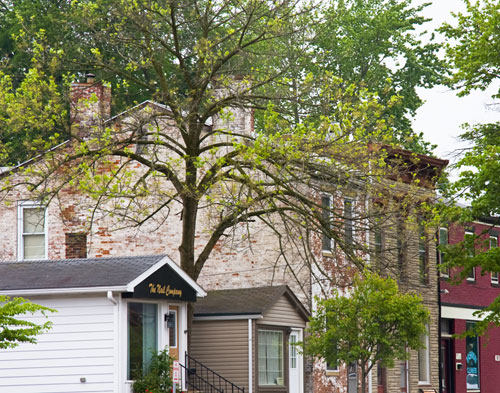
We spent some time in the city of Madison, which is right next to the park.   Our camera club had gone on a field trip to Madison last fall and I wrote about it then.  Ellie is a quilter and when she visits a quilt shop, it is a good idea for me to have some way of amusing myself, which in Madison is easy to do if you enjoy photography. 

The overcast sky saturates the colors.  Here’s an unidentified shrub poking through a crack in a fence.

In our initial tour around the park Sunday afternoon we heard a wood thrush.  If there is a more beautiful bird call in North America, I don’t know what it is.  We didn’t hear another until we were leaving the park Tuesday morning.  Great book ends for a very happy time at Clifty Falls.

But the trip wasn’t quite over.  We went home by a different route and along the way found Big Oaks National Wildlife Refuge.  There wasn’t much to see but this shot was worth the side trip.

We were away a little under 48 hours but we will remember this trip for a long time.

Back to photographing little things

Last fall I wrote a post about shooting little things.  Winter came and I set about shooting big things.

But not all of the images were of large things.

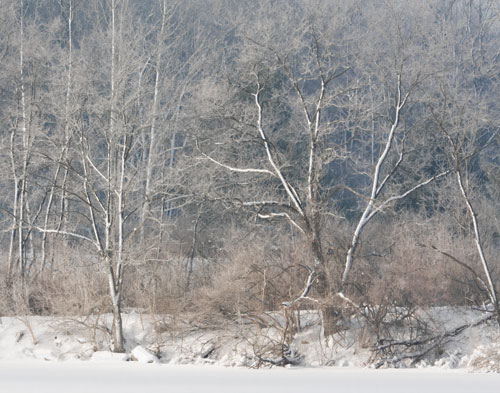
Spring is here and I find that the large scenes I had photographed before are not as interesting as they were when the snow was on the ground.  Compare this

with this.

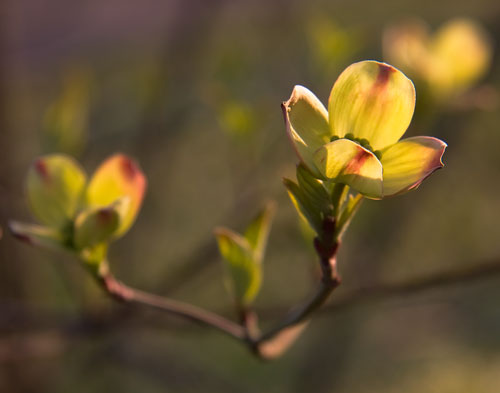
The scenes are roughly the same and neither was given much treatment in Photoshop; that’s the way they came out.  The only reason for making the springtime image was to compare it with the winter interpretation.  But if it is unfair to directly compare the same scene at different times of the year, it is also the case that, for me, I find I do much better with the smaller subjects in the spring.

I’m recycling through flowers again now but I find I am looking at them a little differently than last spring.  Who knows what next spring will bring?

Creative encounter

When events are spread out over time, say one now, another in a week, a third two weeks later and the fourth a month after that, we aren’t as inclined to see them as being connected as we would be if they happen over the course of two hours.

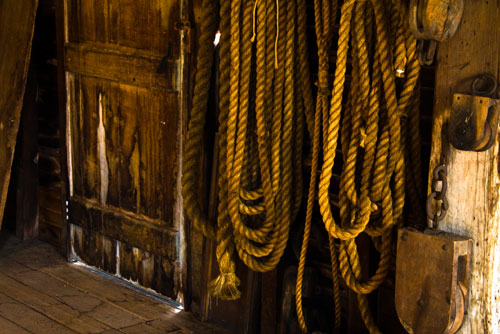
I had been working on an image that came out of the camera club trip to Adams Mill, a trip I wrote about in an earlier post.   This is one of those images that seemed like a good idea at the time but which resisted giving up the image within an image, the image with personal meaning that I hoped was in there somewhere.

This was of a set of ropes hanging by a door.  As shown here, it is essentially what came out of the camera.  The subject – whether the ropes, the door, the colors, the texture or some combination of elements – wasn’t coming clear to me.

Easter morning arrived and I was involved in the usual Sunday morning battle with myself over whether to go to church.  My wife and I belong to a wonderful church with an excellent minister, good friends, a strong bent to community service, and people tolerant of one another’s political and religious beliefs.  But I have never liked going to church and the feeling is getting stronger over the years.  Aside from delivering an elderly lady to church who had (thankfully) lost her driver’s license, I had no special demands on me to go.  I could drop her off and go to Fort Harrison State Park to do some shooting.  Or I could go to church.

I was in my studio reading ‘The Courage to Create’, a book by Rollo May.  He was making the point that any creative act is an encounter, essentially an interaction between an individual and a situation, scene, problem, another individual, etc.   The intensity of the encounter is a major force in deciding the outcome.  The encounter for me would be with a scene and later perhaps with the image as it (and I) matured.  The camera, lens, Photoshop and printer are secondary to the encounter; they provide the means for realizing it, or expressing it.

At this point I felt compelled, driven, pushed,  to stop reading and go back to work on the image in Photoshop.  What was needed now seemed entirely clear – crop it down to show some of the ropes and the door and darken the image to emphasize the light seeping in around the door and through the knothole.  That was it.  The light is what this image is about.

I emailed  the completed image to a friend, not telling her the title.   Here is her response:

‘My initial reaction was curiosity and I liked the warmth of the brown wood and the texture of the rope. A moment later,  I began to assign my own projection of danger to it and realized something bad could be lurking on the other side of that door or within the dark space.’

I then told her the title – ‘Doorway into the Light’ – and she responded:

‘That would definitely work. One could definitely anticipate good things on the light side – and there might be a hellish aspect to the dark door and the heavy or possibly threatening rope.’

I was glad to get that response, it is consistent with what I saw.

I decided to go to church, if only to see if it seemed like a mistake when I was in the church service.  This Easter Sunday the minister did not give the usual sermon about resurrection.  Rather, he talked about the essence of the Christian experience being an encounter with Jesus.  There was that word again.  Encounter.  In my frame of reference that made an encounter with Jesus a creative act.  Reflecting on Jesus’ dialogs with various disciples and other followers, in all the cases I can think of, someone asks a question and Jesus answers in an unexpected way, a creative way.  This encounter with Jesus absolutely requires intensity, giving oneself to it.  Through that intense encounter comes transformation.

It was all coming together.  The encounter with the scene of the ropes, door and light; the resolution of the problem of what the image was to be; understanding better the nature of creativity;  coming to see  encounter with Jesus as critical to the Christian experience.

The image now takes on additional meaning.  It can be frightening to pass through that doorway, not knowing exactly what is on the other side.  Better perhaps, to stay on this side of the door in the comfort of what we know.  But hanging there are those ropes which can bind us to the present, hold us back.  That fear can indeed make the experience of passing through the door, the encounter,  intense.  This gives us a better idea of what May meant when he titled his book ‘The Courage to Create’.  It does take courage to step out and create something new, whether it be a photograph or a spiritual transformation.

I think I’ll give church another chance.

No herons for you today, would you take some nice Canada geese?

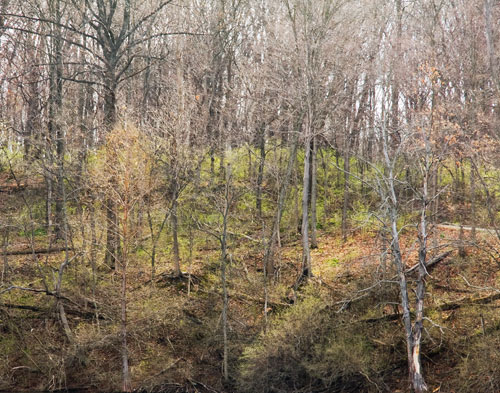
Becky and I went over to Fort Harrison State Park this morning.   I wanted to see how the trees were starting to come out across Lake Delaware.  I had taken a similar shot a couple of days ago and this time of year, things change pretty quickly.  That earlier shot was included in my last post.

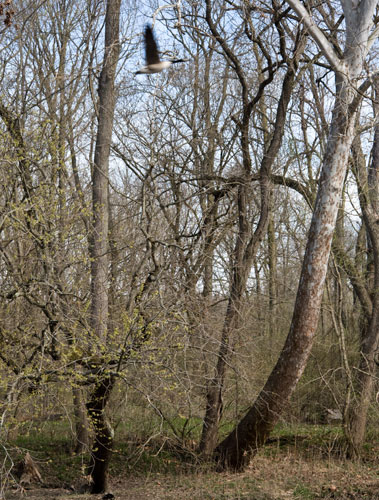
The trees are starting to turn green and I was glad to be there to record it.  As I was setting up for this shot I was showing Becky where the heron was that I wrote about last time.  It had come in from the left and swept across right in front of me.  But because of the camera settings I had forgotten about, I blew the shot.  As I was talking she was nodding rather vigorously and when I was through she said a heron had just flown behind me.  This was April 2, not April 1.  She was telling the truth.    OK, I can be philosophical about these things but then Mother Nature rubbed it in.  She gave me Canada geese.

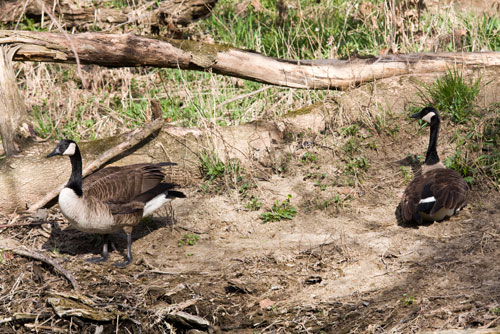
There was a nesting pair across Fall Creek and why not get a shot of them?

The nesting pair attracted others and we counted nine geese.  There were probably more.  They were everywhere.

The occasional Canada goose is nice but I’m holding out for the heron.  Next time I’ll be ready.  Unless she (or he) is readier.