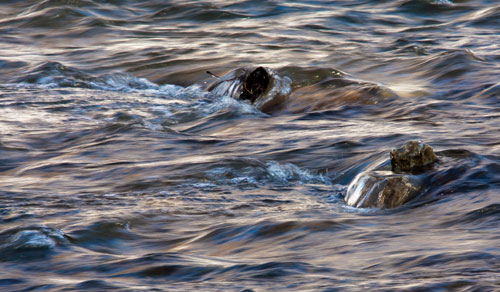
Feel free to touch the paint

My brother is an academician who studies Mormon missionaries – why they are so dedicated to their mission, what it is like to be one, etc.  He himself is not Mormon but has had a long standing interest in that religion.  He told me about a couple of young missionaries who were going door to door in a small town.  They walked up the sidewalk of this one house and across the front porch.  They knocked on the door and after a few moments it was opened by a very irate man who said ‘What’s the matter with you?   I just painted the porch and can’t you see that paint’s still wet?  Who are you and what do you want?’   Thinking fast, one of the missionaries said ‘We’re Jehovah’s Witnesses and we’ll come back another time!  Sorry to have walked on your wet paint!’
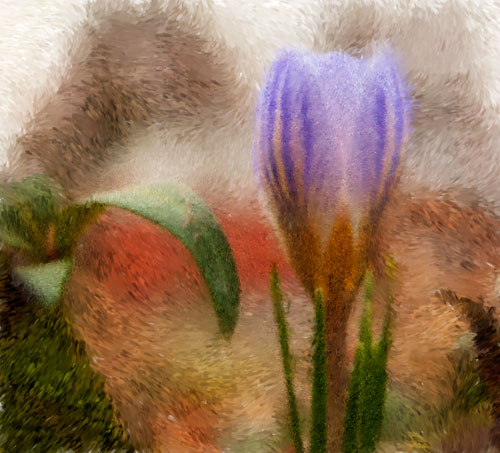

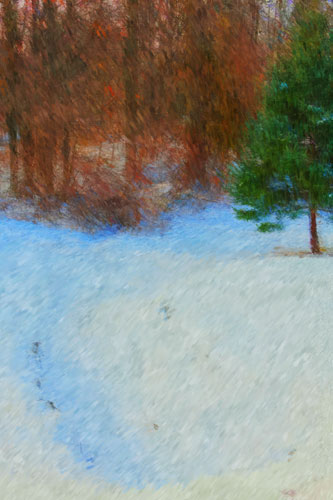
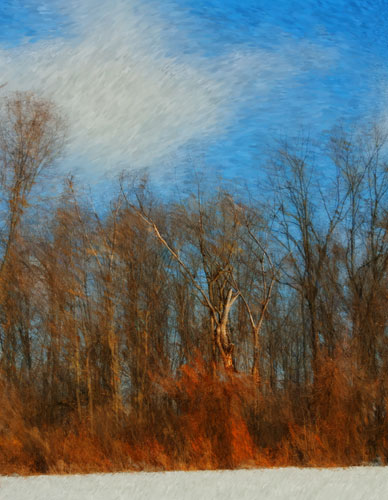
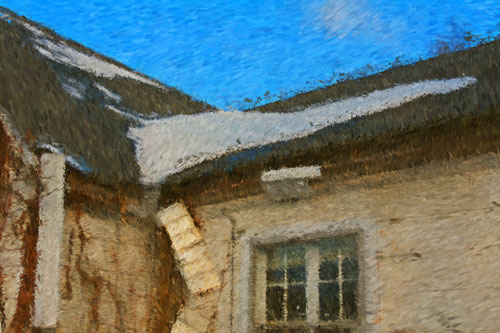
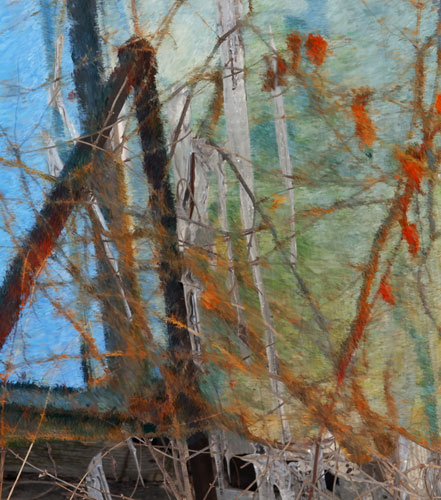
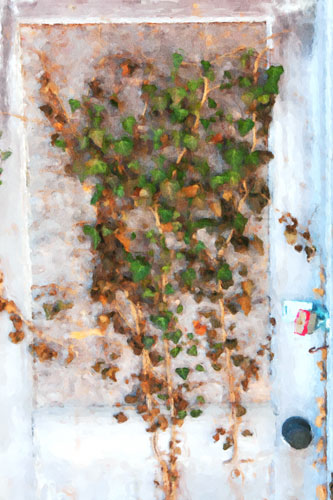
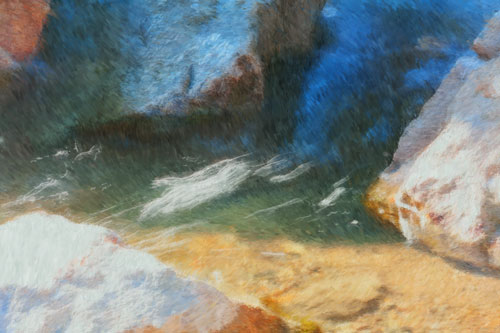
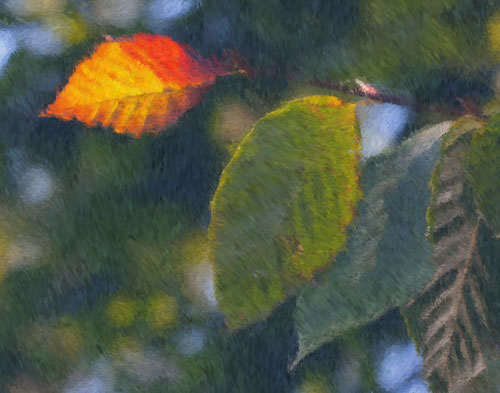
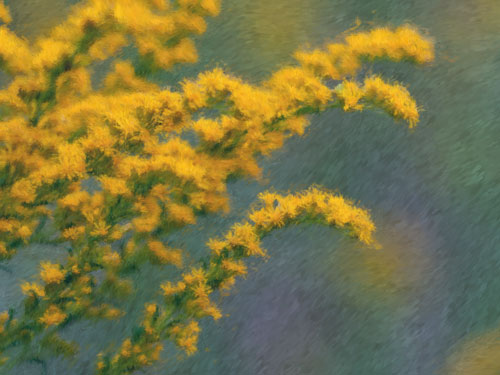
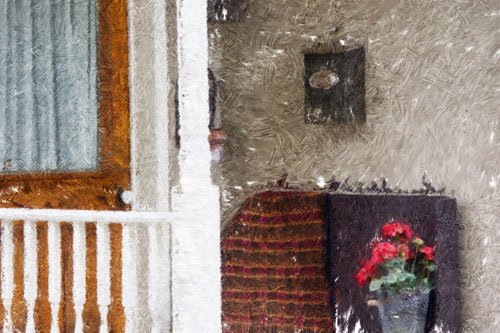
I’ve been working with Corel Painter 11 along with Photoshop and have been so immersed in it I haven’t even been out to shoot much let alone write about it.  Lots of paint here but no wet paint.
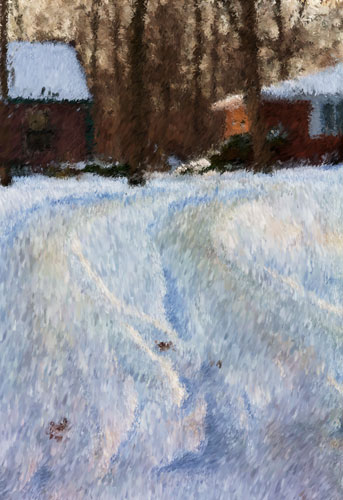

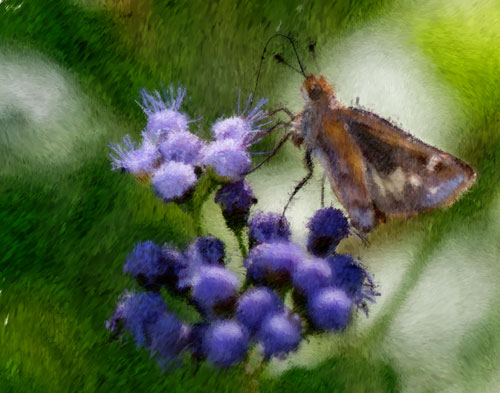
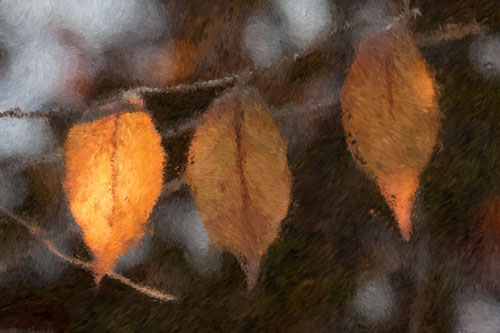
One of the first things I found out about this program is that it destroys details and presents pretty much only the larger elements along with tonality and color.


In other words, it puts a high premium on basic composition.
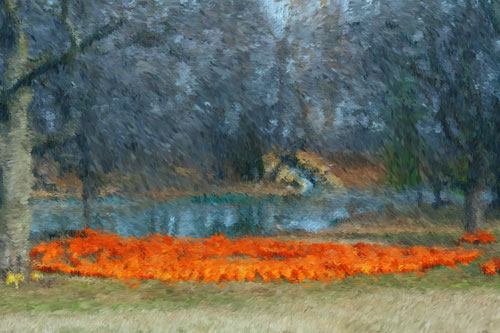

One quickly finds out that ‘it don’t mean a thing if it ain’t got that swing.’  And the swing here is composition.
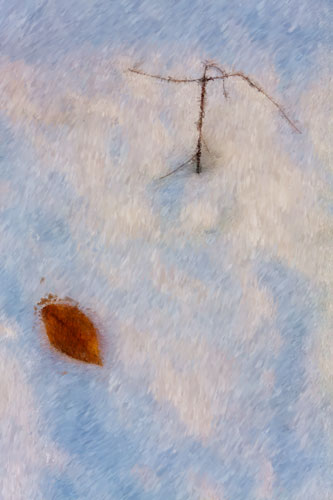

I’m starting to get it.  The good thing about it is that many elements of composition can be learned.  Probably not all of them, certainly not all of them, but enough that any photographer or painter can improve.
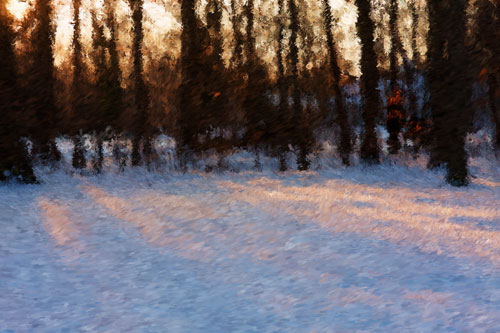

Painter is almost as complicated as Photoshop so the learning curve is long.  But one can do enough right from the start to provide encouragement.
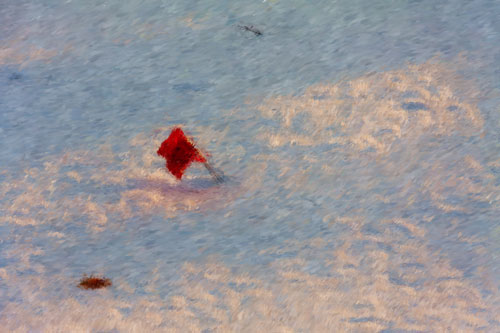

I’ve mentioned before that I’ve always wanted a painterly effect in my work and now that possibility is here in spades.
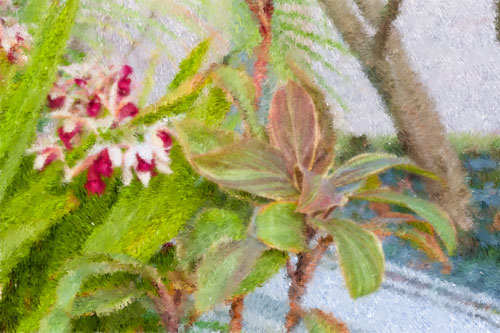

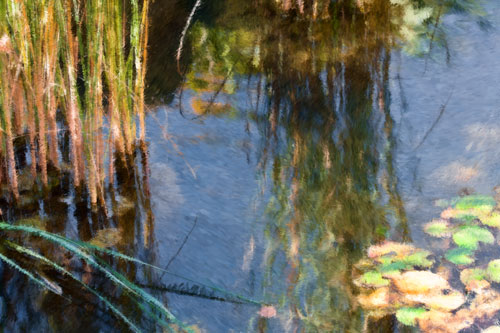
We had a lot of rain night before last and there were puddles in the driveway.  As soon as I saw them I knew I had to photograph them.  I’ve photographed puddles before and been disappointed because too much detail showed.  Gravel and blacktop aren’t that interesting to look at.  That’s changed now that I am using a paint program.
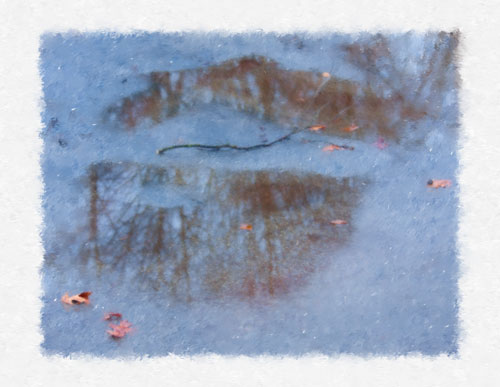

It’s fascinating to notice that I’m looking at the world differently now.  I’m not sure how to describe it, but having some idea of what I can do with images – standard photographic techniques and now painterly effects – affects what I look for.


Makes for a larger world. And it’s a world where the paint doesn’t need to dry.

What is there and what you see

Photo Venture Camera Club went to Garfield Park in Indianapolis to photograph flowers and foliage in the conservatory yesterday.  This is always a good trip.


A friend and I were talking as we were shooting and he said that his wife asked why he photographed leaves.  He responded that he was attracted by the textures, colors, shapes, etc.; in other words, aspects we see but which do not translate easily into words.  The leaves were more a platform for exhibiting these features than they were objects in and of themselves, at least for my friend.  I suspect that is a problem for some photographers – they go out to photograph, say, leaves, and don’t get much because they are not attending to the light, the shapes, colors, textures etc., aside from the label ‘leaves’.  I bring this up because it can be hard to avoid getting trapped by the words.


Words are important as ingredients of communication but unless one is doing documentary photography where it is extremely important to show exactly what is there – the aftermath of a storm, the condition of a house that is for sale, an accident scene – the features of the scene – the light, textures, shapes, colors – are often more important than the fact that we are photographing leaves, trees, reflections in water.


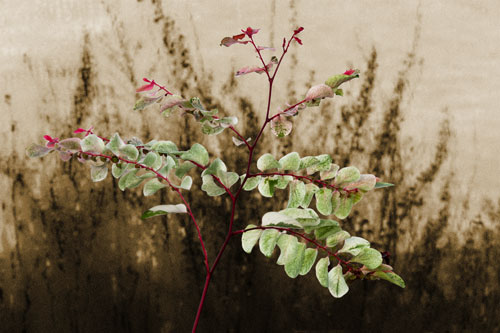
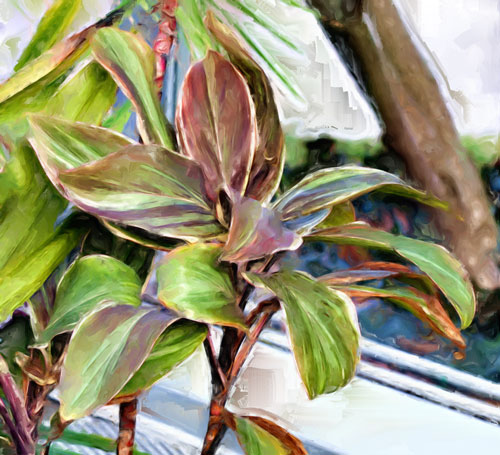
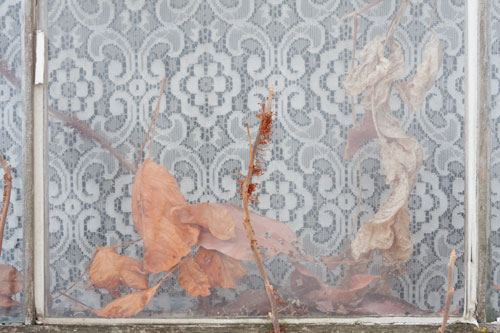
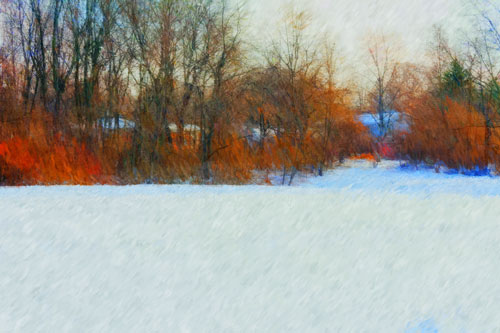
As you can see from the examples I have shown so far, I don’t think it too important to represent what I saw as objects so much as platforms for the features.

On the way home it struck me that maybe this is at least part of the answer why photographers are so often attracted to crumbling buildings.  These buildings can’t really be adequately described by words; pictures, images are needed and what is interesting about them is not so much the crumbling structures themselves but the textures, colors and shapes.

Well.  Having solved that problem we can move on to solving the problem of bringing peace to the world.


On second thought, let’s save that problem for another day.

A good day

Several of us were at church this morning digging out the driveway and enough of the parking lot that people could be dropped off in front of the church.  Two inches of hard, tight ice is difficult to remove.  While we were getting organized and the guys who were going to be using the rental frontloader were figuring out how to use it, I did a little photography.


The frontloader was equipped with a device on the back with large teeth.  The idea was that the teeth would break through the ice and as it was pulled along, the ice would come up.  The ice was not impressed.


So several of us attacked the ice with pickaxes, shovels, etc. while a snowplow on a garden tractor, a soil cultivator and the frontloader all peeled back the ice a little bit at a time.


Various ideas were proposed, including building a 10 foot wide parabolic mirror to focus the rays of the sun on the ice and drilling holes in the ice and loading them with M-80 fireworks.  Then we went back to work with the pickaxes and the shovels.

All this photography, by the way, was done before we got organized.


There is an abandoned house next to the church.  It called.  I answered.


If you are wondering when I will quit obsessing with impressionistic painting techniques, the answer is I don’t know.


I’m enjoying it though.  I hope I’m not as stiff in the morning as I am now.

Seems like a day for Impressionism

It’s snowing.  I’ll probably go out later today to do some shooting but right now I’ve been looking at older images and applying an Impressionist effect to them with Corel Painter Essentials and Photoshop.


I’m not pining for summertime even with two inches of ice on the ground, and more importantly, ice piled on the roof and in the gutters.  Also, we’ll be getting two to four inches of snow today.  But for some reason, Impressionism, which I normally associate with warm weather, seems the order of the day.


In keeping with the season, the above shot was made in early January.
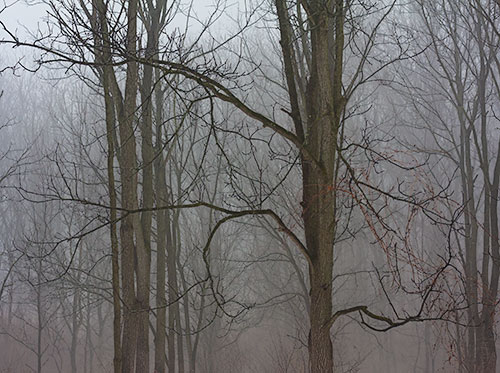

The season in these images is pretty obvious.


Gesundheit.


I don’t think Monet would eat his heart out after seeing this one unless he felt in some way responsible for it.


I know this one is over the top but I still like it.  Time to go get cold.

Learning more about painting photographs

I’ve found that learning often progresses by spurts followed by a leveling off and then, if I keep at, another spurt and more leveling off.  The longer I’m at it, the more time elapses before the next spurt.  Right now I’m early in the process of learning to use Corel Painter Essentials 4, a paint program that, with a lot of choices on the user’s part, can turn a photograph into what looks like a painting.


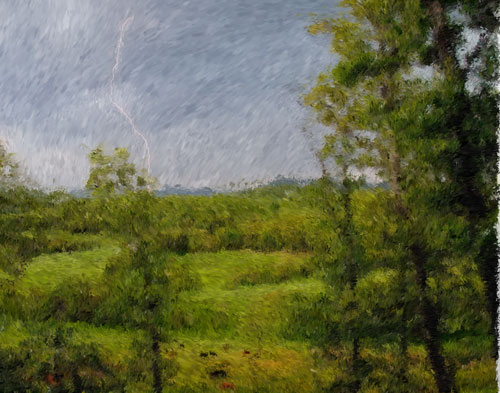
This image (above) started out as a photograph of a tree in a rock wall along the Buffalo National River in Arkansas.  Below is a spring storm on that same trip.


Here’s a hummingbird coming in to feed.


I do like this program.  And for all my complaining it isn’t hard, it just takes getting used to.


There are programs (apps) for the iPhone that do amazing things with photographs taken with the iPhone.  All the work is done in the phone and it is surprisingly good.  To see some good examples, click on the link to see Rad Drew’s work.  Be sure to look at the whole album.  For my part, I’m not tempted (yet) to get an iPhone.  I am happy to play with Photoshop and Painter Essentials.


Can’t go anywhere with my wife without seeing quilts of some kind:

I am still working on this one.


Actually I’m still working on all of them.


And I’m starting to see image possibilities with a view toward doing these ‘paintings’. More about that later.

Practice painting

Since I downloaded Corel Painter Essentials 4 I’ve been practicing with it, working at getting a feel for it.


When I’m working with Photoshop I have a pretty good idea what the effect of a particular manipulation will be.  I plan it, do it, and most of the time, there it is.  The situation with this paint program is quite different.


I don’t have a feel for this program yet.  I can’t predict what will happen when I push the button and when I can, it is often an effect I don’t want, but I have to try it to be sure. This is nothing to complain about, it is part of the process and I have to keep at it.


The rewards are there often enough to justify the effort.  Back when I taught psychology, we would talk about a random reinforcement schedule.  The rat presses the bar repeatedly but food is delivered after a random number of bar presses.  The rat works hard under this condition.  So do I.


It’s been 35 years or so since I taught regularly and I haven’t been keeping up with the literature and I wonder if the rats work better while listening to Stan Kenton.  I do.


By no means do I want this to sound as if it is drudgery.  It is not.  I’m enjoying myself but I do look forward to being able to predict the effect of a combination of painting type (oil, modern, impressionist, etc.) with brush type (smeary round, captured bristle, broad water, gritty charcoal, etc.) and color rendition (chalk, high contrast, intense, watercolor, etc.).  How do we get to Carnegie Hall?  Practice, practice, practice.

St. Paul’s Episcopal church

Indoor shooting today.  One of the members of our Photo Venture Camera Club invited us all to come shoot at his church this morning.  It was well worth the time.


A lot of stained glass and beautiful appointments here.  The cross is a central theme in any Christian church and this one is particularly beautiful.  It gives me pause, though, when I think of what the minister in my church once pointed out about the cross.  If Jesus were put to death today by authorities, they might use an electric chair or lethal injection.  Can you imagine either of those being beautified?

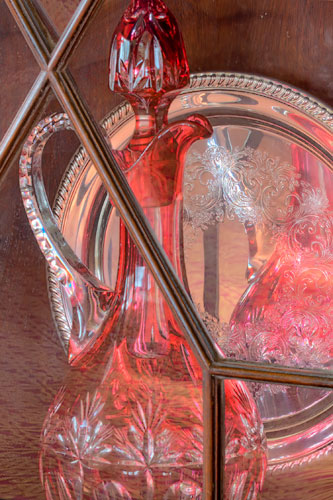
A lot of people were shooting in the sanctuary.  I wandered around and was attracted by bright and shiny objects in a cabinet in a common room.


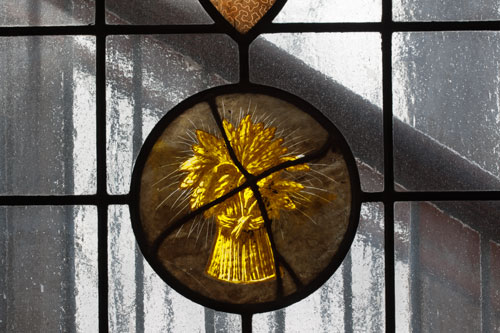
The stained glass is beautiful.

St. Paul’s is well worth the visit but I still prefer the cathedral of the outdoors.


‘I love to think of nature as an unlimited broadcasting station, through which God speaks to us every hour, if we will only tune in.’ ~George Washington Carver

It is what it is

I will freely admit that I don’t really like to go out in the rain to shoot but when that’s what we have and it is foggy, and I haven’t been out with a camera for a few days, well, it’s that or nothing.


I seldom have anything but the most general expectation for what I will find, this morning it was ‘there will be fog’.  Sure enough, there was fog and it works well to separate subject from background.

I made a print of the image above and I was surprised at how well it works.  Part of the reason was the condition of the weather but another important factor was the software I used to sharpen the image.  For a variety of reasons a digital camera softens the image a bit and it makes all the difference to get the sharpness back and accentuate it some.  There are lots of ways of sharpening and the garden variety methods, in the hands of an expert, work very well.  I’m not an expert.  I have been using Pixel Genius’s most recent version of their sharpening software (PhotoKit Sharpener 2.0)  and it performs well beyond expectation.  One of its features is to produce an image that looks just lousy on the screen but works well as a print.  As it turns out, the process of printing introduces some softening too and their software accounts for that.  The image above used a different set of parameters for display on a monitor.


I was also pleased to get all the shots appropriately vertical.  I am forever tilting the camera one way or the other and then having to straighten the image in Photoshop or live with it.  Today all went well.


It’s really pretty funny when you think of it, but I was out with a couple of thousand dollars worth of equipment (camera, three lenses, good tripod, etc.) and one addition that saved the day  This was a plastic grocery bag I put over the camera as I was lining up the shot and leveling it.   This is not exactly in the same league as

For want of a nail the shoe was lost.
For want of a shoe the horse was lost.
For want of a horse the rider was lost.
For want of a rider the battle was lost.
For want of a battle the kingdom was lost.
And all for the want of a horseshoe nail.

But it was essential that the camera and lens not get too wet.  The plastic bag came through.

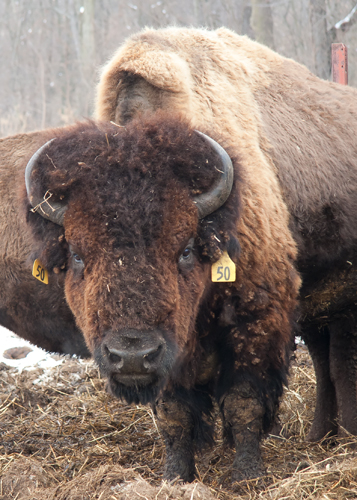
Off to shoot buffalo (or bison, whichever you prefer)

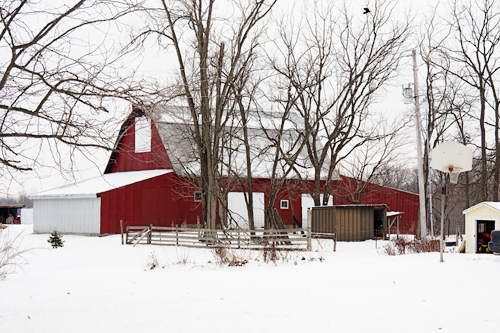
Sally had learned of English’s Buffalo Farm west of Bainbridge IN and we went there this morning.  Arriving in the area before our appointment, we wandered around.  Here was a prototypic Indiana farm with a well kept barn and a basketball hoop.


We arrived at the buffalo farm right on time and went out to the pasture where the adults are kept.  We rode out with the owner on a Ranger vehicle.  This is an open vehicle that will seat about six or seven people.  It has neither sides nor roof and is excellent as a platform for photography.  We were warned to stay in the Ranger; buffalo are unpredictable and not our friends.  This is not a petting zoo.


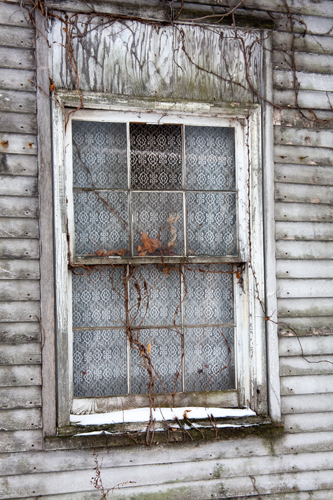
This is the number one bull who weighs in at nearly a ton.  He can run at a speed up to 30 miles an hour and turn on a dime.  Very impressive.  We spent about half an hour in the pasture and then were on our way back to Bainbridge and lunch at the Bonton Cafe.  After lunch we stopped at a derelict house we have admired on other occasions.


I don’t know what it is about buildings in this kind of shape but they draw photographers more than buildings that might appear in House Beautiful.


Windows seem especially interesting.


Perhaps it is time to organize a field trip for our photography club designed around visiting abandoned buildings.

Paying attention

I suppose that someone walking through the woods on a beautiful day in the winter talking on a cell phone is staying in touch after a fashion.  They just aren’t in touch with what is around them.

Thomas Jefferson had something to say about this:

” A strong body makes the mind strong. As to the species of exercise, I advise the gun. While this gives a moderate exercise to the body, it gives boldness, enterprize, and independance to the mind. Games played with the ball and others of that nature, are too violent for the body and stamp no character on the mind. Let your gun therefore be the constant companion of your walks. Never think of taking a book with you.  The object of walking is to relax the mind.  You should therefore not permit yourself even to  think while you walk; but divert yourself by the objects surrounding you.  Walking is the best possible exercise.”

Nowadays, Mr. Jefferson wouldn’t have to take a gun with him, he could take a camera.  You can shoot with either device.  I have an idea he would have been an avid photographer.


The world around us goes on its merry way whether we pay attention to it or not.  And it’s beautiful whether we pay attention to it or not.


I had shot the same scene (below) the day before but it was overcast then and there were no shadows.


I couldn’t think of a good reason to go swimming, so I didn’t.  To use Jefferson’s words that would likely have been “too violent for the body” although it would probably have stamped “character on the mind”.


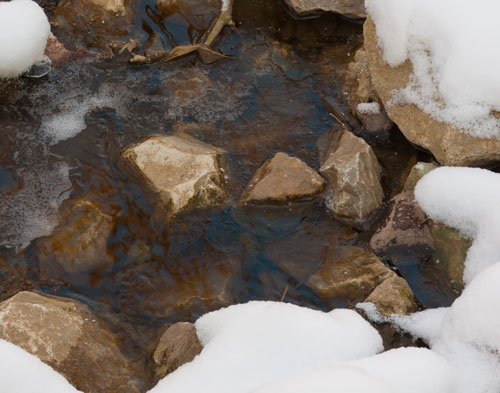
Watching the water from the bank was enough of an experience and one I’m likely to repeat.