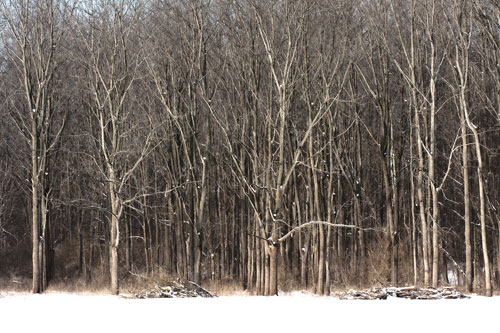
What is there and what you see

Photo Venture Camera Club went to Garfield Park in Indianapolis to photograph flowers and foliage in the conservatory yesterday.  This is always a good trip.


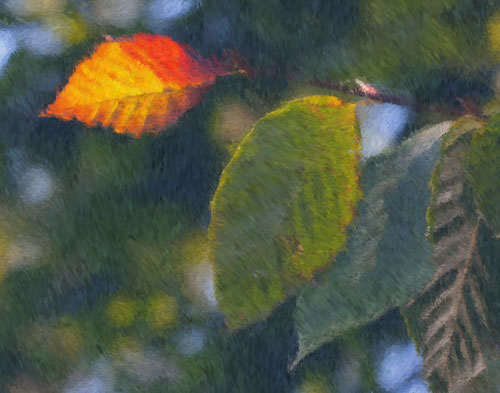
A friend and I were talking as we were shooting and he said that his wife asked why he photographed leaves.  He responded that he was attracted by the textures, colors, shapes, etc.; in other words, aspects we see but which do not translate easily into words.  The leaves were more a platform for exhibiting these features than they were objects in and of themselves, at least for my friend.  I suspect that is a problem for some photographers – they go out to photograph, say, leaves, and don’t get much because they are not attending to the light, the shapes, colors, textures etc., aside from the label ‘leaves’.  I bring this up because it can be hard to avoid getting trapped by the words.
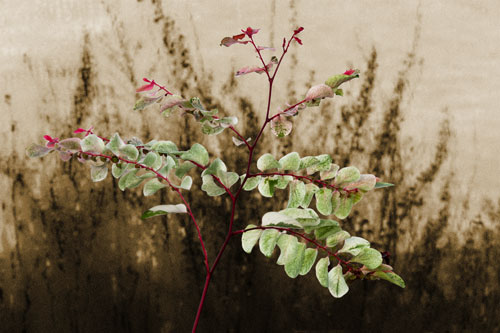

Words are important as ingredients of communication but unless one is doing documentary photography where it is extremely important to show exactly what is there – the aftermath of a storm, the condition of a house that is for sale, an accident scene – the features of the scene – the light, textures, shapes, colors – are often more important than the fact that we are photographing leaves, trees, reflections in water.
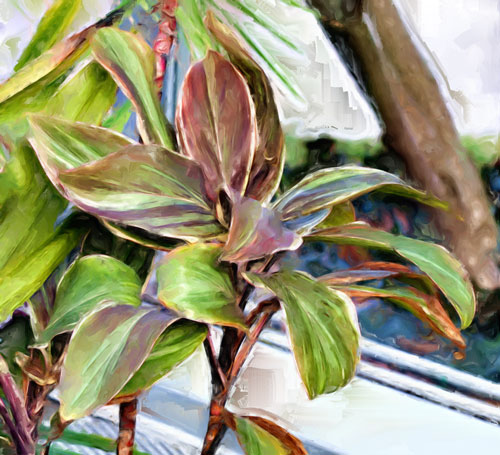

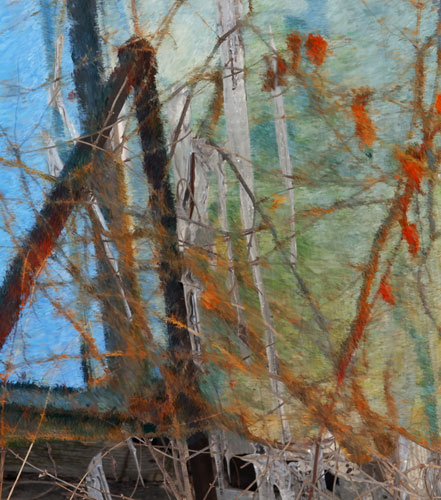
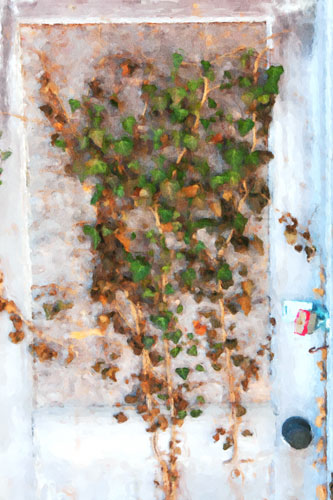
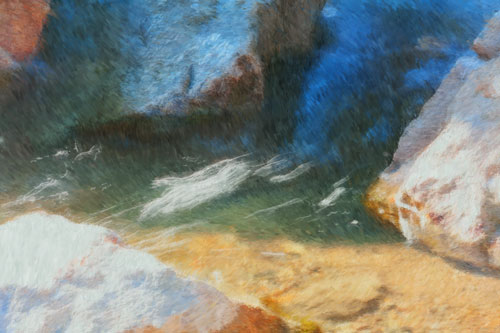
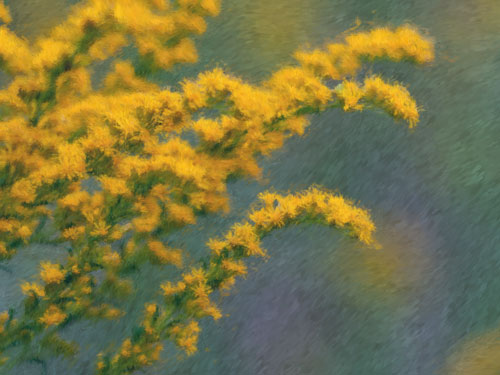
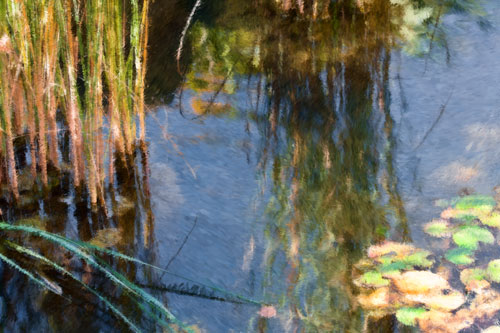
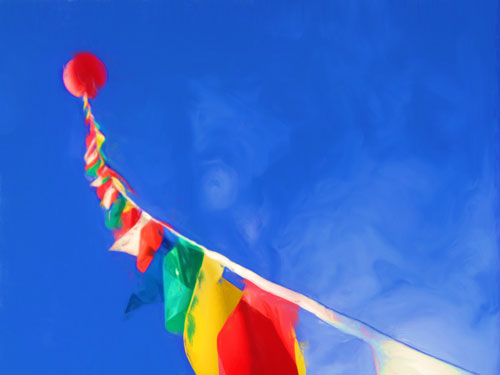
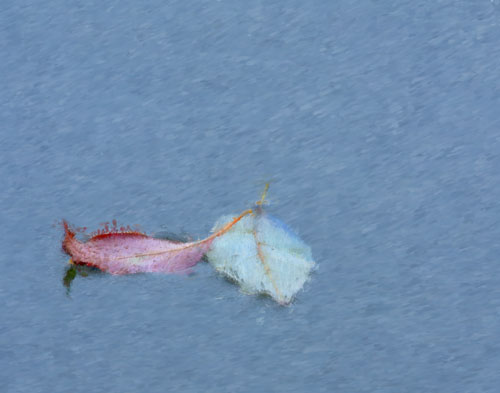
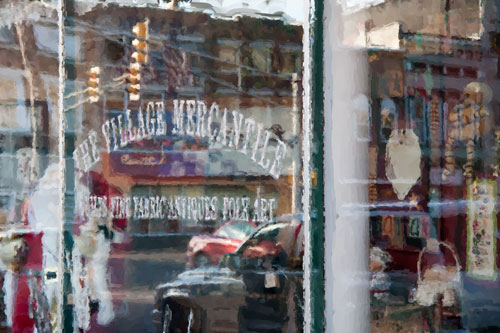
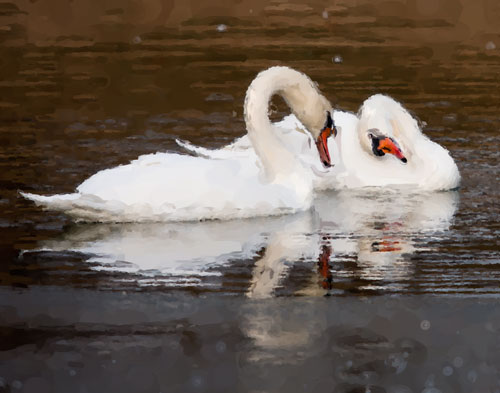
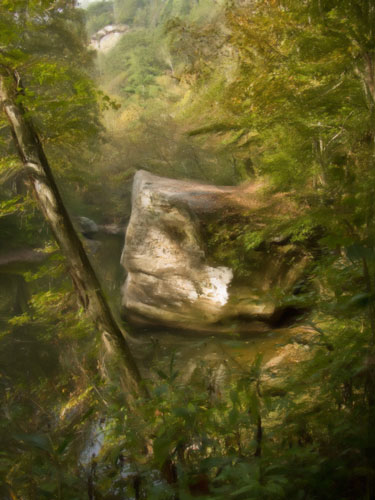
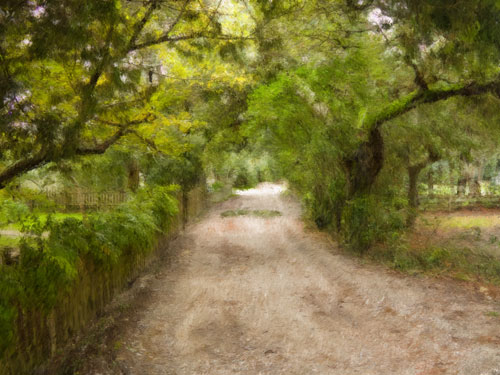
As you can see from the examples I have shown so far, I don’t think it too important to represent what I saw as objects so much as platforms for the features.

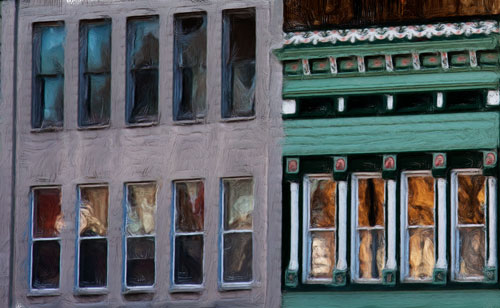
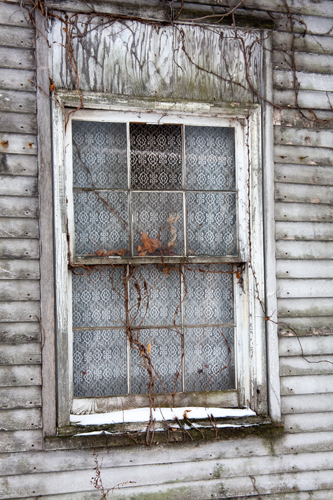
On the way home it struck me that maybe this is at least part of the answer why photographers are so often attracted to crumbling buildings.  These buildings can’t really be adequately described by words; pictures, images are needed and what is interesting about them is not so much the crumbling structures themselves but the textures, colors and shapes.
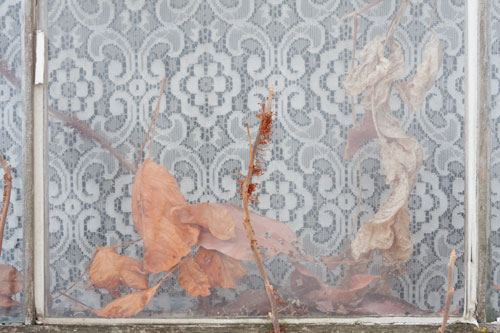
Well.  Having solved that problem we can move on to solving the problem of bringing peace to the world.


On second thought, let’s save that problem for another day.
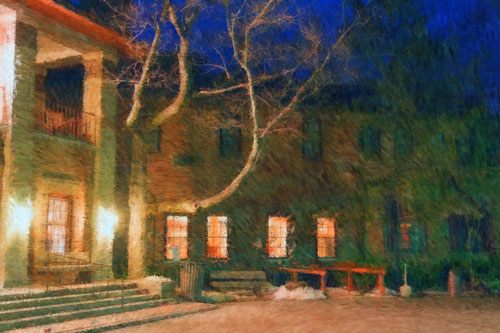
Turkey Run

Ellie and I spent a few days at Turkey Run State Park.  The weather was decent and it was good to get away.


They were running a two-nights-for-the-price-of-one deal and as we drove around the park on first arriving, Ellie’s comment was ‘no wonder it’s two for one, half the roads are closed here.’  But we did have a good time.


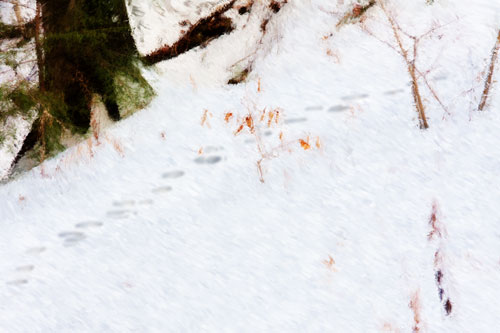
I wasn’t anxious to go off on the icy trails by myself so I stayed fairly close to the roads.


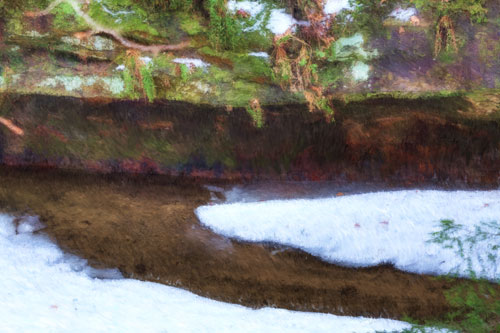
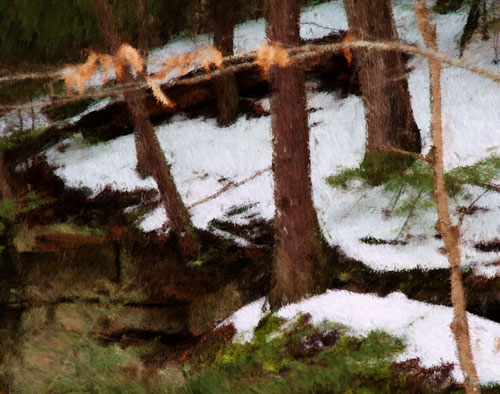
Even so there were good opportunities for photography.


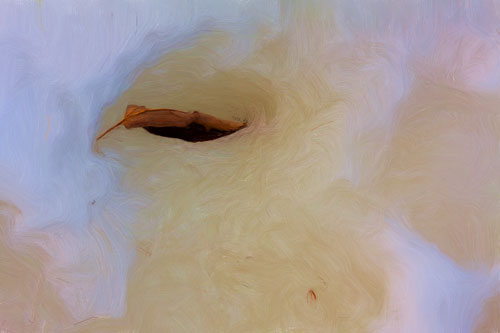
I was going to throw this next one out but I think it works.


It’s good to get out.

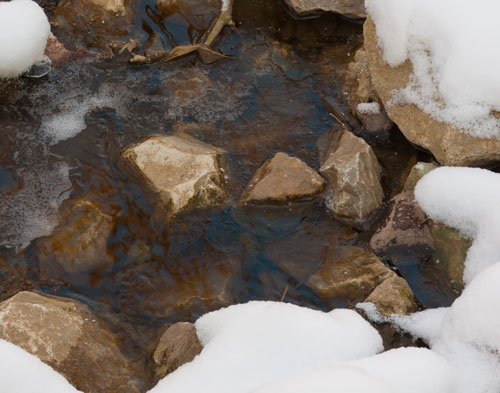
The leaf stuck in the ice might feel that way too.

A good day

Several of us were at church this morning digging out the driveway and enough of the parking lot that people could be dropped off in front of the church.  Two inches of hard, tight ice is difficult to remove.  While we were getting organized and the guys who were going to be using the rental frontloader were figuring out how to use it, I did a little photography.


The frontloader was equipped with a device on the back with large teeth.  The idea was that the teeth would break through the ice and as it was pulled along, the ice would come up.  The ice was not impressed.


So several of us attacked the ice with pickaxes, shovels, etc. while a snowplow on a garden tractor, a soil cultivator and the frontloader all peeled back the ice a little bit at a time.


Various ideas were proposed, including building a 10 foot wide parabolic mirror to focus the rays of the sun on the ice and drilling holes in the ice and loading them with M-80 fireworks.  Then we went back to work with the pickaxes and the shovels.

All this photography, by the way, was done before we got organized.


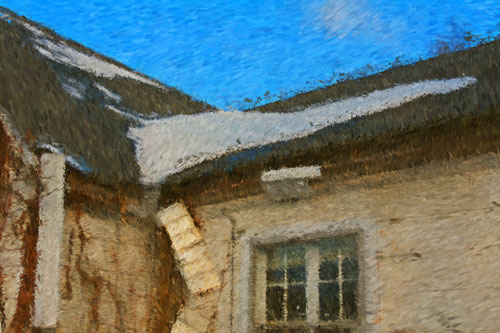
There is an abandoned house next to the church.  It called.  I answered.


If you are wondering when I will quit obsessing with impressionistic painting techniques, the answer is I don’t know.


I’m enjoying it though.  I hope I’m not as stiff in the morning as I am now.

Seems like a day for Impressionism

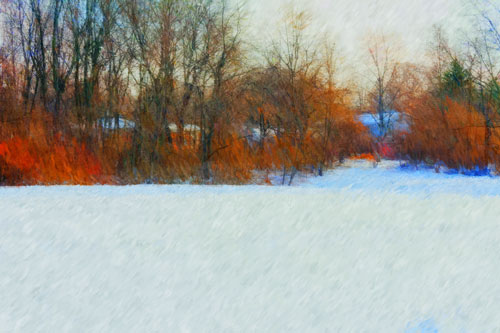
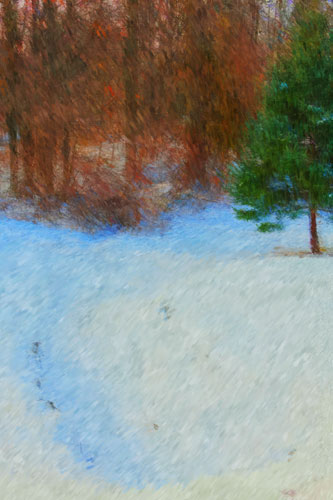
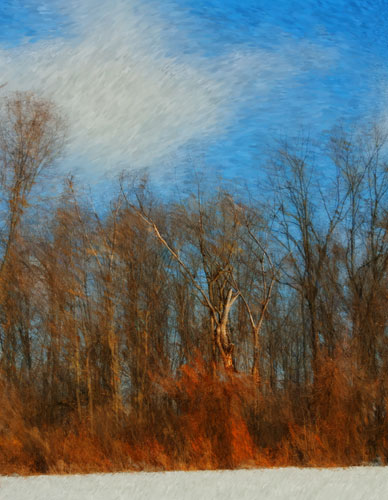
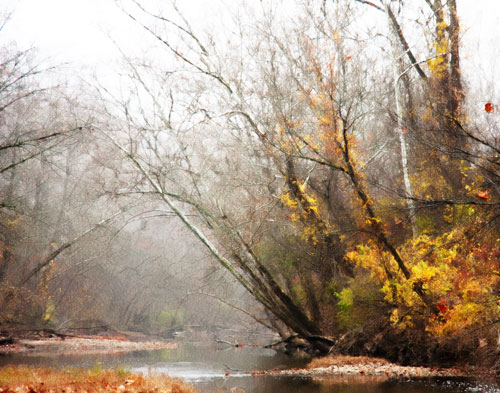
It’s snowing.  I’ll probably go out later today to do some shooting but right now I’ve been looking at older images and applying an Impressionist effect to them with Corel Painter Essentials and Photoshop.


I’m not pining for summertime even with two inches of ice on the ground, and more importantly, ice piled on the roof and in the gutters.  Also, we’ll be getting two to four inches of snow today.  But for some reason, Impressionism, which I normally associate with warm weather, seems the order of the day.


In keeping with the season, the above shot was made in early January.


The season in these images is pretty obvious.


Gesundheit.


I don’t think Monet would eat his heart out after seeing this one unless he felt in some way responsible for it.


I know this one is over the top but I still like it.  Time to go get cold.

Need to simplify composition

As photographers, and I will stress, consumers, we pant after the next version of the ‘the best camera to come along in a long time’.  Meaning that the best camera to come along that I can afford (I’m willing to sacrifice to make that purchase) will cost a lot of money and, because it has more pixels, better color rendition, etc., etc., I will need to get better lenses (read in the thousands of dollars apiece).  This would mean that I can capture more detail, more sharply.


Then along comes the ability to apply painterly effects to the image.  Now the game changes.  One of the things a paint brush doesn’t do well, compared with a camera, is record fine detail in relatively small images, that is, images under, say, two feet by three feet.  But who cares?  Jumping back into the consumer frame of reference, paintings, when they are sold, go for more than photographs.  That is, purchasers are expressing preferences in concrete terms and those preferences are not favoring fine detail.  So if I want to produce something people like, and more importantly what I like, what’s the need for the expensive camera and lens?


As you may know, I’ve been obsessing for the last week or so over Corel’s Painter Essentials 4 which allows controlled application of painterly effects to digital image files.  The first thing the program does is to blur the image to some extent, wiping out some of the detail.


So if detail is gone, or at least disappearing, what do we do when looking through the viewfinder at a scene we want to eventually turn into one of these painterly images?  The answer is we simplify the composition.


I’ve been reading Richard Schmid’s ‘Alta Prima: Everything I Know About Painting’ to see what a painter could tell photographers; after all, these painter people have been at this for hundreds of years and photography has only been around for a little over a century and a half.  His recommendation on starting the composition is to look at the scene and squint.  If you are practiced at this, you see a blurry image with a lot of the detail gone.


You see the major outlines and it turns you toward simplifying composition.  Does the blurry image look as if it has potential?  If so, take the picture or paint it, depending on whether you are a photographer or a painter.


I don’t want to come away from this post saying detail is not important.  It is very important for photography but in setting up the composition, simplicity will win out over complexity just about every time.


I wonder what cameras would be like today if the final images produced were always painterly.   There would be little need for tens of megapixels and super sharp lenses. 
Cameras could be much simpler and less expensive.


In fact there is a thread of a movement to do just that.  The iPhone has applications available to take pictures and apply painterly effects to them.  See for example the work of Rad Drew, Dan Burkholder, or Harry Sandler.  And from the other direction, serious paint artists such as David Hockney are working with the iPhone and iPad.  This is an important development.  It isn’t going to run Canon or Nikon or Adobe out of business but the simplicity it permits is a welcome innovation.  Composition is bound to improve.

Now on the assumption that my wife is reading this, I really didn’t mean that I don’t need a better camera or better lenses……..

Learning more about painting photographs

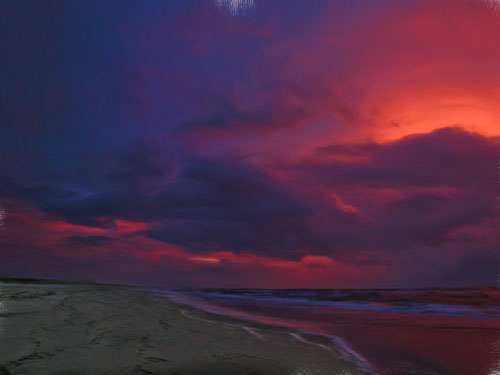
I’ve found that learning often progresses by spurts followed by a leveling off and then, if I keep at, another spurt and more leveling off.  The longer I’m at it, the more time elapses before the next spurt.  Right now I’m early in the process of learning to use Corel Painter Essentials 4, a paint program that, with a lot of choices on the user’s part, can turn a photograph into what looks like a painting.


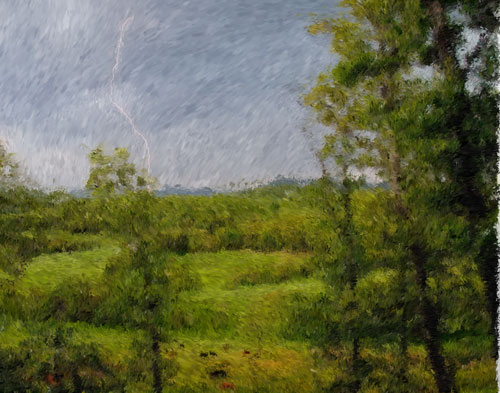
This image (above) started out as a photograph of a tree in a rock wall along the Buffalo National River in Arkansas.  Below is a spring storm on that same trip.


Here’s a hummingbird coming in to feed.


I do like this program.  And for all my complaining it isn’t hard, it just takes getting used to.


There are programs (apps) for the iPhone that do amazing things with photographs taken with the iPhone.  All the work is done in the phone and it is surprisingly good.  To see some good examples, click on the link to see Rad Drew’s work.  Be sure to look at the whole album.  For my part, I’m not tempted (yet) to get an iPhone.  I am happy to play with Photoshop and Painter Essentials.


Can’t go anywhere with my wife without seeing quilts of some kind:

I am still working on this one.


Actually I’m still working on all of them.


And I’m starting to see image possibilities with a view toward doing these ‘paintings’. More about that later.

An error leads to a new path

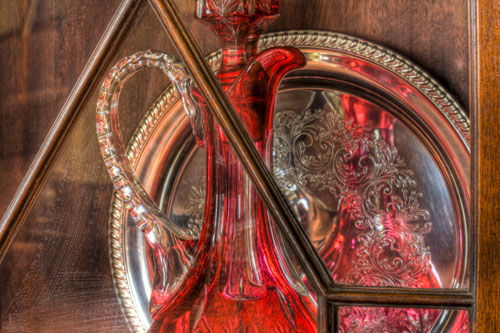
In my last post I described a camera club trip to a beautiful local church.  We did a lot of shooting in the sanctuary and I wandered off to other parts of the building.  There was a glass fronted cabinet in another room and in it were a decanter and a sterling silver tray.  They made a compelling image.  Here it is after sandwiching five images taken at different exposures.

This image is small and you may not notice the smear on the glass in the lower left corner.  Whoever cleaned the glass wiped over it but  missed a spot.  Here is a closer view:


We are definitely in the ‘whoops’ category.  I tried many things in Photoshop and nothing did a credible job of cleaning it up.  Sometimes the better strategy is not to try to eliminate a problem like that but to move in a different direction entirely and see if the effect is still so obvious.

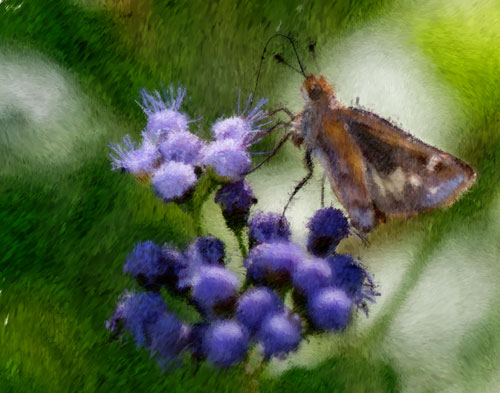
Ever since I first picked up a camera, I’ve wanted to create what I’ve come to know as ‘painterly’ images, images reminiscent of paintings.  There are lots of paint programs for computers and I looked into them.  I found Corel Painter Essentials 4, a reduced version of Painter.  Painter is the painting equivalent of Photoshop in terms of power.  I downloaded the trial version and tried it.  There are many effects that can be done automatically and one of them is an oil painting effect.  You start with your photograph on the screen and push the button for the selected option.  The screen turns white and paint daubs and strokes appear one after another, building up to a final image.  If you are familiar with the Harry Potter series, it is as if someone waved a wand over the photograph and a brush went to work by magic.  When it was done, this was the result.


I like this image a lot.  And look at the smear in the lower left part of the image.


By no means is it gone but it is a lot less obvious.  As it turns out I will be cropping out a lot of it and I will continue to work on it so if any part of it remains, it will not be obvious.  The larger point I want to make, though, is that this program is now not only allowing me to mitigate errors, it is giving me a new way of looking at the world when I go out with a camera.

When I go out for a shoot, I often am splitting my looking at the world between what is there and what lens I am using.  If a macro lens is on the camera , I tend to look for macro images.  If a telephoto lens is on the camera, I’m looking for distant objects.  That isn’t the whole story of course, if I see something interesting that requires another lens, I’ll go for it.  But there is no doubt that my choice of images will now be affected not only by the lens and the intended final disposition as a photographic image, but I’ll also be looking for images that will work well as ‘paintings’.  Here’s one I especially like:


Would I have gone this direction, and purchased a painting program, had someone done a thorough job of cleaning that glass cabinet?  I would probably eventually have gotten there, but this speeded it up and hey, they were running a half-price offer good to the end of the month.  This is getting to be more fun by the day.
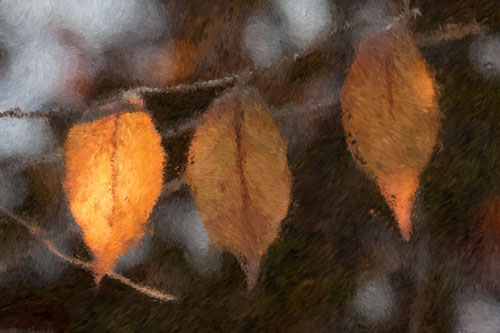
Off to shoot buffalo (or bison, whichever you prefer)

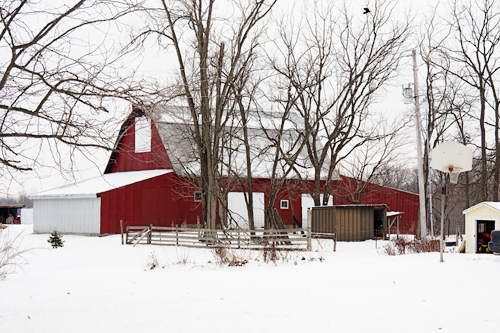
Sally had learned of English’s Buffalo Farm west of Bainbridge IN and we went there this morning.  Arriving in the area before our appointment, we wandered around.  Here was a prototypic Indiana farm with a well kept barn and a basketball hoop.


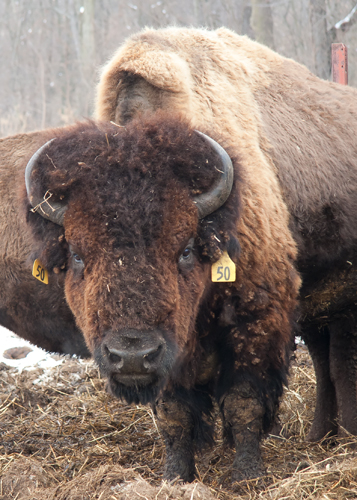
We arrived at the buffalo farm right on time and went out to the pasture where the adults are kept.  We rode out with the owner on a Ranger vehicle.  This is an open vehicle that will seat about six or seven people.  It has neither sides nor roof and is excellent as a platform for photography.  We were warned to stay in the Ranger; buffalo are unpredictable and not our friends.  This is not a petting zoo.


This is the number one bull who weighs in at nearly a ton.  He can run at a speed up to 30 miles an hour and turn on a dime.  Very impressive.  We spent about half an hour in the pasture and then were on our way back to Bainbridge and lunch at the Bonton Cafe.  After lunch we stopped at a derelict house we have admired on other occasions.


I don’t know what it is about buildings in this kind of shape but they draw photographers more than buildings that might appear in House Beautiful.


Windows seem especially interesting.


Perhaps it is time to organize a field trip for our photography club designed around visiting abandoned buildings.

Paying attention

I suppose that someone walking through the woods on a beautiful day in the winter talking on a cell phone is staying in touch after a fashion.  They just aren’t in touch with what is around them.

Thomas Jefferson had something to say about this:

” A strong body makes the mind strong. As to the species of exercise, I advise the gun. While this gives a moderate exercise to the body, it gives boldness, enterprize, and independance to the mind. Games played with the ball and others of that nature, are too violent for the body and stamp no character on the mind. Let your gun therefore be the constant companion of your walks. Never think of taking a book with you.  The object of walking is to relax the mind.  You should therefore not permit yourself even to  think while you walk; but divert yourself by the objects surrounding you.  Walking is the best possible exercise.”

Nowadays, Mr. Jefferson wouldn’t have to take a gun with him, he could take a camera.  You can shoot with either device.  I have an idea he would have been an avid photographer.


The world around us goes on its merry way whether we pay attention to it or not.  And it’s beautiful whether we pay attention to it or not.


I had shot the same scene (below) the day before but it was overcast then and there were no shadows.


I couldn’t think of a good reason to go swimming, so I didn’t.  To use Jefferson’s words that would likely have been “too violent for the body” although it would probably have stamped “character on the mind”.


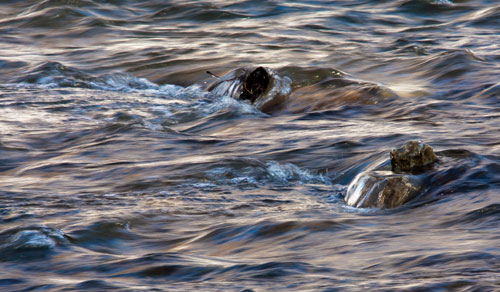
Watching the water from the bank was enough of an experience and one I’m likely to repeat.

Wondering in the trees

I really had no idea what I would be shooting today, I just knew I was going out.  The day was bright and around 20 degrees.  We haven’t had a great deal of snow but what there is, is hanging on.

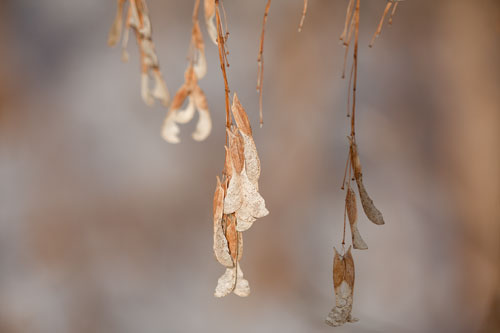
I would like to say that I was ready to shoot anything that would stand still long enough but in the case of the image below, the seed pods were still for most of the 1/3200th of a second the shutter was open.  Otherwise they were moving pretty briskly.


I had to chase this one for awhile too.  Not exactly strenuous exercise but fun.


I’ve been doing more with sandwiching multiple images exposed for different lengths of time (high dynamic range or HDR).  This is part of a walnut plantation.

It reminds me of the Robert Frost poem, ‘Stopping by Woods on a Snowy Evening’ – ‘The woods are lovely, dark and deep.’  And like all of us, I have promises to keep.